The Complex Perspective · 2016 Chapter 9 of 12 · ≈ 58 min read
The Digital Economy
Digital, Innovative, and Growing Exponentially
The technologies and inventions discussed in the previous chapters have had a profound impact on the economy and society. Over the last 30 years, there has been a transition from a traditional physical economy to a digital, information-processing economy. Erik Brynjolfsson and Andrew McAfee of the MIT Sloan School of Management summarize these changes with the following three “building blocks” [BA14]:
- The digitization of information and the networking of computers and mobile phones
- The massive advances in information technology driven by exponential growth
- Combinatorial innovations
The two scholars believe that humanity is at the beginning of a second industrialization, the dawn of a second machine age. They expect many more changes to follow in the coming decades. But what exactly has changed?
Digitization and Networking
Digitization means storing information as a sequence of bits, zeros and ones. Information is “preserved” and processed as data, as discussed in previous chapters.
The second building block is the rapid distribution of data via the Internet: networking. Before the Internet, data was exchanged using physical storage media such as CD-ROMs, DVDs, or magnetic tapes. Today this is much faster and cheaper. Computer programs can also exchange data with one another, a process known as machine-to-machine communication (M2M). The possibilities for communication have increased enormously.
When new technical and social inventions appear, conflicts of interest arise in the economy and society. Usually the established part of society has little interest in change, because it already lives well with existing methods. Only the “dissatisfied” want change. This could also be observed as the Internet spread.
The first “victim” of digitization and the Internet was the music industry. In 1999, music was still distributed on CD-ROMs. The music itself was already stored digitally, but the medium was not yet the Internet. Technically, it was very easy to read a CD-ROM and copy it to an Internet server. Others could then download this “pirated copy” and burn it onto a CD. Many people also regarded the music industry as socially unjust because it produced very wealthy superstars while CDs remained quite expensive. This led to the founding of the “music file-sharing service” Napster in 1999 [Hin13]. “Pirated copies” of CDs could be downloaded there.
The entertainment industry launched the “War on Piracy” (Note: in the US, there are many such “wars,” such as the “War on Drugs,” the “War on Terrorism,” and the “War on Poverty”). This “war” was one of the first confrontations between an old, established industry and the then-new Internet with its new possibilities. Napster was very successful and had more than 26 million users. The music industry tried everything to stop Napster and filed many lawsuits. The numerous legal disputes eventually forced Napster to close in 2001. By then, however, many imitators had appeared, including FastTrack, Gnutella, Kazaa, and BitTorrent. The “war” was therefore far from won for the music industry [Hin13]. The old world, in which music could spread only through CDs and radio programs, no longer existed. The many lawsuits were merely drops of water on a very hot stone. The music industry had to find a way to prevent MP3s from being copied. One solution was digital rights management (DRM). This ensures that a music file can be played only on a specific device belonging to the buyer, not on other devices. The files are still easy to copy, but they are useless to others. This “copy-protected” music was distributed through dedicated online “stores.” Apple was one of the first companies to introduce the “iTunes Store” in 2003. Together with the playback device called the iPod, it was a huge success.
Important: The music industry needed a new business model. The old one was threatened by technological development.
It is also important to recognize that the music industry was by no means ideal before the Internet, and that incomes were distributed very unequally. When an established industry is threatened by new technology, however, the old conditions are often “whitewashed.”
Videos require much more storage space than music. The film industry was therefore affected by the Internet later than the music industry. Here too, however, there were initially legal disputes with file-sharing platforms. The heavyweights of the established industries tried to exhaust every legal avenue. But as with the music industry, a change in the business model was needed: streaming. One pays a monthly membership fee and can then watch movies selected from a “pool.” The films are loaded directly from the Internet while being watched. In the USA, Netflix began this; in Germany, Telekom did. Today, video-streaming data accounts for a large share of Internet traffic. Technically speaking, the old television cables are no longer needed. Everything can be transmitted via the Internet.
Software can also be purchased “online” today. Apple began this with the iPhone and “apps.” These “app stores” have since become very widespread. They exist on all game consoles, PCs, and mobile phones. Books are also available digitally; some companies rely on DRM, others do not. Some also release freely copyable books under Creative Commons licenses, which we will discuss below.
Exponential Growth
Different Types of Growth
The phrase “We are on the second half of the chessboard” will be heard more often in future discussions about computer technology. It is used to explain particularly large leaps in progress. To explain what it means, however, we first have to step back and cover a few basics. There are different types of growth. The following table lists four typical types as examples:
| n | Linear | Quadratic | Logarithmic | Exponential |
|---|---|---|---|---|
| 1 | 1 | 1 | 0.00 | 2 |
| 2 | 2 | 4 | 1.00 | 4 |
| 3 | 3 | 9 | 1.58 | 8 |
| 4 | 4 | 16 | 2.00 | 16 |
| 5 | 5 | 25 | 2.32 | 32 |
| 6 | 6 | 36 | 2.58 | 64 |
| 7 | 7 | 49 | 2.81 | 128 |
| 8 | 8 | 64 | 3.00 | 256 |
| 9 | 9 | 81 | 3.17 | 512 |
| 10 | 10 | 100 | 3.32 | 1024 |
The simplest form is so-called linear growth. Here the value always increases by the same amount. In this case, 1 is always added. It can be expressed mathematically as $f(n) = n$ or recursively as $f(n) = f(n-1) + 1$. In quadratic growth, $n$ is always squared, i.e., $f(n) = n^2$. Quadratic growth is superlinear, meaning that it grows faster than linear growth. An example of sublinear growth is logarithmic growth, which occurs very frequently in computer science1.
The following function graph illustrates these three types of growth:
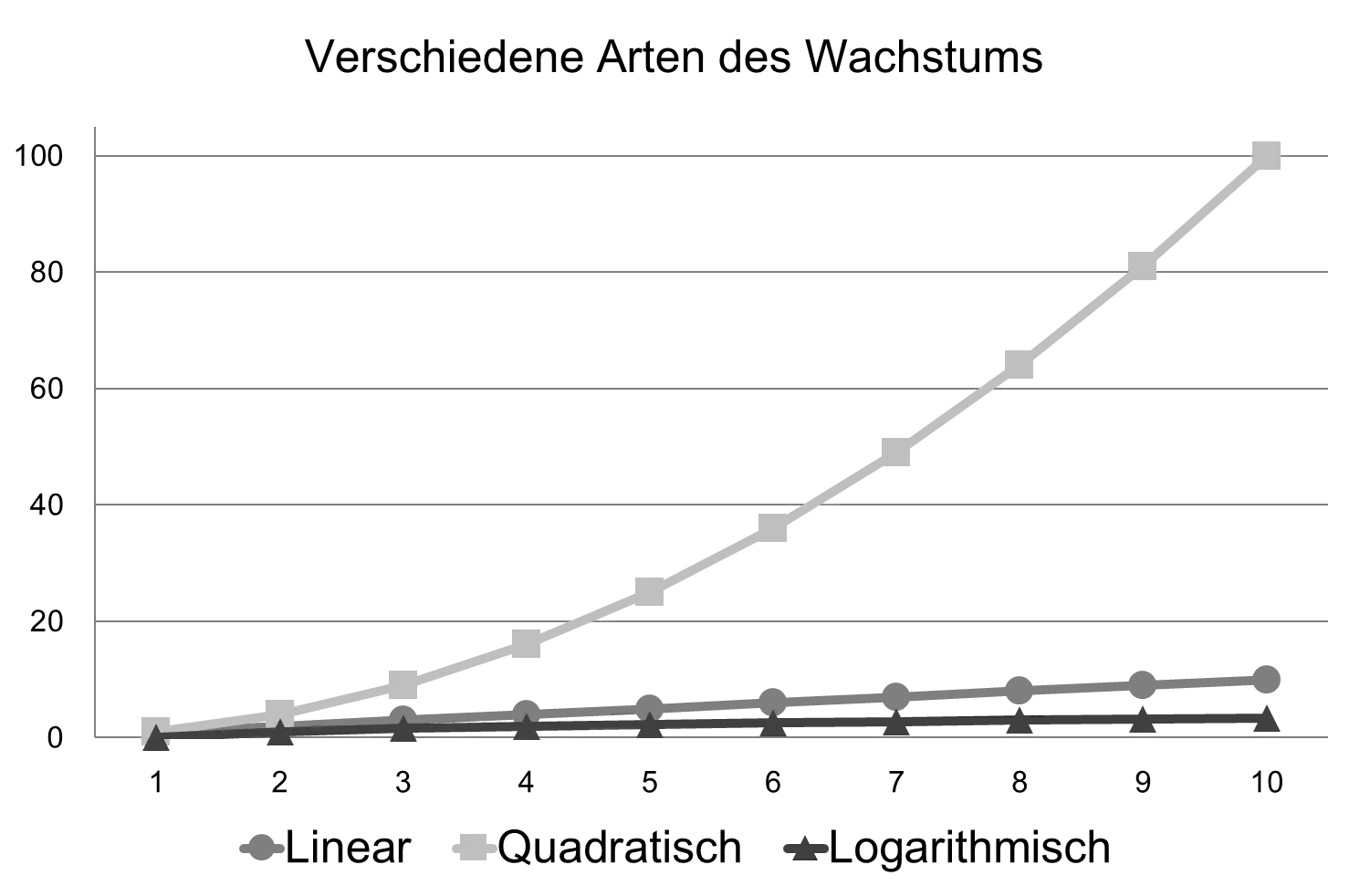
Such a function graph is often simply called a graph, but that creates a risk of confusion with the graphs that represent networks. The function graph has two axes: a horizontal x-axis and a vertical y-axis. The x-axis contains the values from 1 to 10, and the y-axis contains the dependent numbers from the table above. These function graphs make it possible to classify growth quickly.
There is another type of growth that increases much faster: exponential growth. Here, the previous value is always doubled: $f(n) = 2 \times f(n-1) = 2^n$. To illustrate this, people often tell the Indian legend of the invention of chess. The inventor of chess presents the game to his ruler, and the ruler is so enthusiastic that he wants to reward the inventor. The inventor replies that he would like to be rewarded in grains of rice: one grain of rice should be placed on the first square of the chessboard, two on the second, four on the third, eight on the fourth, and so on. The number of grains should be doubled each time. The ruler agrees and is in for an unpleasant surprise, because the number of grains becomes very large very quickly. This is exponential growth to the base 2. A chessboard has $8 \times 8 = 64$ squares, and the number $2^{63}$ (2 to the power of 63) is much larger than the total number of rice grains in the world at that time [Kur06, BA14]2.
Exponential growth is not shown in the previous figure because it would make it difficult to distinguish the other three curves, as shown in the following figure:
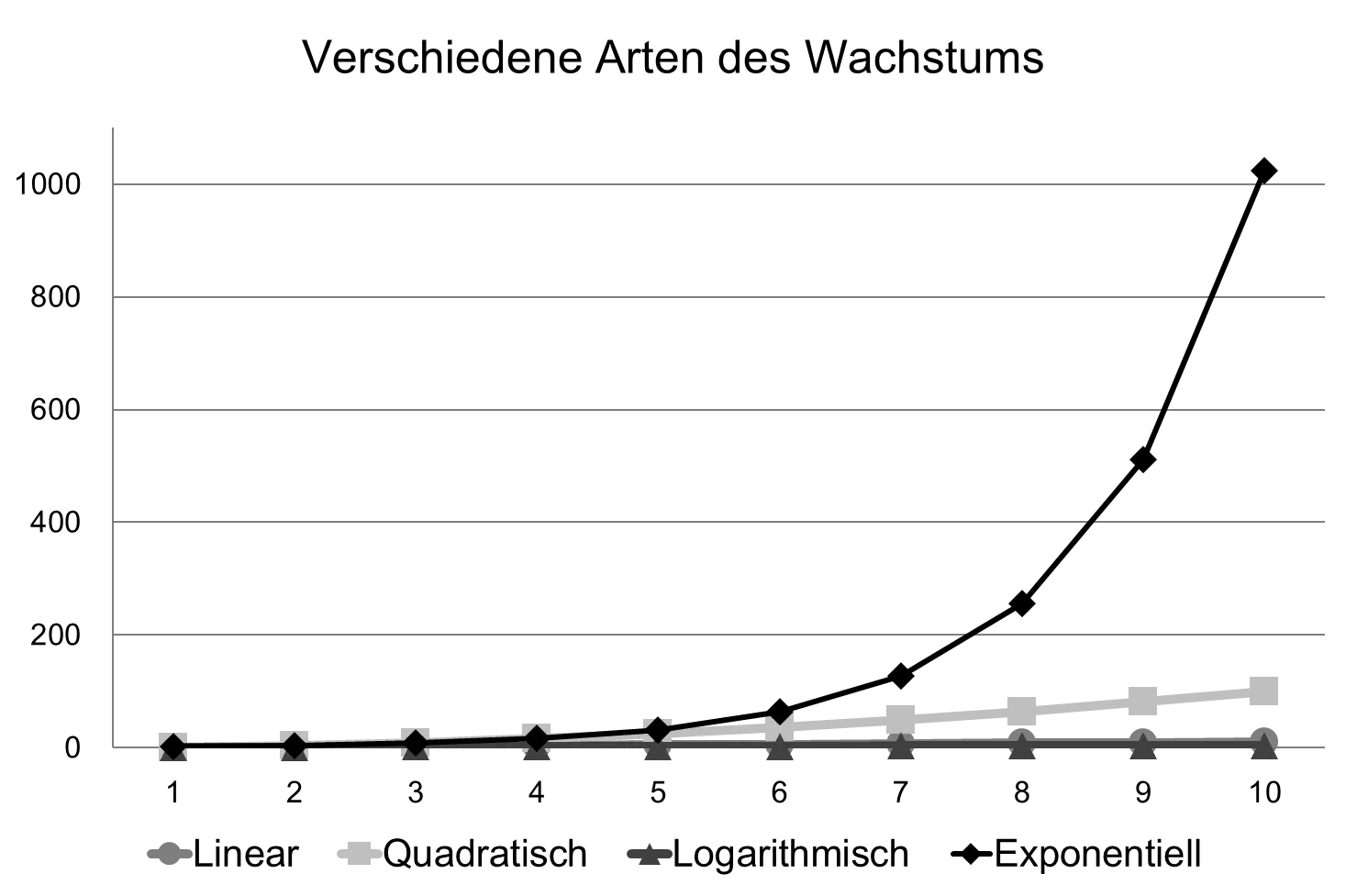
These “exponential curves” have remarkable properties that make them difficult to handle: in a diagram, the slope of an exponential curve initially always looks like linear growth. In the example above, up to a value of 4, there is almost no recognizable difference from linear growth. Later there is a “turning point” (around 8 in the diagram), and by the end the exponential curve looks almost vertical. A scientist may therefore observe a process with exponential growth and notice it only when it is too late. Dealing with exponential growth requires practice and caution.
Is a lot of growth good or bad? That depends, of course, on whether something positive or negative is growing. The growth of prosperity is obviously good; the growth of poverty is not. Exponential growth can also be very negative, for example in the hyperinflation of the 1920s in Germany and Austria, or in the spread of diseases.
Moore’s Law
An example of positive exponential growth was identified by Gordon Moore in 1965: approximately every 18 months, the number of transistors on integrated circuits doubles. This means that the complexity of computers can double every 18 months. Engineers can build in “twice” as much “logic” and, for example, increase the number of cores in a multicore CPU3.
Moore’s Law, however, is not a “law” in the sense of a law of nature, but an empirical “observation”. The doubling does not occur automatically. So far, the many researchers and companies involved have repeatedly succeeded in doubling the number of transistors because they invented new techniques and, for example, greatly increased the integration density of chips. But this cannot continue forever, and since it is not a law of nature, the end of Moore’s Law has often been predicted. According to the current state of discussion, however, it should hold at least until 2030 [BA14]. And, as we will see in the course of this section, it is very difficult to look further into the future than that.
What does this have to do with the second half of the chessboard?
Exponential growth becomes more and more powerful. At first, the differences are quite small: 1, 2, 4, 8, 16. Later, however, the differences become larger and larger. When a doubling from $2^{32}$ to $2^{33}$ happens in 18 months, that is already a huge leap. Scientists have examined the development of the number of transistors and found that the 32nd doubling took place in 2006 [BA14]. Computers will therefore make enormous performance leaps in the coming years. Progress in this area will become faster than in the past.
Extrapolation
If one wants to imagine what the world will look like in 10 years, one could compare today’s world with the world 10 years ago and then “extrapolate”. One identifies the differences that emerged over those 10 years and adds them to the present state. One considers how much memory a PC had, how fast the CPU was, how many cores the CPU had, and so on, and then adds the difference to today’s values.
But that does not work. The picture created by this “linear extrapolation” is reached much sooner than in 10 years. This would work if the number of transistors grew linearly. With exponential growth, it does not [Kur06].
Let us do a simplified calculation with Moore’s Law, assuming that the number doubles every 18 months. Suppose the 32nd doubling occurred in 2006. How large was the “acceleration” in the 10 years before 2006, from 1996 to 2006, and how large was the acceleration in the 10 years after 2006, from 2006 to 2016?4
The answer: The growth in the 10 years after is 64 times greater than the growth in the 10 years before.
This fact is exactly why people intuitively misjudge exponential growth and therefore misjudge the future. In extrapolation, the differences must not be added; they must be multiplied.
Important: Exponential growth is faster in the future than in the past. This makes predicting the future difficult.
Other “Growth Laws”
There are other examples of exponential growth. One example from the past is the cost of light, which fell exponentially. In earlier times, there was only candlelight, and at first it was reserved for the wealthy. Over the course of technical development, light became cheaper and cheaper. In the past, people had to work much longer for one hour of candlelight than they do today for one hour of light from a lightbulb [Gil13, War07]. Recently, however, light and electricity have become slightly more expensive again in some countries as part of environmental protection measures.
Today, in computing, it is not only the number of transistors that is growing, but also energy efficiency (FLOPS/watt), hard drive capacity (bytes/dollar), and Internet download speed (bytes/dollar) [BA14]. According to “Butter’s Law”, the amount of data that can be transmitted per second through a fiber optic cable doubles every 9 months [SC13, Gil13].
The “Law” of Accelerating Returns
But these are all individual phenomena. Some people have already felt it intuitively, and it is true: the whole world is developing faster and faster. This is not just about computer technology. After Alexander Graham Bell (further) developed the telephone in 1876, for example, more than 50 years passed before half of Americans had one. With the smartphone (not the mobile phone), it took only 5 years. The whole world has become incredibly “productive” [DMW15].
What an individual person accomplishes is called their productivity. The productivity of society is then the sum of individual productivities. In the past, networking through the Internet increased the number of people involved in product development and research. In China, India, and Brazil, for example, great progress has been made in integrating people into the global economy. More people are now working on things. Productivity has also risen through computer-aided research and product development. The overall productivity of society, its collective intelligence, has increased. Unless wars or other disasters intervene, it will continue to rise. A “positive feedback” loop has emerged that ensures development becomes faster and faster. Futurist Raymond Kurzweil summarized this in the “law of accelerating returns” [Kur06]. According to Kurzweil, progress is even “doubly exponential” because digitization can enormously increase growth, and not all areas of life have yet been digitized. As soon as a technology can be produced using information technology, the level of technological knowledge will rise exponentially. With the Internet of Things, physical objects will soon be “digitized” (see Section 10.4). According to Kurzweil, genetics, nanotechnology, and robotics are further candidates for major growth increases. In his 2005 book, Raymond Kurzweil wrote that progress doubles every 10 years. In 2015, according to his prediction, there was twice as much progress as in 2005.
Important: Humanity as a whole is developing faster and faster. Therefore, the future is very difficult to predict.
The Digital Economy
The three building blocks, digitization, exponential growth, and combinatorial innovations, lead to a digital economy in which many things differ from the traditional material economy [BA14, SV98]. The three biggest differences are:
- Rivalrous goods vs. non-rivalrous goods
- Scarcity vs. abundance
- Network effects
Rivalrous goods are consumed during use, such as food. You can only eat a cake once. Non-rivalrous goods, by contrast, are not consumed by use. Digital data is not consumed; an MP3 file can be listened to as often as desired. Storage media such as hard drives and USB sticks, and the playback device itself, do wear out. There are also many intermediate stages between “rivalrous” and “non-rivalrous.” A hammer, for example, can be used by several people in succession; it does wear out, but not quickly. A pencil wears out faster.
Digital goods are non-rivalrous and also easy to copy. Once they have been created, they are therefore available in an almost unlimited quantity. Only the first creation is costly. This initial creation can, of course, be very expensive, as with Hollywood films or computer games. The computer game “Grand Theft Auto 5,” for example, had a budget of more than 250 million US dollars. Carl Shapiro and Hal R. Varian put it this way: “Information is costly to produce but cheap to reproduce” [SV98]. Digital goods are no longer scarce. Physical goods, such as cars or washing machines, have different properties. There is a big price difference between producing 10 cars and producing 10,000, because mass production can lower unit costs through optimization. Even the 10,001st car, however, still costs a significant amount to produce. Economists call the cost of moving from $n$ units to $n+1$ units the marginal cost. Marginal costs usually fall. Proverbially, one can say: “the more you produce, the cheaper it becomes per unit.” A copy of a file, however, always costs the same, and that cost is low from the start.
So-called network effects can be observed in all networks. Imagine that no one yet had a telephone. It would not make sense for one person to buy one, because most other people would not have one either. The more people buy one, however, the more people can be reached and the more worthwhile it becomes. The utility of a network increases with the number of users. The more users join, the more utility the network provides [BA14, Kad11, EK10].
Because of these three properties, non-rivalrous goods, abundance, and network effects, the digital economy differs from the traditional one. This has led to many changes, including changes in business models.
Innovation vs. Competition
In the past, a company had to provide many services itself. The following are some things a company needed up until the 1990s [Hin13]:
- Space: offices, production facilities, warehouses
- Equipment, inventory
- Mail delivery and receipt
- Printing jobs
- Personnel and HR management: directors, department heads, secretaries, managers, workers, salespeople, notaries
This involved high costs. Today, much of it has been digitized and can be purchased from other companies as a service. A company therefore no longer needs to hire as many people itself, and small companies do not need an HR department. Hiring subcontractors, freelancers, and self-employed people on a contract basis is not only more flexible than classic employment, but also necessary because of specialization. A single company cannot permanently employ an expert for every possible issue. Unfortunately, flexible employment models are hindered in many EU countries [Hin13], or there is great legal uncertainty, as in Germany.
Today, a company also no longer needs to manufacture large parts of its products itself; it can commission suppliers to do so. Chip manufacturers such as Apple, NVIDIA, and AMD, for example, all have their chips manufactured by the semiconductor manufacturer TSMC. Digital products require no packaging and are not sent by mail. Communication within companies has been significantly improved by email, chat, video conferencing, and so on [Hin13]. The costs of starting a company have also been reduced in many countries. In Europe, however, it is still more expensive than in the USA.
It is therefore relatively easy today to become an entrepreneur oneself. This is no longer the same as being a “capitalist,” because very little capital is required today. What is needed is entrepreneurial knowledge and a business idea.
In the past, technical progress was much slower. The economy was less dynamic, and by today’s standards everything moved in slow motion. A typical employee completed an apprenticeship and then worked for only a few companies until retirement. Some even worked for a single company their entire lives.
On the whole, global competition in the 20th century was a slow process. In most markets, a few globally active companies dominated. These firms competed with one another, such as Ford versus General Motors, Coca-Cola versus Pepsi, or Burger King versus McDonald’s [DMW15]. In this climate, “competition” was the central topic in management literature, as Michael E. Porter’s 1985 book “Competitive Advantage: Creating and Sustaining Superior Performance” shows [Por85]. Because there were fewer innovations, markets were more static and the economy was mostly a zero-sum game: one firm could win only at another’s expense. It was always about market share. A large part of corporate strategy was therefore devoted to competition: monitoring competitors, analyzing market structure, defending one’s own territory, and attacking other firms [Por85]. “Competition” was the magic word and also shaped American culture in the 1980s, from soap operas like Dallas to hip-hop music, where mostly male singers emphasized pronounced competitive behavior. At the time, people thought: “I can only win if I am better than others, if I defeat others, if I beat others.”
Because technical innovation was slow, markets were “fixed,” meaning they did not change. The products sold were therefore all very similar over long periods until the next innovation. A company in such a market can differentiate its products only through price and quality: the product must become cheaper. Companies therefore look for ways to reduce costs. On the one hand, this means optimizing the production process, which is welcome. On the other hand, companies also try to save on workers and employees. This was achieved, for example, by moving production to other countries. Price wars become increasingly harsh in fixed markets. A race to the lowest costs begins. On the supply side within the company, this is bad for employees and suppliers; on the demand side, it is good because products become cheaper. As explained earlier in Section 5.4, everything in economics has two sides, like the Yin and Yang symbol.
Economists and management consultants W. Chan Kim and Renée Mauborgne found the most fitting metaphor for fixed markets in which competition became “bloody” and merciless: a market with a lot of competition is a “Red Ocean”. A market with few competitors, by contrast, is a “Blue Ocean”. In their book “Blue Ocean Strategy: How to Create Uncontested Market Space and Make the Competition Irrelevant”, they develop a “program” with which companies can go in search of blue oceans [KM05].
Much of the criticism of “capitalism” or the market economy arose because of these “red oceans.” In the past, this criticism was partly justified. But it was also one-sided, because critics looked only at the negative phenomena on the supply side, not at the price reductions on the demand side. Karl Marx, for example, thought that the proletariat would become impoverished over time because workers would earn less and less under cost pressure. He thought they would eventually earn only as much as they needed to survive, at subsistence level. But his prediction was wrong, because new inventions repeatedly created blue oceans, and price reductions in the red oceans eventually enabled prosperity for workers because they could buy more products than before.
Today’s economy is global because of digitization and the simple communication possibilities associated with it. This “globalization” has different effects depending on production costs and wage levels. A firm in a country with high wages and high production costs cannot compete in a red ocean with firms from countries with lower wages if wages make up a high share of costs. For a firm in a country with low wages and production costs, a “red ocean” is not dangerous if so far it contains only competitors from “high-price countries.” Globalization has created many red oceans. A large share of production, for example, was moved or “outsourced” from the USA and the EU to Asian countries.
Today’s economy therefore focuses on innovation rather than competition, and this is reflected in management literature.
Important: Globalization forced companies in high-wage countries to change their strategy from competition to innovation so they could escape competition from low-wage countries. They must create blue oceans.
Peter Thiel, one of the two founders of PayPal and the first outside investor in Facebook, expresses the difference between red and blue oceans, between competition and innovation, in his book “Zero to One: Notes on Startups, or How to Build the Future” as globalization and technology [TM14]: for him, technology is innovation, while globalization is competition.
Future competition really does take place globally. By 2020, 40% of 25–34-year-olds in emerging markets such as Brazil, China, India, and South Africa will have a higher education than those in OECD countries, that is, in the “Western” world of the USA and EU. A large part of “complicated” work will then also migrate to emerging markets [Pea15]. Only the “complex tasks” remain for the “West,” and these are the innovations.
Agile Companies
Companies have changed significantly in recent decades because they have had to adapt to technical progress and globalization. In the past, firms were mechanistic and hierarchical; they were based on control, “top-down” planning, and competition. It used to be necessary to achieve economies of scale in production through sheer size, in order to reduce costs and survive in competition. Firms therefore became larger and larger. Today, firms have flat hierarchies, want to be as flexible as possible and able to react quickly, are “agile” and “lean,” use quality control with SixSigma, optimize their processes with Kanban, and do “knowledge management” in competence centers [DMW15, Cor11, Hin13].
Waterfall vs. Agile
A good example of this changed perspective is software development. In the past, software was developed according to the so-called Waterfall Model. The individual steps were processed one after another:
- In Requirements Analysis, it was determined what the customer wanted to achieve with the software. What data is entered, and what is output?
- In the Specification Phase, a rough model of the software was created. How is the software divided into components, how do these parts communicate with one another, and what classes are there?
- In Implementation, software developers created a program from the specification.
- The program was then tested in the Test Phase.
- Finally, the program was put into operation or delivered to customers.
Software development methodology in the 1970s and 1980s truly regarded this model as the ideal. In certain industries or bureaucracies, it is still used in part today. The problem is that knowledge emerges only during the project. It is very difficult for people to formulate knowledge explicitly. Customers often do not know exactly what they need. During requirements analysis, they do not yet have a precise idea of what the actual program should look like. The second problem is that software projects can last several years. If a system was finished after two years using the waterfall model, the business situation had often long since changed.
Today, software is therefore developed agilely and iteratively. The preferred method is called “Scrum” [Sch07]. Development in Scrum is divided into short “sprints”:
- The “ScrumMaster” manages the project and coordinates development.
- The “ProjectOwner” defines the requirements and determines which features the program should have.
- Development takes place in Sprints. These last 1–4 weeks. Before the sprint, the developer team, together with the ProjectOwner and the ScrumMaster, defines which “features” should be implemented in the current sprint.
- After each sprint, an analysis of what has been achieved and a reassessment of the situation take place.
Scrum makes it possible to build features into the system that were not planned at the beginning, and it is much more successful than the waterfall model. In Scrum, it is important always to have a working system. Scrum is a good example of improving productivity through analysis and improvement of work steps, as already mentioned in Section 4.2. The waterfall model has the same problem as the centrally planned economy: knowledge must be collected and centralized beforehand. In Scrum, it remains distributed in teams, and decisions are made decentrally. In industrial manufacturing, other methods have emerged that can also be used in software development, such as Kanban, Kaizen, and Lean [OF14].
Capital, Knowledge, and Entrepreneurship
The term “capital” originally referred to money. In the past, when capital was the limiting factor of production, money and the ability to hire workers were truly all that was needed to start a company. The money was used to buy machines, which at that time were still easy to operate. Today, because of progress, a great deal of knowledge is required. Money alone cannot create a successful company. Staff must be educated, for example, and the company’s supply chain and processes must be optimized and adapted to the specific conditions of the company and its markets. Interestingly, the term “capital” has simply been retained and extended in several directions:
- Human capital is the knowledge of employees
- Structural capital is the knowledge in business models and processes, such as the supply chain
- Relationship capital is knowledge about customers, suppliers, and employees
- Intellectual capital is the knowledge of the company
In this way, one can still say today that a company needs only “capital” and that we live in “capitalism.” But that is “cheating,” and it has clouded many people’s view. As already stated in Section 4.2, knowledge is now the limiting factor.
Important: Knowledge and money have one major difference: money can be easily transferred or exchanged; knowledge must first be learned through years of work.
It is not easy to “transport” knowledge from one person to another. The “skills shortage” in Germany is an example of this difficulty. Otherwise, people could simply be “retrained.” The public is often not aware, however, that “capital” is no longer enough. During the Euro crisis, German media often discussed whether Greece would be helped if money were lent to it or its debts deferred. But money is no longer the important factor in helping with an economic crisis. What matters is entrepreneurial and economic knowledge: entrepreneurship. In these countries, the economy must be restarted, and in the knowledge society that can no longer be done with “capital.” Another example is Germany’s fiscal equalization system between federal states (Länderfinanzausgleich). Today, structurally weak federal states can no longer be helped simply by transferring capital.
For “intellectual capital,” one must distinguish between the following two categories [BA14]:
- User-generated content
- Intellectual property (IP)
User-generated content is created on platforms such as Facebook, Twitter, YouTube, and Pinterest. Through the network effect, the quality of other people’s content determines the usefulness of the service. Intellectual property includes copyright, patents, trademarks, and trade secrets, among other things. Since intellectual property also has a political component, we will discuss it later in the political chapter in Section 11.8.
Innovations
Large companies have a problem: they are often sluggish and bureaucratic. To remain competitive, a company must adapt its processes to its current products. A successful company optimizes product manufacturing: everything is fixed on current production. If new products are to be manufactured as well, or if major changes are made to products, production must be converted. Today, with small changes, this is often not too difficult because of Supply Chain Management (SCM) and Enterprise Resource Planning (ERP). But if the changes are so large that they affect the company’s organization, for example because departments must be merged, then they are often difficult to achieve because employees, parts of management, or unions do not understand, support, or may even boycott them. Headlines often then appear in the media such as “Company X wants to lay off 2,500 people, even though profits are so high.” The large company then cannot adapt to the changed situation, while the press believes that it is acting purely out of “greed for profit.” The adaptation does not occur, and the firm becomes “more fragile”.
The history of the IT industry, for example, shows that even successful companies regularly have difficulty staying at the top [Chr97]. In the 1960s and 1970s, IBM led the mainframe market. In the 1980s, Digital Equipment Corporation (DEC), Data General, Wang, Nixdorf, and Hewlett-Packard led the market for corporate computers. In home computers, Commodore and Atari were the most popular. The market for graphics workstations in the 1990s was dominated by Silicon Graphics (SGI) and Sun. IBM managed to set a standard only in the PC sector, and even there it was displaced by the many clones from Asia. In technical markets, competition and many innovations produce a constant up and down. The centralization processes described by Karl Marx, which were ultimately supposed to lead to monopoly capitalism, do not exist in reality.
In his 1997 book “The Innovator’s Dilemma”, management consultant and professor Clayton M. Christensen examined why good firms were unable to adapt to “disruptive”5 technologies [Chr97]. He also developed a set of criteria that could help managers make better decisions in the future. In the following years, management techniques for dealing with rapid technological change were further developed. Today, agility and speed are important. A company should be “lean” and ideally even a “learning organization.” In the summer of 2015, for example, Google announced that the company would be restructured and that the parent organization would be called Alphabet. Stock traders use “Alpha” to describe stocks that promise above-average returns, and “to bet” means to wager: alpha-bet. Alpha-bet. This reorganization can be seen as Google’s attempt to protect the company against obsolescence and bureaucracy and to make it more robust.
Entrepreneurs
Innovations are therefore often created by new companies because the old ones are too sluggish, too busy, or too uninterested. A large company can also pursue the strategy of obtaining innovations from suppliers or buying and integrating young innovative companies. Large firms such as Apple regularly buy small firms when it is financially advantageous for them.
Today’s company founders are not necessarily people who primarily want to build a career and earn a lot of money. Starting a company is too risky for that. Many entrepreneurs seek meaning in their work, want to change the world, and do not want an automatic and boring “9 to 5” job [Pea15]. Peter Thiel, founder of PayPal and the first investor in Facebook, describes the entrepreneur as a person with strengths and weaknesses, as a figure of light and shadow, as both an insider and an outsider [TM14]. An entrepreneur must be an outsider because they need an idea beyond the mainstream. They need something new, a surprise. They must have an idea of something that will have value for others in the future, something no one else is thinking about today. In an interview, Peter Thiel first asks applicants the following question: “What important truth do very few people agree with you on?” [TM14]. On the other hand, the entrepreneur must later also be able to convince others, lead a company, and be an “insider.”
Entrepreneurship is still a relatively young topic, but books about self-employment and founding companies are appearing everywhere. Unlike bureaucratic organizations such as public authorities, banks, and large companies, many startups have flat hierarchies and offer the possibility of leading an individualistic life. In a small company, one is not a cog in a large machine. For many young people, it is the only way to lead a creative and fulfilling life. Bureaucracy is based on adherence to hierarchies, rules, and regulations, while a startup is based on lateral thinking, experimentation, and trial and error. Innovations need free people and free companies.
New Business Models
The Unbundled Corporation
To run a company successfully, it must have a certain vision of itself and the world: a business model. This model describes how the company earns money and what functions the individual departments have. The business model is the “architecture” of the company, “the rationale of how an organization creates, delivers, and captures value” [OP10].
These business models can be described with patterns, so-called business model patterns [GFC13]. These patterns can be used to analyze and describe the structure of companies. Examples of business patterns include direct sales from the factory, flat rate, subscription, and “pay what you want.” We also mentioned the example of “franchising” in Section 5.5.
Management consultants John Hagel and Marc Singer identified the following three fundamental “pillars” within companies [OP10]:
- Customer relationships
- Product innovation
- Infrastructure
Customer relationships are about relations with existing customers and finding new ones. New products and services emerge through product innovation. Infrastructure consists of factories, industrial plants, offices, cars, and similar assets, as well as the management of these objects.
These three areas differ greatly in their tasks and their “cultures.” Every company should therefore examine whether one of these areas should be outsourced to a separate firm. When a company offers only one “pillar,” it is called an unbundled corporation. Since the Internet and digitization enable new types of communication, new types of unbundling have also emerged.
An example of a company that has not yet been unbundled is a taxi company. A taxi company consists of a dispatch center with a telephone, a fleet of vehicles, and taxi drivers. It connects a person with a driver. It is a middleman between passenger and driver. A taxi company therefore consists of the pillars of customer relationships (the telephone number, which is often easy to remember and well known) and infrastructure. Such a taxi company is not yet unbundled. Here one can expect specialized companies for infrastructure (fleet management) and customer relationships to emerge in the future. The large car rental companies have already begun to move in this direction.
Long Tail
If a supermarket wants to keep a large number of different products in stock, it needs a lot of space, and visitors must cover a long distance when they shop. An important task for a retailer is therefore to carry only those goods that will find buyers. The supermarket operator performs a preselection.
Economist Vilfredo Pareto, whom we already met in Sections 2.4 and 5.2, formulated the so-called 80/20 rule, also known as the Pareto principle. In the following figure, the sales of a very small supermarket are shown as a sales curve.
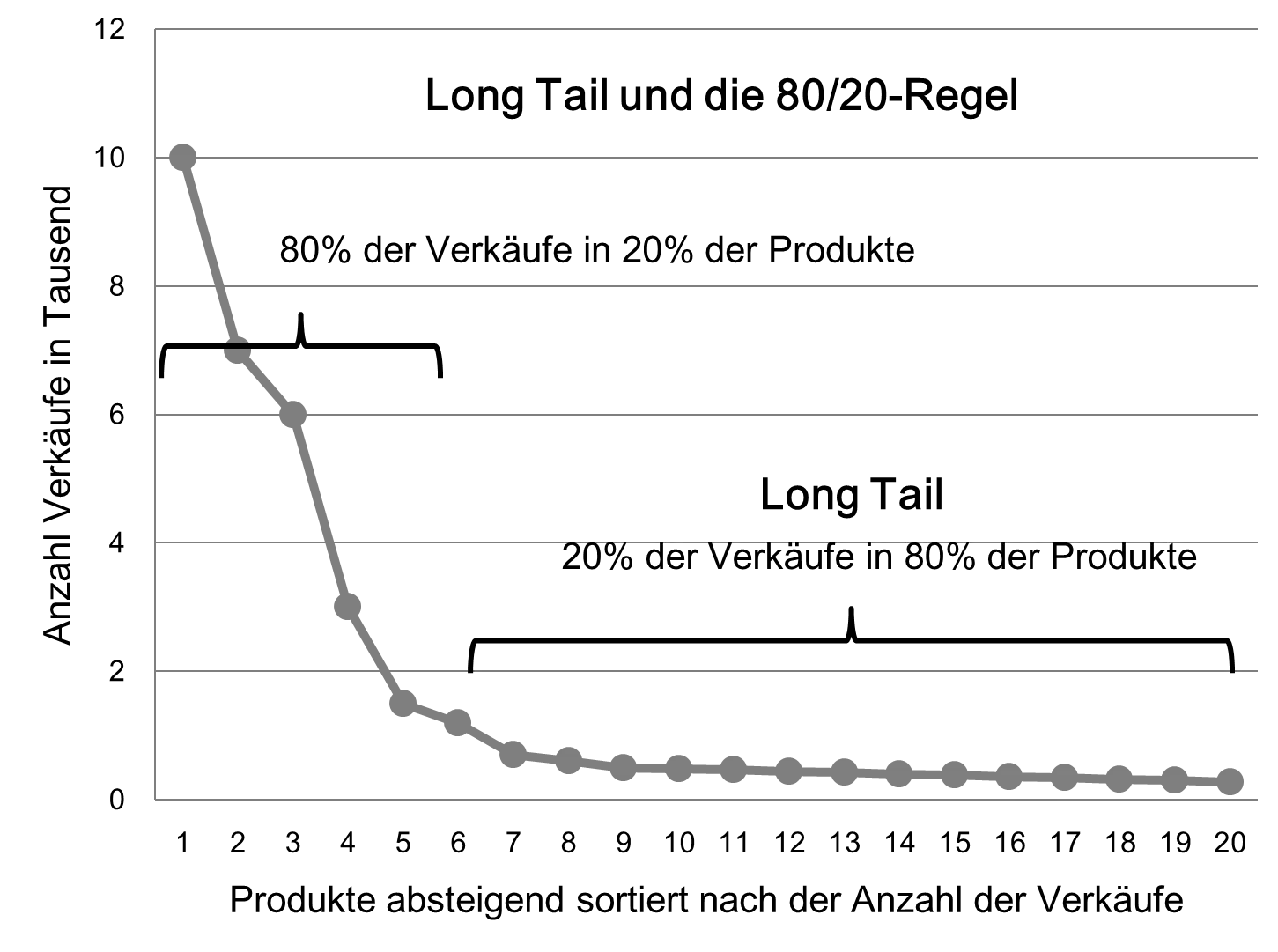
Products are shown on the horizontal x-axis, numbered from 1 to 20 for simplicity, and sales on the vertical y-axis. This type of distribution is also a Pareto distribution, like wealth in Sugarscape in Section 2.4. Typically, a few products sell very well. Most sell only in small quantities because not many people are interested in them. The “Long Tail” is the long end of the curve.
Digital products require little space on a hard drive. They are therefore very easy to keep in stock. This is why online booksellers can offer significantly more different digital books than a bookstore in a pedestrian zone. This has advantages for less well-known authors, because they can reach potential readers directly through an Internet platform. Books by unknown authors are rarely carried by traditional booksellers because the books would take up space in the store.
The “Long Tail” therefore means that the Internet also makes it possible to offer highly specialized products and services, because supply and demand find each other more easily.
Crowdfunding
Some projects or companies can only really take off if they receive financial start-up assistance. They can ask banks for a loan or apply for venture capital from private firms. Often, however, such a loan is tied to heavy bureaucratic requirements. In some cases, a lender also wants a say in the company. In any case, it is not easy, and instead of developing the actual new product, the company first develops the required documents and business plans demanded by the lender.
But there is a way out: a crowdfunding website brings potential private investors together with people who need investment capital. The projects and products to be financed are presented on a website, and investors can pledge their financial support. This pattern has already proven itself several times in the past; computer games, films, and music albums, for example, have been financed this way. Crowdfunding is a social innovation. It is an example of how technical inventions are followed by social inventions.
Crowdsourcing
Companies often have to outsource certain tasks. Because specialization is so high, a company cannot hire a specialist for every contingency. Smaller companies in particular need employees with many skills who can be deployed flexibly. Specialists must then be “bought in” from outside. In databases alone, for example, there is such variety that a specialist is needed for a specific database vendor, sometimes even for a specific version. This matching is often carried out through project exchanges.
A refinement of this principle is the assignment of individual tasks to others. One example is “Amazon Mechanical Turk.” The “Mechanical Turk” was a machine presented in 1769 in the form of a table with a chessboard on it and a puppet dressed in Turkish clothing that could play chess. But it was a hoax, because a human chess player was hidden inside the machine [BA14]. On “Amazon Mechanical Turk,” individual tasks are offered, so-called “Human Intelligence Tasks,” which others can complete for payment. These are tasks that cannot (yet) be solved with the help of artificial intelligence. Human intelligence is still needed, which is why the process has also been jokingly called “artificial artificial intelligence”.
Sometimes companies also reach the limits of their employees’ ingenuity. They award research and development tasks to third parties. This is also called open innovation. It is similar to the Mechanical Turk, except that the tasks are usually aimed at private researchers and are intellectually demanding. They often involve scientific challenges [BA14].
This handing out of work to others is called “crowdsourcing.” In crowdsourcing, concerns have naturally been raised about exploitation and compliance with legal requirements. However, it has also been reported that people from poorer countries can earn comparatively high incomes this way. The topic of “outsourcing” touches a central point of the social market economy, namely the status of work and the employment relationship, and is therefore often discussed.
A slightly different use of the term “crowdsourcing” appears when users can collaborate on a website or database, as with Wikipedia. The work here is often voluntary and unpaid. Gigantic databases have already been created in this way. Another example is the classification of galaxy images as part of the Sloan Digital Sky Survey [HTT09]. A galaxy can rotate clockwise or counterclockwise. A person can easily recognize this from a photo. In 2008, however, this did not yet work with artificial intelligence. Researchers had countless photos of galaxies but could not classify them automatically. They therefore built a website where volunteers could perform this classification task. Each photo was presented to several volunteers to avoid errors. Within one year, 50 million classifications were made. Science can also be carried out as a community task.
Two-Sided Market
A two-sided market establishes contact between two different groups. It offers both groups an economic platform. At Google, for example, there are customers on one side who are allowed to use the search engine for free, and companies on the other side that can place advertisements for certain search terms [Shn15]. Facebook offers people a social network on one side and advertisements and games on the other.
Two-sided markets often depend on network effects. Only when one side is large enough does it become interesting for the other. Game consoles or operating systems can serve as examples. A console is worth buying for players only if there are good games for it. For game developers, by contrast, development is worthwhile only if there are enough potential buyers of games.
Cloud
One of the three pillars of a business model is infrastructure. Here, the “Cloud” has fundamentally changed what is possible, especially for small firms. The entire data center can now be rented as a service. In the past, firms had to invest a great deal of money in new computers and new software. One problem was scaling: computers cannot always be expanded at will, and when a computer was at capacity, one had to either buy a new one or artificially limit the service. Today, the entire infrastructure for servers, databases, web servers, and so on can be rented. Some tariffs require payment only for the computing time actually used. Often, any number of additional computers can also be rented if demand becomes unusually high.
“Cloud computing” has advantages particularly for small firms and startups. When a new website is developed, there are initially only a few customers, and with rented computers in the cloud, costs are not so high. If the website becomes more successful and word spreads, one simply rents more servers. Here, however, it is important that the software also supports this “scaling” and was explicitly developed as a distributed application [Dav14].
Open Source
Software is coded in a programming language and compiled into executable apps (in Windows, these are, for example, the *.EXE files). The source code is called “source” in English. In commercial software, the source code is a trade secret of the manufacturer. If a programmer has access to the source code, they know how the software works and could “re-program” it very quickly. The long development time would then not have been worthwhile for the manufacturer. The source code was therefore not published.
In the 1980s and 1990s, the so-called “Open Source” movement arose at American universities. Software should no longer be “commercial,” and the source code should no longer be secret; software should be “public,” and everyone should be able to modify it as they wished. Instead of buying software, one could simply download it. The open source movement was partly “the virtual equivalent” of the unconstrained vision from Section 3.4. These programmers generally had well-paid jobs at universities or large American software companies and had an “idealistic” vision of a better world with “free software.”
Open source really did produce very good and important programs, such as the Linux operating system, GNU, Eclipse, and Hadoop. But the initial vision that all “commercial” software could be replaced was unrealistic. At first, open source rebuilt already known software rather than implementing truly new innovations. Open source was “competition” rather than “innovation.” The best-known open-source projects, Linux and GNU, were “rebuilds” of already available software.
The interesting thing, however, was that many commercial firms jumped on the open source bandwagon. Many companies invested in open source and “participated” by allowing their developers to spend time on open source projects. Companies disparaged as “information capitalists,” such as Google and Facebook, have already made a great deal of open-source software available to the public. According to its own website6, Google has already published 900 open source projects, including the Android mobile operating system, the Angular web framework, and the V8 JavaScript engine. From the perspective of a software developer, these companies are also doing something good.
Overall, open source has democratized the software market. With the right community, small developers can achieve success very quickly. The success of open source has also led to imitation in other areas. The so-called Creative Commons license emerged. If you publish a work under the Creative Commons license, whether a book, a graphic, a piece of music, or software, you have the following options:
- Is anyone allowed to further process and also publish the work if they name the source?
- Is the work allowed to be used commercially?
These licenses are now very widespread. Such works can often be recognized by the word “Open” in their name. For example, “OpenStreetMap” is a non-commercial world map. Collective intelligence can grow significantly faster through “open” models. The speed of progress has increased enormously.
Data as Economic Value
Data contains information, and information has value because it can be used to reduce uncertainty. With data, processes can be examined and optimized, new customers found, new medicines discovered, traffic flows optimized, and the environment protected. Data is an economic good. It can have enormous value, both in business and in science [PF13, Dav14]. We already mentioned this in the chapter on Data Science: one cannot tell by looking at data what knowledge is hidden in it, and therefore what value it might have for others. This leads many firms to “collect data in reserve”. Storing data is relatively cheap if it might still be useful.
There are many different ways a company can work with data. Data aggregators, for example, collect data on certain areas and offer it back in combined form [Cor11]. There are, for example, product-comparison websites that collect all the test reports about a product. Films are compared at “Rotten Tomatoes”7, and films, series, and video games at Metacritic8.
Many new applications combine different types of data: social data from social networks, local data about the environment, and mobile data from the phone produce “SoLoMo” apps (“social,” “local,” “mobile”), such as Foursquare9 [BA14].
Creating data, however, involves costs. It is often advantageous to purchase certain data. In addition to commercial data, there is now also “open-source data,” for example from the following sources [CM16]:
- US Government: http://www.data.gov/
- European Commission: http://open-data.europa.eu
- World Bank: http://data.worldbank.org/
- Music: https://musicbrainz.org/
Many other countries offer their statistical data “openly.” A data “culture” is emerging here.
Social Networks and Democratization
Today, a social network is usually a website where users can register and create their own profile. They can become friends with other users in this network and send them personal messages. They can also publish messages for a larger group of recipients on their own page. Many social networks offer ways to rate the messages of other users: the famous “Like” button.
A social network is an example of a so-called multi-sided market: first, the network gives users the opportunity to meet other people and exchange ideas with them. Second, the network operator can show users personalized advertising from other companies. And third, the operating company receives valuable knowledge about society in the form of the social graph. Friendships and users’ “likes” are stored in a graph database. It is a database with many statistical data points about its users, such as age, number of children, or place of residence. But it also contains relationships between people and between people and other things, such as music bands, television films, and computer games. These connections offer previously unimagined possibilities for sociological research. For the first time in human history, it is possible to examine these relationships on such a large scale.
The company operating the social network can sell the “knowledge” contained in the social graph to interested companies. Facebook does this, for example, with “Audience Insights.” Here it must be made very clear that this is not about address data, phone numbers, or email addresses, but about “social data”: which music bands you like or which films you have seen.
But who owns this data in the “social graph” (without address, telephone number, or email address)? The user themselves stated that they like a certain computer game. Is that the user’s data? Technically speaking, the data is stored on the social network’s computers. As soon as users enter the data on a social network website, the data has left their PC or smartphone. It is no longer “their data.” The only exception here is cloud services that sell storage space. There, “their data” must also remain “their data” and may not be passed on.
Some critics fear “surveillance” by these data-hungry companies and demand, for example, more state data protection. On the one hand, these fears are of course justified, because companies are often no angels and have already used their market position and size against people’s interests. Companies are also forced to work with state organizations, such as the National Security Agency (NSA) in the USA, or in the case of Facebook censorship in Germany. On the other hand, no one is forced to use a social network, and certainly no one is forced to “publish” all their data there.
Many problems in the past arose because the medium was still “new territory” for many users and there were no alternatives. Facebook, for example, lured many users with games such as Farmville or Candy Crush. One only had to register and immediately had a few nice games. In return, many people gladly “sacrificed” their data. And who wants to forbid them? It is their data. Who wants to dictate to whom they may give their data and to whom they may not? That would not be data protection, but data paternalism.
Over time, the market for social networks will also become more critical because it is no longer new. New things always fascinate people. In the future, users will pay attention to what is being done with their data, and the providers of social networks will have to adapt. This also happened in the food industry in the 1980s with organic food and more recently with vegan food.
Democratization
The Internet enables direct communication and direct search. With the Internet, many “middlemen” can be bypassed. In countries with state-regulated or even censored television channels, information can be checked on the Internet. With the help of the Internet, the cost of starting a small company has fallen sharply. Everyone can run a media company; everyone can start a website with an online shop. In the past, that required paying expensive rent in a pedestrian zone. Many can now receive job offers to which they previously had no access. The Internet is therefore also a means of making the world more democratic and increasing equality of opportunity.
Low-Cost Education
The Internet has greatly reduced the cost of education and knowledge. The best-known example is Wikipedia. Wikipedia now contains more than 50 times as much information as the Encyclopaedia Britannica, the most respected encyclopedia in Great Britain. In the past, encyclopedias were created by a number of employees of a company. Wikipedia, by contrast, was created by thousands of volunteers from all over the world. Anyone can register and suggest changes, which are then voted on democratically. Wikipedia is a democratic encyclopedia. The socialist slogan “of the people, by the people” would fit well here. Ironically, however, Jimmy Wales, the founder of Wikipedia, encountered the ideas behind Wikipedia through Friedrich A. Hayek’s article “The Use of Knowledge in Society” [Hay48], which we already discussed in Section 5.3. Knowledge is distributed throughout society.
Many universities now also offer courses on the Internet, such as the world-famous Massachusetts Institute of Technology (MIT) in technical fields10. Many online schools for children and adolescents have also emerged, such as the Khan Academy. Many further offerings can be found under the keyword “massive open online courses” (MOOC).
Platforms as Middlemen
The Internet makes it possible for supply and demand to come together globally. This has led to the so-called sharing economy, in which private individuals can enter into business relationships with one another. One example is renting living space to vacationers through airbnb. A homeowner can offer an apartment, and apartment seekers can search for and book it via the web or an app.
With Uber and Lyft, any car owner can become a taxi driver. Contact with the customer is established through the app. Previously, a taxi company was necessary for this. A customer called the company’s dispatch center, and it provided a driver with a car. This task can easily be replaced by a website and a mobile app. Taxi companies once arose because passengers and drivers could not arrange rides directly. Today that is different. The sharing economy therefore leads to major economic changes. There is a conflict of interest between established hotels and taxi companies and the newcomers. In France there have even been violent protests by taxi drivers against Uber. The new technology is therefore, naturally, discussed very controversially, and there have also been calls for bans and regulation.
Many discussions view the situation as a zero-sum game: what Uber gains, the taxi company must lose. But the market is not fixed, that is, Uber adds lower-income customers. Rides become cheaper. It is a non-zero-sum game. Second: if taxi companies lose something, then they are offering something that the market can now produce more cheaply. The prosperity of the overall population increases as a result. People receive the same ride and even have money left over. So there are winners and losers.
The Arab Spring
In December 2010, street vendor Mohamed Bouazizi was harassed by local police in the Tunisian town of Sidi Bouzid because he did not have a “permit.” After the police confiscated his goods and his scales, Bouazizi set himself on fire in public and died from the consequences on January 4, 2011 [DMW15, TG15, SC13].
It was the protest of a self-employed small businessman against unfair “regulation” by the state. It must be said here that in Germany, he would most likely not be allowed to operate such a stall either. He might be accused of bogus self-employment. At the very least, he would have to register a business and pay trade tax. It is unlikely that he could feed his family this way, since as an individual trader he probably would not make enough turnover.
In any case, news of Mohamed Bouazizi’s death spread through the Arab world via social networks in no time and triggered protests throughout Tunisia. The dictator at the time, Zine el-Abidine Ben Ali, even visited Mohamed Bouazizi in the hospital. But that did not help, because the population was incensed, and the dictator had to leave Tunisia a few days later, on January 14. The flame had been lit and spread to the entire Arab world. The “Arab Spring” led to rebellions in many countries.
Why this “spring” did not then lead to “democratization” is controversial. Organizing an uprising is much easier than developing an “understanding” of democracy across the entire population. This “understanding” is a paraphrase for “knowing how to behave in a democracy and that win-win situations for all are better in the long run.” A democracy must be realized “bottom-up” in society; it cannot be ordered “top-down” or brought about by an “overthrow.”
Economic Growth and GDP
To evaluate the development of the economy, mainstream economics uses Gross Domestic Product (GDP). GDP is the sum of all goods and services produced within a country’s borders over a period of one year. This is the traditional “top-down” view of the economy. One looks at an aggregate, a sum, or an average, and tries to use it to evaluate the current state of the economy [BA14].
Such numbers, which serve as a basis for assessing status or making decisions, are called Key Performance Indicators (KPI). A basic management principle is “what gets measured gets done” [BA14, TG15]. By tracking changes in KPIs, one can observe the success or failure of one’s own actions. In complex systems, an action always has side effects. And only what is measured can be evaluated; otherwise it remains unobserved.
It is also important, however, that KPIs are interpreted correctly. In the case of GDP, for example, inflation must be factored out, that is, the devaluation of money through an increase in the money supply11.
GDP also has major difficulties in an information and knowledge society because it measures only capital, not information and knowledge [BA14]. The use of Wikipedia and Google is free. Many magazines can be subscribed to more cheaply online. A call via Skype is cheaper than a telephone call. A chat with WhatsApp is cheaper than an SMS. All these services make life better and increase quality of life, because the money saved can be spent on other things. Brynjolfsson and McAfee summarize this nicely with “analog dollars are becoming digital pennies”. But these savings cause GDP to fall. Economists evaluate the increased quality of life as negative because digital services cost less than analog ones. The sharing economy and the open economy have positive effects that do not appear in GDP.
The benefits of digitization are therefore not visible in GDP. Unfortunately, this has not yet been widely understood, and “growth in GDP” is often equated with “economic growth.” New metrics are therefore needed. Economists, however, do not yet agree on successors [BA14]. How can the progress represented by lower-cost digital products be evaluated? In the meantime, economists must take into account that a large share of innovations does not appear in GDP.
“The winner takes it all”
Long ago, before the invention of mail order, goods always had to be bought locally in a regional store. If products were not available, customers also bought the second- or third-best products. Often people knew only the local products available on site. A pedestrian zone in Great Britain in the 1980s still differed greatly from one in Spain, France, or Germany. The products in supermarkets were also different. Today, much is the same. The same multinational firms offer the same products in the same branches.
Today, the Internet and globalization have created global markets. Customers can find out about all products, either on the manufacturer’s website or on product-comparison sites. It is therefore possible always to buy the “best” product. This has led to greater competition among providers. It is no longer enough to be second. On the other hand, a company today also has the advantage that it can offer more diversified products because of the “Long Tail” and supply-chain optimization.
Customers benefit from the comparability of goods on the Internet, while firms “suffer.” Because of digitization, there is less room for those who are not the best. In the economy, the motto “The winner takes it all” increasingly applies [BA14]. Competition therefore takes place globally, making the “blue oceans,” the innovations, all the more important.
-
The logarithm to base 2 is the number of times you can divide a number by 2 and the remainder is still greater than or equal to 1. The logarithm of 2 is 1, because you can divide 2 once by 2. The logarithm of 15 is 3, because 15 / 2 = 7 remainder 1, 7 / 2 = 3 remainder 1, 3 / 2 = 1 remainder 1. ↩
-
The logarithm to base 2 is the “opposite” of exponential growth to base 2. It holds that log(2^x) = x. ↩
-
This Gordon Moore is not the Edward F. Moore after whom the Moore neighborhood from Chapter 2 was named. ↩
-
Here is the calculation for the mathematically interested: In 10 years there are 10*12/18 = 6.67 doublings, which we simplify to 6 doublings. If 2006 was the 32nd doubling, then in the 10 years before there was growth from 2^(32 - 6) = 2^26 to 2^32 in the year 2006. And that results in a difference of 2^32 - 2^26 = 4,227,858,432. In the 10 years after 2006, however, there was growth from 2^32 to 2^(32 + 6) = 2^38 and that is 2^38 - 2^32 = 270,582,939,648. That is 64 times! 64 = 2^6 for 6 doublings. In general, this is the 2^k-fold, if the number of doublings is k, because (2^(n + k) - 2^n)/(2^n - 2^(n - k)) = 2^k. ↩
-
A “disruptive” technology replaces the previously used technology. ↩
-
One must be careful today with inflation, because inflation in mainstream economics is calculated as the consumer price index, in which rents, houses, and stocks are not included. Intermediate products in industry are also not included. Finally, a basket index is also calculated, in which “experts” decide on the composition of the basket. Technical devices, such as computers, are also included here. However, technical devices become cheaper due to technical progress and thus artificially lower the inflation index. An index “blurs” the information, as explained in Section 5.3. Today, the term “inflation” is therefore being fudged. ↩