The Complex Perspective · 2016 Chapter 10 of 12 · ≈ 37 min read
The Future
Utopias and Dystopias
Predictions are difficult, especially …
The Danish physicist Niels Bohr once said, “Predictions are difficult, especially when they concern the future.” He was absolutely right. Knowledge about a complex system is always uncertain, because the agents in that system can change their behavior. The further one tries to look into the future, the more uncertain the forecast becomes, because the number of possible changes grows proportionally. If you do not know what the agents will do in the next time step, you certainly cannot know what they will do in the one after that. In statistics, historical data is often used to “extrapolate” the future. This works very well for simple and complicated systems, provided the historical record is long enough. In complex systems, however, change itself is what makes prediction so difficult.
The psychologist Philip E. Tetlock has studied decision-making and forecasting since the 1980s. Together with the journalist Dan Gardner, he describes the difficulty of making accurate predictions in “Superforecasting: The Art and Science of Prediction” [TG15]. Using an internet platform, they investigated how well a crowd of volunteers could make predictions. One result of this study is that well-known media “experts” often predict no better than chance. We already noted in Section 2.6 that complex systems require special techniques. When these are taken into account, somewhat better forecasts become possible.
Important: Reliable predictions over a long period are highly unlikely in complex systems.
An example makes this clearer. Let us go back 30 years, to 1985. That was the year “Back to the Future” was released, and the Warsaw Pact still existed. Some economists at the time still believed in the superiority of the socialist planned economy. Even Perestroika, which triggered the major changes, did not begin until 1986. Digitalization and the Internet were barely visible. Predictions made in 1985 for the year 2015 therefore simply could not be right, because the world developed in an entirely different direction.
But why do we see so many predictions in the media then?
Because they can serve many purposes. Some predictions help particular political groups encourage people to take certain actions or accept particular changes in the law. Two strategies are common here: reassurance, as in “pensions are safe,” and alarm, as in warnings about old-age poverty, the environment, and crises. Insurance companies and banks use forecasts of price movements to sell their products or reassure existing customers. Predictions should therefore always be read with an eye to the forecaster’s interests. What are they trying to achieve? Who benefits from the prediction?
Utopias and Dystopias
Many people have thought about the future. These visions can be divided into two groups: in a positive utopia, the future is better than the present, or at least no worse; in a dystopia, a negative utopia, the future is worse. People apparently tend to concern themselves more with dangers than with pleasant possibilities. There are, in fact, far more negative than positive utopias. Under the motto “Good news is no news,” positive stories are harder to sell.
Examples of negative utopias include George Orwell’s “1984” (1949), Ray Bradbury’s “Fahrenheit 451” (1953), and Aldous Huxley’s “Brave New World” (1932). There are also many films, such as “The Matrix,” “Terminator,” “Brazil,” and “Soylent Green.” In most books and films about artificial intelligence and robots, the machines eventually become “evil,” or are used by “evil-doers,” and the protagonists must defeat them.
Even the “serious” humanities contain many negative utopias: Oswald Spengler wrote “The Decline of the West” in 1918. Through the “Frankfurt School” around Theodor W. Adorno, Max Horkheimer, and Herbert Marcuse, originally positive Marxism was turned into the negative “Critical Theory,” according to which capitalism is “to blame” for absolutely everything [Her07]. For the late Karl Marx, capitalism was still supposed to develop “to its end” and then lead almost automatically to socialism [Des04]. In France at the end of the 19th century, the “fin de siècle” movement (“end of the century”) addressed “cultural decay.” Today’s media also present many threats and anxieties about the future: diseases and epidemics, environmental problems, limits to growth, and threats from technical developments. Few people seem to look optimistically into the future.
For reassurance, however, one can say that a very large share of these predictions is most likely wrong, because complex systems cannot be predicted over long periods when their agents adapt. In our world, the agents are people who learn and change their behavior.
In 1966, for example, Harry Harrison’s novel “Make Room! Make Room!” (New York 1999) was published. The author tried to look 33 years into the future. The book remained relatively obscure, perhaps because the author got his forecast so badly wrong. In the book, New York in 1999 has a staggering 35 million inhabitants, most of whom live in mass poverty because food and drinking water are scarce. According to Wikipedia, the author explained himself as follows1:
“In 1950, the United States, with only 9.5 percent of the world’s population, consumed 50 percent of the earth’s raw materials. This percentage is constantly rising, and at the current growth rate, within fifteen years, the United States will consume over 83 percent of the annual production of all the earth’s raw materials. If the population continues to grow at the same scale, this country will require more than 100 percent of the earth’s raw materials by the end of the century if the current standard of living is to be maintained.”
Here the author simply extrapolated the figures of his own time into the future and ignored several dynamics. On the one hand, there is technological development, and people now produce goods using fewer resources. On the other hand, demographic development took a completely different path. Since the late 1960s, the invention of the “pill” meant that people no longer reproduced as before. This created the “birth slump” (Pillenknick). At least the author openly admits his naive “extrapolations” when he writes “at the current growth rate” and “if the population continues to grow”. But the world is dynamic. In a market economy, prices rise when raw materials become scarce. People then begin to think about which alternative raw materials they could use. The rising oil prices of the 1970s and 1980s are one example. People tried to find substitutes for expensive oil and gasoline. They began riding bicycles and using trains, and today we even manufacture electric cars.
A large share of the predictions published in the media today suffers from these extrapolation errors. Simply extending the present in a straight line and ignoring possible changes does not produce an accurate picture of the future.
Important: Only a few predictions so far take the findings of complex systems into account.
The Conditions
What do the Economic Advisors Say?
Economic advisors Richard Dobbs, James Manyika, and Jonathan Woetzel describe their view of the future global economy in “No Ordinary Disruption: The Four Global Forces Breaking All the Trends” [DMW15]. They argue that the world is facing major changes and that everyone, especially managers and politicians, must “reset” their intuitions. Remember Systems 1 and 2 from behavioral economics? Dobbs et al. mean that the complex system of the economy has changed, and that the heuristics memorized by System 1 are no longer correct. These heuristics must now be explicitly unlearned so that people can adapt to the new situation.
The global economy is no longer what it once was. Dobbs et al. cite India’s Mars mission as an example. In September 2014, the “Indian Space Research Organisation” sent a spacecraft into orbit around Mars, at a cost equivalent to 74 million US dollars. The Hollywood film “Gravity”, by contrast, had a budget of 100 million US dollars. India therefore now has major comparative advantages relative to the United States and is no longer simply a “developing country.” Speaking of “developing country”: Peter Thiel makes a very perceptive point about the term. It implies that there are also “non-developing countries,” that is, “developed countries.” This creates the illusion that countries such as the USA and the EU nations are “finished” and no longer need to develop [TM14]. If this illusion really exists, then companies in these countries stop searching for blue oceans. A “developed” country does not need innovation, they think. As a result, however, they lose their “competitive advantage,” which leads precisely to the effects seen as negative in the West during “globalization”: companies move production for cost reasons. As long as progress exists, “developed country” is a misleading term. India, at any rate, is the fourth country on earth to have completed a Mars mission and is now ahead of many other countries in that respect.
According to Dobbs, Manyika, and Woetzel, the following “forces” will strongly change the world in the near future [DMW15]:
- Globalization and Urbanization
- Demographic Changes
- Acceleration of Progress
- Connectivity
These four “forces” interact with and reinforce one another. They lead to changes in almost every market and almost every economic sector. The economy is becoming more dynamic. Predictions are already difficult enough, but according to Dobbs et al., these four “forces” will make them even harder [DMW15].
Globalization and Urbanization
In the coming years, many people will be integrated into the global economy [DMW15]. Most inhabitants of so-called “developing countries” once did not even have a landline telephone. Mobile phones made them reachable for the first time. It is estimated that between 1990 and 2010, one billion people escaped poverty and were able to enter the global “consumer world.” Another two billion are expected to follow by 2030. Smartphones and mobile internet access will continue to improve communication possibilities for many people: they will become part of “collective intelligence”.
These people need work, so production is being outsourced to these countries. “Globalization” will continue. Jobs are already being moved from emerging countries such as China to even “cheaper” countries. In China itself, robots are already being used in production because human labor has become too expensive [BA14].
Second, emerging and developing countries still have a relatively high share of rural population. As these countries are integrated into the global economy, fewer people will work in agriculture and more will move to cities. According to Dobbs et al., there will be a wave of urbanization. The advantages of cities still outweigh their disadvantages [Rid10]. Cities shorten communication times, reduce the cost of finding new workers, and serve as centers of communication and encounter. Because of the division of labor, people depend on social cooperation. A higher division of labor increases a society’s productivity. Previously medium-sized and little-known cities, such as Kumasi, Foshan, Porto Alegre, and Surat, will become important metropolitan and industrial centers. Each of these cities forms a metropolitan area with more than 4 million people, and according to Dobbs et al., each will contribute more to future economic growth than Madrid, Milan, or Zurich [DMW15].
Western companies must first learn to understand these rapidly changing countries. Previously, 70% of global gross national product was generated in the “developed countries” and the large cities of emerging markets. For 2025, it is estimated that only 33% of growth will take place in the “old” world.
Demographic Changes
In almost all countries, the composition of the population will change, and the share of older people will rise [DMW15]. In 2013, 60% of the world’s population lived in countries where more people die than are born. In Western countries, there is the “birth slump.” In China, for a long time, only one child per marriage was allowed. This is now called the “4:2:1 problem”: each adult child must care for two parents and four grandparents. By 2030, according to current estimates, the number of available workers worldwide will have fallen by one-third [DMW15]. This “aging” will challenge the social systems of welfare states. Fewer young people will be working, while more older people will be retired.
The “productivity” of working young people must therefore increase. That, in turn, requires innovations. Given the current pace of progress, these are certainly possible, provided progress is not “politically” prevented.
The Disruptive Dozen
As discussed in Section 9.1, Erik Brynjolfsson and Andrew McAfee identified three factors: digitalization and connectivity, exponential growth, and combinatorial innovations [BA14]. The Internet of Things, explained in Section 10.4, will greatly increase the number of digitized processes and information sources. Connectivity will increase. Exponential growth in the number of transistors is expected to continue until at least 2030. The number of people involved in product development will rise, as will their productivity, so the number of combinatorial innovations will also increase. Together, these three factors trigger the “Second Machine Age.”
But which technologies will this mainly affect? Dobbs et al. consider the following twelve technologies to be particularly important for the next decade (until 2025) [DMW15]:
- Building Blocks
- 1 Life Sciences: Genomics
- 2 Materials Science: Nanomaterials, smart materials
- Energy Sector
- 3 Better energy storage: Accumulators, batteries
- 4 New extraction possibilities for oil and gas (“fracking”)
- 5 Renewable energies
- Machines
- 6 Robots
- 7 Self-driving vehicles
- 8 3D printing
- Information Technology (IT)
- 9 Mobile Internet
- 10 Internet of Things (IoT)
- 11 Cloud services
- 12 Automation of knowledge work (Big Data, Data Science, AI)
Each of these twelve technologies has the potential to replace existing technology and is therefore called “disruptive”. Dobbs et al. call these twelve technologies the “disruptive dozen”. Half of this dozen is occupied by information technology, since robots and self-driving vehicles also belong to IT. Engineers can now build robots quite well, but computer scientists cannot yet control them intelligently enough.
Information technology forms the “brain” with Big Data, Data Science, and AI, and the “nervous system” of the economy with the Internet of Things.
The Brain: Big Data, Data Science, and AI
As explained earlier, the development of computers has reached the second half of the chessboard. The leaps are becoming larger. But the findings from artificial intelligence show us that they will not be quantum leaps. Technology will become better and faster, and larger amounts of data from many sources will be processed. Over time, increasingly complex decisions will be automated. But there will be no “wonder computer” that suddenly becomes more intelligent than a human being and wants to take over the world.
There will, however, be progress, and in the next five years systems will be developed that are not yet considered possible today. It can be assumed that by 2020 there will be self-driving cars, although they will not yet be permitted in all countries. Kitchen robots will be able to prepare meals (in specially designed kitchens, not in every kitchen) after someone has cooked the dish for them once. Computer systems and robots will observe and imitate demonstrated behavior in specific areas of application. Computer systems will also master natural languages and, in some subfields, enable automatic translation of spoken language. Someone speaks English to someone who speaks German over the phone, and both hear the other person’s statements in their own language. This will be of poor quality at first, but will gradually improve. There will be diagnostic systems to support knowledge-intensive work, for example in medicine or law [CM16].
As described in Chapter 7, Data Science is not itself intelligent. It is a tool with which intelligent people try to find the knowledge contained in data. The intelligence lies in the Data Scientists who combine and use these algorithms. Here too, there will undoubtedly be progress, but not the feared “omnipotence of computers.” The horror scenario in which “computers know everything about us” will not become reality with today’s technology and today’s progress. Computers themselves cannot “know”; they can store information. “Knowledge” is information that humans can apply. Computers can process only symbols whose meaning they do not truly understand. They process syntax, not semantics.
With a word like “Hamburger,” people know only from context whether it means a food item or a person. Computer scientists are working on a “Semantic Web” in which every word carries information about its meaning. This process is very labor-intensive and also increases the cost of creating texts. Perhaps a semantic database can be created through crowdsourcing. Initial techniques already exist, such as the “Resource Description Framework” (RDF), with which “things” can be precisely defined in a formal language, or the “Web Ontology Language” (OWL), with which ontologies can be created. Humans possess “common sense,” for example. Everyone knows the properties of the physical “space” around them. Everyone knows that the opposite of “up” is “down.” A person can interpret phrases like “in front of the garage” or “behind the refrigerator.” In an ontology, this basic spatial knowledge can be formulated so that it is available to a computer as background knowledge. Without this “semantic” information, a computer does not “know” what it is doing. But formulating this knowledge, creating these “ontologies,” requires a great deal of work because it is a form of “programming” and “logical formulation.” For the time being, therefore, there will be no computers with “common sense.”
The Nervous System: The Internet of Things
The Internet Today
So far, only “larger” technical devices have been connected to the Internet, such as smartphones, tablets, laptops, PCs, televisions, and perhaps light switches. Today’s Internet could be called the “Internet of people and large devices.” A private network currently looks roughly like the following diagram:
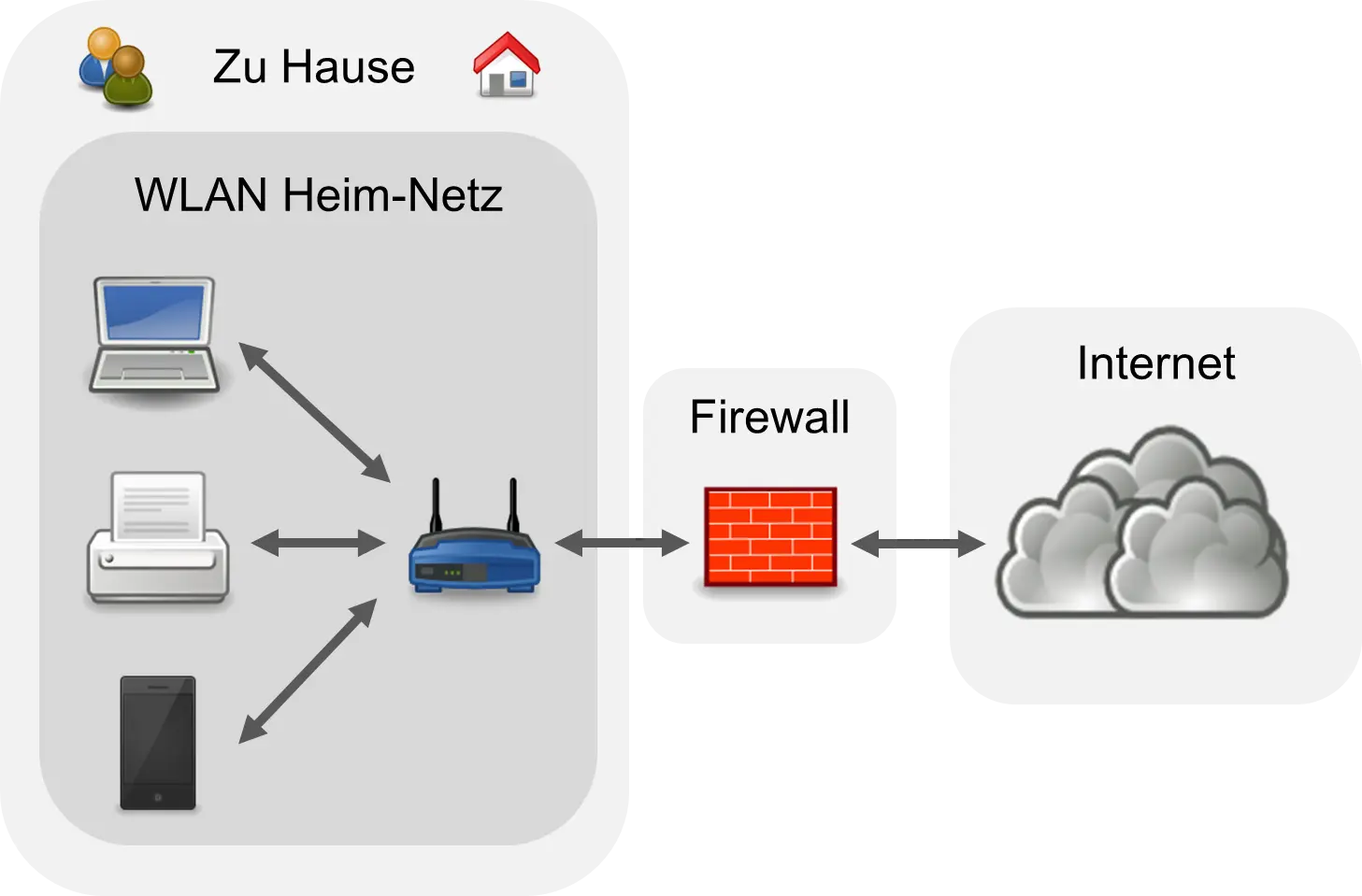
Most people have a DSL connection to the Internet, and a WLAN (“wireless local area network”) connects the devices in the house. Most have a combined device that is both a DSL modem and a WLAN router. What some people do not know is that the DSL modem has a so-called firewall. A firewall is a security mechanism that can check and filter “packets” from the Internet. It prevents “hackers” from accessing household devices from outside. Such a firewall can be configured so that only certain connections are permitted, or only the truly necessary “services” are allowed through.
This firewall is often forgotten when critics of artificial intelligence describe the dangers of AI in drastic terms. Some critics imagine a scenario in which an AI could reach and control all technical devices. That is precisely what these firewalls prevent.
Corporate networks place even greater emphasis on security, and often contain a so-called “demilitarized zone” (DMZ), which is protected by firewalls on all sides [Don11]. In the following figure, the corporate network is protected from the DMZ by a firewall, and the DMZ is protected from “hackers” on the Internet by another firewall.
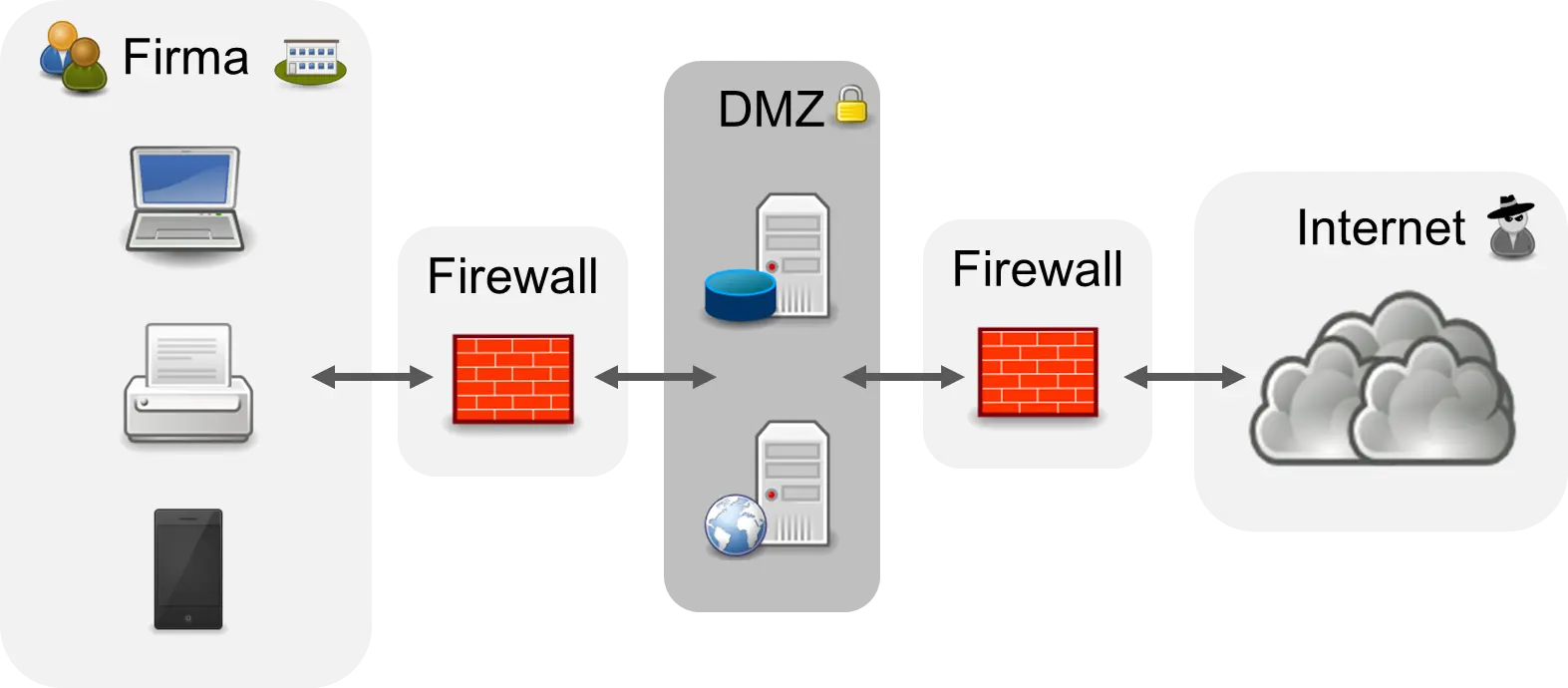
Inside the DMZ are the computers for the services and data that need protection. Direct access to the servers from outside and inside is no longer possible. The corporate network is “isolated.” System administrators usually monitor the firewall log files semi-automatically. Unusual access is investigated by administrators. As a rule, today’s companies are well protected against attacks from the Internet. An artificial intelligence cannot achieve more here either, especially since “hacking” also requires creativity, and it remains completely open whether “creative” AIs will ever exist.
The Internet of Things
In the Internet of Things (IoT), all “things” that can send or process information are to be connected to the Internet. It is the information-technology capture of the physical world. The beginnings of the Internet of Things are already here, since the following devices can already be connected to the Internet [And13]:
- Body scales that send weight via WLAN to a website for evaluation
- Light switches controlled via WLAN
- Motion sensors that, for example, turn on the light when motion is detected
- Parcel tracking with the post office and delivery services
- Home automation: Thermometers and heaters
- Industry 4.0, e.g., in the supply chain, see Section 6.2
- Heart rate monitors with GPS trackers
At present, however, WLAN components are still relatively expensive to produce, so so-called WPANs (“wireless personal area network”) were developed with cheaper network components. This market is still developing and is not as standardized as WLAN, where the IEEE 802.11 standard exists. The protocols include, among others, the following [Gre15]:
- Bluetooth
- IrDa (“Infrared Data Association”) for infrared, e.g., for remote controls
- Z-Wave
- ZigBee
At home, you then have more than just one network, as shown in the following diagram.
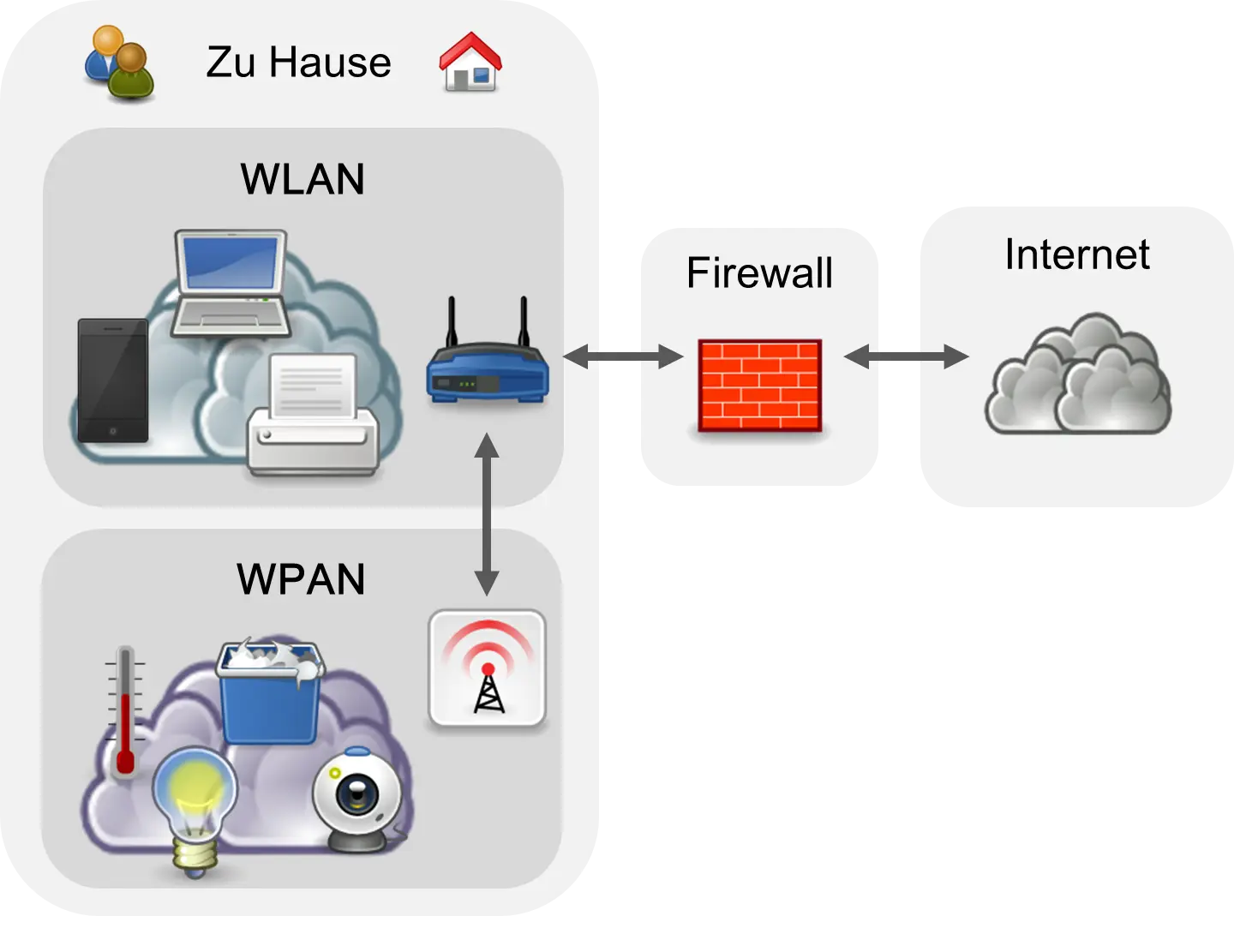
You have a WLAN and one or even several WPANs. In the Internet of Things, everything is somehow connected to the Internet. The possibilities are endless and will significantly change the world. The new technologies are often labeled with the prefix “Smart,” as in Smart Home, Smart Traffic, or Smart City.
Of course, some people warn of the dangers, but, as the figure shows, the WPAN is also protected from Internet access by the firewall. How it will be protected locally against nearby attackers remains to be seen. But here too, the basic techniques already exist.
Identification with RFID
There are many “things” in the real world that cannot really communicate, but only need to be identified. A shoebox is one example. For a shoe retailer, it is useful to know whether a size 46 shoe is still in stock.
For this purpose, the identification method RFID (“radio frequency identification”) was developed. RFID consists of a very small microchip that can store a number, together with the ability to read this number via radio waves. Often the Electronic Product Code (EPC) is used as the number: an internationally used key and code system for unique identification. With RFID, a very small chip is glued to the shoebox, or even to every shoe, and the shoeboxes are checked in and out at the warehouse door.
In industry, Walmart in the USA has used RFID chips on suppliers’ pallets since 2005 [GB06]. Every pallet can be uniquely identified via RFID, allowing Walmart to improve the logistics of supplying its stores. When a truck loaded with pallets arrives at a Walmart warehouse, every pallet is scanned with an RFID reader. The supermarket then knows which products it has received and can update its inventory database. The company “knows what it has in stock.” Identification using the EPC could also be done with barcodes, but these must be “scanned” manually and require visual contact. That is cumbersome. RFID uses radio, so “scanning” can take place automatically [Gre15]. RFID makes it possible to document processes better and obtain a better “overview”:
- Inventory can be determined automatically.
- For perishable goods, shelf life can be determined.
- Processes such as the supply chain or Enterprise Resource Planning (ERP) can be improved. This reduces waste and losses.
- Processes could be “documented”: when the product was manufactured, when it was delivered, etc.
- In the case of defective goods, one can use the RFIDs to determine where in the production process the error occurred.
Since 2013, for example, Walt Disney World in Florida (USA) has used RFID [JL14]. Every visitor receives a wristband containing an RFID chip. Before arrival, visitors can book and/or reserve certain attractions online. For example, they can arrange to meet a Goofy character at a specific time. This avoids overcrowded events and queues in front of restaurants. The company, meanwhile, can use the data obtained in this way to further improve the park. Regarding data security, it should be said that only an artificial ID is stored in the wristbands. The booked attractions are determined from this ID in an encrypted database. According to Disney, this database contains no credit card data or other personal information. Personal data therefore cannot be inferred from the wristband.
For security, it should be mentioned that RFID jammers and scan-proof wallets now also exist. RFID can therefore be bypassed if privacy needs to be protected.
Machine-to-Machine Communication (M2M)
RFID can therefore build a bridge between the physical and the virtual world [Gre15]. This bridge between physics and information consists to a very large extent of machine-to-machine (M2M) communication. A thermometer sends its data to a WPAN receiving device, which forwards the data to a database on the Internet. This database is in turn used by a web portal where a user can view the data. From a technical perspective, it is important that these data transmissions work securely, reliably, and, in the case of confidential data, with encryption.
Much additional infrastructure is still needed here. The comparison with road traffic is obvious: in addition to motorways, one needs access roads, signs, gas stations, rest areas, motels, repair shops, and so on. The Internet of Things will be similar: devices, software, programming techniques, tools, and much more [Gre15]. A “nervous system” is emerging that can connect the devices of the world with one another. This connection must, of course, be voluntary. It will also be possible to operate certain devices or services only within a private subnet or a “Virtual Private Network” (VPN).
Still in Development
At the time of writing (2015), the Internet of Things is on the S-curve at the “in development” stage (see Section 5.6). Many things still need to be learned and developed. Of course, there will also be setbacks and security gaps, at least for some products and some users. Mistakes are made in every development.
Many critics have serious concerns here and fear the surveillance of people. If someone buys shoes and pays by credit card, the shoe store could link the shoes’ RFID with the buyer’s name. When the customer enters the store again wearing those shoes, the store can “recognize” the buyer. Opinions differ: some would welcome this as a service, while others would feel “monitored.” There will therefore be many more discussions about this in the future. Yet this possibility already exists in road traffic without anyone getting upset about it, because every car has a clearly visible license plate.
The Improved Collective Intelligence
In the coming years, an Internet of Things will emerge that can be evaluated “semi-intelligently” with human help. The greatest progress will come from combining new technologies and data. New social networks and communities will emerge. Because more people can participate in the Internet, progress will accelerate further.
Examples of the Internet of Things
The many devices in the Internet of Things will continuously generate data, which will be processed using Big Data and analyzed with Data Science. Rule-based systems already exist that trigger certain actions based on the data, such as ifttt2. A rule has the format “IF Sensor THEN Actuator.” Adapters exist for various software, devices, and social networks. Examples of rules and corresponding hardware available today include:
- If the sun is not shining, turn on a light
- Read the headlines of a website and send them via email
- If the weather forecast predicts rain the next day, send an SMS
- Turn on the lights when you come home and it is already dark
These rules and services will certainly become more sophisticated and complex in the future. Later, more mature artificial intelligence techniques will come into play, using decision trees or neural networks.
There are also many applications in environmental protection. The “Hawaiian Legacy Reforestation Initiative”3 has set itself the goal of restoring Hawaii’s original ecosystem, which was destroyed by industrial cultivation of sugar and pineapple. Volunteers can “donate” a tree. In total, more than 225,000 trees have already been planted [Gre15]. These trees are managed and maintained with modern technology: every new tree receives an RFID chip so that it can be found again via its GPS coordinates. The care of the trees, including possible watering during droughts, can be planned using the database.
In agriculture, moisture meters, thermometers, and pH meters can enable many improvements, such as reduced and better-adapted fertilization and irrigation. Sensors also make it easier to manage free-ranging cattle [Dav14].
In logistics, for example with containers or parcel services, “tracking systems” have been used for some time. Here too, the economic savings are enormous. The environment also benefits if parcel delivery vehicles take fewer detours than before.
In so-called Smart Cities, traffic management systems could one day help avoid traffic jams and accidents and make it easier to find parking spaces. Self-driving cars will drive more energy-efficiently because they “oversteer” less than humans. They will accelerate and brake more precisely than humans [Gre15].
The Internet of Things will therefore become both a telescope and a microscope. No industry will remain untouched by it. In connection with Big Data and Data Science, it creates previously unimagined possibilities for progress [Gre15] and “collective intelligence.”
Application: Climate
With the Internet of Things, it will be possible to obtain much more data about the environment. This is where “environmental applications” will arise [HTT09]. These applications will manage and control various aspects of the environment, such as water quality. In research, better and more realistic environmental models will emerge because more and better data are available. With inexpensive sensors, it will also be possible for the first time to explore previously unexamined parts of the great oceans with Big Data and AI. With a combination of nanotechnology, biotechnology, information technology, computer models, image processing, and robotics, it will eventually be possible to conduct research in the depths of these oceans with remote-controlled or autonomous robots.
Application: Health
Demographic changes in the world population, with more old people and fewer young people, make improvements in healthcare systems necessary. To maintain the same level of performance, productivity gains are required. When a new medication is introduced, it is important to react as quickly as possible if new side effects become known. This can be enabled, for example, by crowdsourcing [HTT09].
Medical research will benefit greatly in the future from the abundance of health data and from the analytical possibilities of Data Science. The number of misdiagnoses and medication errors can be reduced [HTT09].
Scales, blood pressure monitors, and other sensors can send their data to websites for processing, enabling automated warnings to be sent to people with certain diseases [HTT09].
A huge amount of new information is generated in medical research. It is estimated that an epidemiologist would have to spend 21 hours every day reading new research reports just to stay up to date [HTT09]. A typical doctor should know about 10,000 diseases and syndromes, 3,000 medications, and 1,100 different testing procedures. This extensive knowledge cannot, of course, be mastered by individuals, so computer-aided knowledge management and diagnostic systems must be developed. One such diagnostic system is IBM’s Dr. Watson [BA14]. A doctor gives the system the patient’s symptoms, such as a slightly elevated temperature, sweating, and a red rash, and the system suggests a series of possible diagnoses. The doctor then selects the diagnosis they consider appropriate.
Application: Financial System
Today’s money is issued by states, which use it, among other things, to pay the interest on their national debt. But it was not always like this. Money is a medium of exchange that facilitates trade. Before money was invented, in the era of hunters and gatherers, direct barter was necessary. A hunter with one hare too many had to find a gatherer who wanted a hare and had something “tasty” to offer in return. With money, this is easier: the hunter exchanges the hare with someone else for money and then exchanges the money with the gatherer for berries. Money is therefore a very simple thing and arose naturally in trade. Even in the time of Ötzi, there were already small copper bars used for exchange [Rid10, Fer08].
Today, money is in state hands, and for various reasons a mixture of computer scientists, cryptologists, and market anarchists sought a digital currency that would avoid the disadvantages of state currencies. Above all, the currency was not to be controlled by a state.
In a digital currency, one would have a digital coin and could store it digitally in an account app. When making a purchase, one would simply “transfer” the digital coin to other people. But digital goods are very easy to copy. How can one prevent a digital coin from simply being copied and spent multiple times? A fraudster could try to use several copies of the coin almost simultaneously at different online retailers. They would only notice the fraud later, when it would be too late.
One possible solution would be a central database in which all IDs of the digital coins are stored, along with the account on which each coin is currently located. During a purchase, a retailer would then have to query this database to see where the coin currently is and whether the buyer really owns it. That sounds all well and good, but it has a major disadvantage: the database is central, and the system is therefore fragile. What happens if this database fails or if a criminal hacks it?
The developers of Bitcoin found an alternative: the so-called Blockchain. The blockchain is a peer-to-peer (P2P) network (see Section 2.3). The database is stored on all participating computers. The blockchain can store which account currently holds a bitcoin. The technology behind it uses sophisticated encryption methods and is still considered quite secure [Ant14].
Bitcoin has many advantages, but at present it also has disadvantages. With Bitcoin, for example, people who have been excluded from the traditional credit economy, as in many African countries, can also participate in international trade. At the moment, however, using Bitcoin is not yet truly user-friendly, and people have lost money because they did not store their digital coins on their own computer but on a server. If such a server is then “hacked,” the bitcoins are gone. Of course, a new monetary system is also a magnet for all kinds of fraudsters and criminals.
The blockchain, by contrast, can also be used for applications other than Bitcoin. Many more innovative applications will emerge here in the coming years [Swa15]. The technology created here definitely threatens many parts of today’s financial system. Before computers and digitalization, banking was very profitable per customer. Back then, “banking” required a great deal of labor and legal work. Then computers arrived and calculations were automated. After that came the Internet, and customer relationships could be moved online. Today, there are “unbundled” banks that no longer have real branches, but only a website and a few service employees for the telephone hotline. It is very difficult for a bank today to make money with its former core business. Critics even speak of an end of banks [Mil14]. The financial market will therefore change significantly in the coming years.
The Distant Future: The Singularity
Section 9.1 explained why the speed of progress increases because of the “Law of Accelerating Returns.” We have also seen curve diagrams for exponential growth and know that the curve eventually rises almost vertically. Will research behave the same way? Will as much research be done in one year as used to be done in 100 years? Several futurists have thought about these questions. The central issue is whether computers really become as intelligent as humans and what they then do with their intelligence [Kur06, Sha15].
The central hypothesis is this: if “intelligent machines” should ever exist that are just as intelligent as humans, then these machines could improve themselves and make themselves even “more intelligent.” These “more intelligent” machines could in turn do the same, so that after several steps, “hyper-intelligent” machines would emerge. This moment is called the “Singularity”. A singularity is a single important moment in a system, a moment when something happens that has a very large impact. In physics, for example, the Big Bang is a singularity, as is a black hole.
Many critics of AI fear that this “recursive self-improvement” could become the end of humanity [Bos14]. They assume an “explosive” and very rapid development of a super AI that is much more intelligent than humans. This super AI could then seize world dominance because, through networking, all systems are connected to one another, and bypassing security mechanisms would be no problem for it.
But several things are wrong with this scenario, and there are many scientific counterarguments. The biggest error is that we imagine the consequences of such a super AI in our present world. What if people at the time of Jesus Christ had been told about tanks? They would have feared their downfall because they could not have defended themselves against a tank. From the perspective of that time, a tank is unassailable and invincible. Today’s Italians, however, would not be particularly impressed by a single tank. It is similar when we imagine the consequences of a super AI today. By the time of the singularity, the world would already have changed beyond imagination. Before one can produce an AI as intelligent as a human, one must have produced AIs that are, for example, as intelligent as dogs or cats. That alone would already change the world indescribably.
Another error is that inventions do not arise abruptly or explosively. They are the result of combinatorial innovation and collective intelligence. The super AI would have to be more intelligent than the 6 billion people living on earth.
Furthermore, human intelligence arises from an “intelligent” combination of Systems 1 and 2 (see Section 3.2). Human thinking is a mixture of time-saving heuristics from System 1 and careful testing of all possibilities with System 2. Both systems can be “simulated” by computer systems: System 1 by neural networks, and System 2 by search algorithms, mathematical differential equations, or simulations with agent-based modeling. A super AI, however, cannot solve differential equations faster than a traditional supercomputer. An NP-complete problem is also NP-complete for a super AI and therefore requires a long calculation time. Many optimization tasks are NP-complete, and today’s computer chips are already improved with mathematical optimization by computer algorithms. If this is already done mathematically optimally today, the super AI cannot improve anything further here. A super AI would also depend on traditional computers, because they can do “number crunching” faster.
Moreover, economic aspects are completely missing from these critics’ views: computers need energy. Today’s supercomputers require the energy of entire power plants. This super AI would initially be very expensive and therefore operable only by large states.
Today, the trend is toward distributed systems. Such systems consist, for example, of thousands of computers that together constitute the system. Computing power is now distributed across entire countries and populations. A super AI would certainly be a distributed system with rather low computing power compared with the rest of the world.
Not all systems are interconnected, either. Many networked systems are located in demilitarized zones secured by firewalls. Encryption methods and passwords are just as hard for a super AI to “hack” as they are for today’s computers and humans. One therefore cannot simply conquer the entire world through the network.
As mentioned in Chapter 8 on AI, it has not yet been scientifically proven that human-like AI will ever exist. Today’s AI merely simulates intelligence. Whether creative and self-aware computers will truly exist one day is still uncertain.
Since today’s AI based on silicon computers has not produced the desired success, many futurists have shifted to imitating human brains. They develop a theory, still entirely fictitious today, that the human brain can simply be read like a data storage device and rebuilt mechanically or through biotechnology. That, they argue, would produce an AI as intelligent as a human [Kur06]. Here too, it is not yet scientifically clear whether this is even possible. The brain is structured far more complexly than a computer. It is a complex network with different parts that react with one another chemically and electrically. Whether this can be simulated in computers remains an open question [Sha15].
The OpenWorm project clearly shows how far away these goals still are4. Researchers there are trying to recreate the roundworm Caenorhabditis elegans in software. Caenorhabditis elegans grows up to one millimeter in size, and the male worm has 1,031 somatic cell nuclei and a brain with 304 nerve cells. Using a computer model, researchers have tried to better understand the organism of the worm. One early finding is that, despite the simple structure, it is very difficult to understand and recreate the complex interactions of the individual parts. Many questions remain open. The project is a good example of how progress in biology can also be achieved through the simulation of complex systems. A human, by contrast, has an estimated 100 billion nerve cells with 60 trillion synapses (connections). We are therefore still at least 10–20 years away from a simulation of the human brain.
In recent years, the media have reported cases in which researchers claimed to have successfully simulated a brain. Here, however, one must take into account that a brain can be modeled and simulated at different levels of abstraction. These simulated “brains” are highly simplified models. The complex chemical brain was reduced to a complicated neural network.
Interested readers are referred to the book by Murray Shanahan [Sha15] or to the “original” by Raymond Kurzweil [Kur06].