The Complex Perspective · 2016 Chapter 11 of 12 · ≈ 50 min read
… and Politics
The Political Game
People have wishes and goals. To reach a goal, they have to find a way to get there. They have to decide which means can be used to achieve it. Let us assume that two “parties” have means and goals that may be compatible or incompatible with one another. Here we can apply a simple table from game theory, already discussed in Section 3.3 [Gha11]:
| Goals Compatible |
Goals Incompatible |
|
|---|---|---|
| Means Compatible |
Cooperation | Coalition |
| Means Incompatible |
Competition | Conflict |
If both parties have the same goals and want to use the same means, there are naturally no difficulties and they can cooperate. If they want to reach the same goal by different means, they are in competition with each other. If they pursue different goals with the same means, they can form a coalition. A real conflict exists only when both means and goals are incompatible. This conflict, in turn, leads to a new zero-sum game similar to the “Prisoner’s Dilemma” or the “Stag Hunt” from Section 3.3. In politics, however, there is also the possibility of turning the conflict into a non-zero-sum game by stepping back from means and goals and working out compromises. Both parties can then develop a win-win situation.
When Karl Marx wrote “History … is a history of class struggles,” he overlooked all these possibilities and reduced human history to a zero-sum conflict.
Individual and Economic Freedom
In everyday language, the word freedom is usually used to express individual rights: freedom of speech, freedom of expression, or freedom to travel. This is individual freedom. Everyone can live as they wish, as long as no one else is harmed.
Economic freedom, by contrast, is the ability to act freely in economic life. How easy is it to start a company? How many laws do you have to know? Which taxes are due, and how high are they? In some places in the American Wild West in the 19th century, it was enough to paint a sign saying “BARBER” and hang it in the window facing the street. You were then a self-employed barber. There was a “right to earn a living.” Provided, of course, that enough customers came. The mercantilism of the Middle Ages, by contrast, was economically unfree. To become a barber, one first had to join a guild and, after years of membership and with a great deal of goodwill from the other guild members, obtain a “license.” The American myth of going “from dishwasher to millionaire” depends on this right to start a company. Somewhere on the path from dishwasher to millionaire, one must be able to go into business for oneself.
With these two freedoms, the usual political tendencies can be roughly placed on the following sketch:
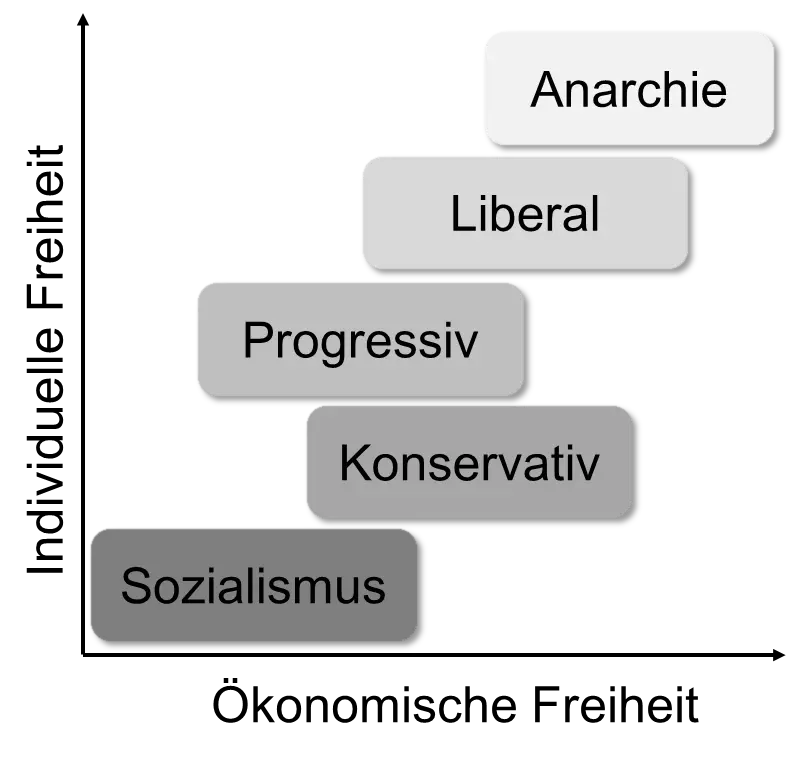
In most countries, politics has two broad tendencies: a “Progressive” one (social democratic, green, or left) and a “Conservative” one. Progressives are generally in favor of more individual freedoms, such as same-sex marriage, religious freedom, and “alternative” ways of life, while Conservatives prefer the traditional life model of marriage and children. Economically, however, Conservatives tend to favor less regulation of the economy than Progressives, who want to regulate the economy as comprehensively as possible. One extreme in this representation is socialism, which is based not on the individual but on the collective. The “social” in “socialism” does not come from “social justice” but from “community.” It is not the individual who decides, but the collective. Exactly who determines the “will” of the collective differs according to the variant of socialism. In the “real existing socialism” of the Soviet Union, it was the party or the bureaucratic state apparatus, while in anarchist variants it is supposed to be workers’ councils or syndicates [Mue84]. The individual, however, cannot decide.
Economic freedom also includes the right to property. With property, one can distinguish between consumer goods and means of production. In communism, according to Karl Marx, the means of production are to be “socialized.” Socialists after Karl Marx interpreted this as “nationalization.” A major problem is that the boundary between consumer goods and means of production is fluid. It is therefore not easy to decide when something should be nationalized and when it should not. That gives the officials entrusted with this task enormous power. If a musician plays a song on a guitar and receives nothing for it, the guitar is a consumer good and his property. But if he receives payment, whether a beer, a dinner, or money, then it is a “means of production” for producing “entertainment.” Accordingly, the guitar would have to be nationalized. Officials in a kind of “Ministry of Music” would decide how guitars are distributed. Is it any wonder that in the 1970s and 1980s the best punk bands came from Great Britain and the United States, not from the Eastern Bloc? Because the music industry was not nationalized. On the contrary: in a market economy, people who were dissatisfied with the music produced by the established music industry could start their own record labels with a little money. So-called “independent labels” emerged and shaped the “alternative” sector. Without private property and the right to start a business, such as a record label, record shop, fanzine, mail-order business, or website, music culture would be much poorer, and some musical genres might not have emerged at all. Something similar can be said about independent computer games. Musicians, authors, game developers, and other creatives are, in a certain sense, also “entrepreneurs.”
Important: The economy and society need innovation; innovation comes from entrepreneurs, and entrepreneurs need a high degree of individual and economic freedom.
The Financial System
Today’s financial system is a very complex system, and in some respects probably even chaotic. Financial systems play an important role in the economy [Fer08]. Today’s financial system, like the rest of the economic system, is a mixture of market and state planning.
It starts with money: in many countries, money is a state monopoly. The U.S. dollar, the euro, and the Deutsche Mark are or were controlled by states. This happens for reasons of state financing, so that states can more easily take on debt and finance, for example, the military and wars. Section 4.2 described how the Duke of Wellington and the Prussian king Frederick William III had to borrow money from the Rothschilds during the Napoleonic Wars (1792 - 1815) to finance the war. With today’s financial system, this is no longer necessary. State monopoly money could also be called “top-down” money. “Market money,” by contrast, emerges “bottom-up” on a voluntary basis. For example, some people collect silver and gold coins. In times of crisis, other scarce goods, such as cigarettes, are also used as currency.
The next important point is the banks’ equity ratio, which allows banks to create money out of thin air [Fer08, May14]. Put very simply: if someone deposits 100 euros at a bank, then with an equity ratio of 10%, the bank can lend out 90 euros and only has to hold 10 euros as security. On paper, this creates a 100-euro claim for the saver and a 90-euro claim for the borrower. If the 90 euros are deposited at another bank, that bank must in turn secure at least 9 euros as equity and can lend out 81 euros. This can continue several times and is called credit expansion. Different money supplies have now arisen: M0 equals 100 euros, and M1 = 100 + 90 + 81 = 271 euros. Of these 271 euros now circulating in the economy, only 100 actually exist. Money is being created out of thin air, and society thinks it is richer than it really is. The system is also fragile: what happens if the first customer wants his 100 euros back? If the first bank does not have enough equity, it has to call back the 90 euros. The next bank has to call back the 81 euros, and so on. A chain of “bank runs” follows, and the system collapses.
Another point is the distinction between asset money and liability money. If one looks at money from the “normal” perspective, one imagines that behind a 100-euro note there are goods worth 100 euros. The banknote exists because it is supposedly “backed” somewhere by 100 euros in goods or in gold. Such “backed” money would be asset money. Today’s monetary systems, however, are “liability money.” Behind every banknote is a “debt,” a promise to pay by the central bank or, ultimately, by the state. The former chief economist of Deutsche Bank, Thomas Mayer, argues for a new monetary system in his book “Die neue Ordnung des Geldes: Warum wir eine Geldreform brauchen” (The New Order of Money: Why We Need Monetary Reform), for example [May14].
Important: Today’s financial system is also heavily criticized within economics.
Another planned-economy element is the setting of the “key interest rate.” When banks need money, they can borrow it from the central bank. The interest rate for this borrowing is called the “key interest rate” and is set by the central banks. In the United States and the EU, it has been at historically low levels below 1% in recent years. Recently, therefore, it has been easy for banks to obtain money. In the media, this is often described as “boosting” or “stimulating” the economy. But interest rates express the relationship between future and present; in a market economy, they normally form “bottom-up” and cannot really be planned “top-down.” In the German media in 2014 and 2015, it was also often said that the eurozone would need different key interest rates because the economies of the individual countries were so different. A key interest rate that is too low can overheat the economy; one that is too high can freeze it.
Important: Today’s financial system is a remnant of a market economy within a planned-economy framework controlled by states and their associated central banks.
The beneficiaries of this system are the states, which can pay the interest on their debts with “cheap money” and take on new debt (“refinance”), and the banks, which can borrow money at low interest rates and use it to “gamble” on the stock markets. Rising stock prices are then sold in the media as an “economic boom” rather than as a consequence of low key interest rates. If this low-interest policy is pursued permanently, it can have consequences that are not yet understood, such as economic crises and hyperinflation [Mis49, DMW15].
The 1968-era rock band Ton Steine Scherben sang back then: “Whoever has the money has the power, and whoever has the power has the law!” At the time, the 68ers assumed that capital was in the hands of the “rich” and the “capitalists.” But the states or governments “have” the money. The banks are brought in because they have the task of supplying indebted states with new loans.
Important: When politicians claim after a financial crisis that “capitalism doesn’t work,” it is a logical fallacy, because today’s financial system is not “capitalist” at all.
Market and State
A Mixture of Capitalism and Socialism
Socialism is characterized by the “nationalization” of the means of production, while a “pure” market economy permits no state restrictions on the ownership and operation of the means of production. Thus, there is an entire continuum between socialism and laissez-faire capitalism:
- Extreme socialism: all means of production nationalized
- Socialism: the “most important” means of production nationalized, only a few free
- Social market economy: some parts of industry nationalized or cartelized
- Minimal state: only security and defense are nationalized
- Laissez-faire capitalism: everything in private hands
Today, most countries have regulated markets and some nationalized industries. Most people in today’s world therefore live in a system that is a mixture of market economy and socialism. But this “mixture” differs from country to country. In one country, for example, there may be a state postal monopoly, while in another the energy supply is run by the state. Even the Soviet Union allowed a small share of market economy again in 1921 with the introduction of the “New Economic Policy” (NEP).
The “government spending ratio” (Staatsquote) is the share of government expenditure relative to gross domestic product (GDP). Today, in most countries, it lies between 45 and 55%. In Germany, for example, it was 44% in 2014, and in France 57%. Former Chancellor Helmut Kohl is said to have once remarked that “socialism begins at a government spending ratio of 50%.” Ironically, the “Left” describes the current economic system as “capitalism” [Sch15], while minimal-state advocates describe it as “socialism” [Baa10]1.
Important: Most states today are a mixture of market economy and socialism. For historical reasons, each country has its own particular mix.
It is also quite interesting that people identify with different regulations. In the 1990s, for example, there were many discussions about the “German Purity Law” (Reinheitsgebot) for beer. Beer production was regulated, and certain additives were forbidden. People had grown used to this regulation and identified with it. It was then used as an argument against importing beers from other countries. A kind of nationalism emerged whose origin lay in the regulation of an industry. More recently, similar arguments have appeared around “chlorinated chicken” from the United States. The use of chlorine to disinfect poultry is banned in the EU but not in the United States. Here, a kind of “EU nationalism” is emerging precisely because of these regulations.
The Optimal Mix?
But what is the optimal mixture of market and state?
A scientific answer to this question has not yet been found. First one would have to clarify what “optimal” is supposed to mean in this context. Should people be as free as possible? Or as wealthy as possible? Should everyone have the same amount? Or should people be paid according to performance? If one could at least agree on a common goal, one would then have to discuss the means by which that goal should be reached. Can it be done without regulation? If several regulations are available, which is better? Should the state merely create a framework and leave the details to the market? Or should the state determine everything down to the smallest detail? Or might the state not be needed at all?
Since society and the economy are complex systems, a scientific answer to these questions has not yet been possible. Today’s insights from complex systems and agent-based modeling are still insufficient for this. At most, one can take a philosophical position today.
Bottom-up vs. Top-down
From the perspective of complex systems, there are two different ways in which a society can change norms, rules, and laws:
- “top-down”: the state issues regulations that everyone must follow
- “bottom-up”: society itself develops “unwritten” laws that are later written down
In complex systems, it is very difficult to bring about the desired behavior simply through top-down rules, because parts of the complex system will probably behave differently than expected and unintended side effects will occur (see Section 2.6).
In television discussions, one sometimes hears the sentence “the state must do that.” In economics, a distinction is made between a “public” sector and a “private” sector. The public sector is run by the state, and the private sector by companies. The public sector is bureaucratic, while the private sector is more profit-oriented (see Section 5.5).
When the state is entrusted with an economic task, such as a postal monopoly or letter monopoly, the private sector cannot take over that task. There is a zero-sum game here between the public and private sectors [Cas12]. How are prices for such a monopolized service determined? Since there is no longer a market for it, there are no market prices either. The monopolist lacks a basis for comparison [Mis49]. Knowledge about operating such a service is in the hands of state officials. The question of whether the same service could be organized more cheaply, or whether there is potential for savings, can no longer be answered easily. With the term “potential for savings,” one must also think of environmental protection: how many sheets of paper are “used (wasted)” in government offices, for example? How many liters of gasoline could be saved through “fleet optimization” by a state-owned mail carrier? As a rule, the private sector can no longer offer the tasks that the public sector takes over. The public sector does not have to make a profit, can offer services below the “market price,” and at the same time can incur higher costs because it is financed from outside. From a macroeconomic perspective, this is wasteful, because more money is spent on a service than is necessary.
Important: The public sector has advantages due to external funding.
“Bottom-up” processes, by contrast, can take a long time to fully unfold. Their advantage, however, is that they are “grassroots democratic” and can develop great momentum. Environmental awareness can serve as an example. In Germany in the 1980s, environmental protection was initially represented mainly by “The Greens.” They were not part of the government at the time, so environmental awareness had to develop “bottom-up.” People recognized the good idea and accepted environmental protection as an additional norm, spent a little more money on organic food, and rode their bicycles to work. This happened in the 1980s without influence from the then-ruling CDU and FDP government. Environmental awareness prevailed “bottom-up.”
Market vs. State
In politics, however, the perspective of complex systems is still largely unknown. In economic policy, there are mainly two directions:
- A lot of state and little market (“Left” and “Right”)
- A lot of market and little state (“Liberal”)
In discussions, the advocates of these two strategies often cannot agree and sometimes face one another with bitterness. This often prevents the problem at hand from being solved. Each side alone is unable to solve many problems in today’s society [CK14]. Direct state interventions fail because of the complexity of society and slow bureaucracy. Markets today are also often not in a position to “function,” for example because of lobbying by large companies, existing complicated regulations, monopolists, and a predatory mentality among “elites.” In Section 5.3, we explained that prices in stock markets no longer contain information and that financial markets more closely resemble a game of chance.
The government spending ratio has changed in many countries in recent years. The Scandinavian countries are often cited as models for modern welfare states. In their book “The Fourth Revolution: The Global Race to Reinvent the State,” journalists Adrian Wooldridge and John Micklethwait call these states “all-you-can-eat” states [WM15]. They argue that the main task of politics in the next decade will be to redefine the state and find ways to halt the strong growth of the state in recent years (“Elephantiasis”). In many countries, “Progressives” generally want better social provision by the state: hospitals, kindergartens, and nursing homes. “Conservatives,” by contrast, want security, prisons, armies, and subsidies for large companies. In the language of the “political game” from Section 11.1, both “parties” use the same means for different goals and can form a “coalition.” They do not even have to govern together at the same time; they can also do it alternately, as in the United States. The state is simply expanded in different directions each time. Voters, meanwhile, have only their own welfare in mind and continue voting as long as politicians promise them short-term benefits, such as earlier pensions, “more net from gross,” or “free subway rides.”
Bureaucracies generally change much more slowly than profit-oriented organizations (see Section 5.5). Many changes brought about by digitalization have therefore been implemented only in companies, not yet in the authorities and ministries of states. Authorities face no pressure to change because they are financed through taxes. Many states spend disproportionately large amounts of money: they employ, for example, only 15 - 20% of all working people but spend up to 50% of GDP [DMW15]. According to Wooldridge and Micklethwait, today’s states face major problems, and it is questionable whether states can carry out these changes. Voters might not be prepared for personal cuts, such as “tightening their belts,” as Chancellor Angela Merkel was still calling for in 2009. Instead, they vote for the radical left or radical right.
At least Denmark and Sweden, however, are somewhat ahead of their time. Both went through economic crises in the 1990s and reformed their states. In Sweden, for example, the education and healthcare systems were reformed [WM15].
Complex Politics
In many countries, most parties support “steering” the economy through politics, as in the days of mercantilism. For this reason, countless laws and regulations are enacted every year. The following saying illustrates this:
“Government’s view of the economy could be summed up in a few short phrases: If it moves, tax it. If it keeps moving, regulate it. And if it stops moving, subsidize it.”
Freely translated, this means:
“The state treats the economy as follows: if the economy flourishes, it taxes it. If it keeps growing after that, it regulates it. If it then no longer works, it subsidizes it.”
But there are very different kinds of intervention, with different effects and side effects. What should such interventions look like? Economist David Colander and management consultant Roland Kupers examine this question in their book “Complexity and the Art of Public Policy: Solving Society’s Problems from the Bottom Up” [CK14]. Their basic insight is this: state and market are not opposites, but a symbiosis that emerged through coevolution. They influence each other and have always had to adapt to each other over the course of history. On the one hand, the state can destroy markets through misguided policy; on the other hand, harmful behavior in markets can force the state to intervene. Markets for contract killers or terrorism, for example, have to be banned by the state if no other social norms can prevent them from emerging.
Important: State and market are a symbiosis and emerged through coevolution.
Colander and Kupers call their system “Laissez-faire Activism”. In their ideal policy, as few “top-down” interventions as possible are made; society and the economy develop mainly “bottom-up.” The state provides only the framework (activism), and society then does the rest itself according to its own ideas (“laissez-faire”). The state should be a midwife, not a controller [CK14]. This is policy-making that takes into account the properties of complex systems, game theory, behavioral economics, networks, ABM, economics, data, and data science. In short, it is politics that needs the content presented in this book. This “complex politics” can unite the opposites of “top-down” and “bottom-up” described above. From the complex perspective, however, the story “I, Pencil” from Section 5.3 looks a little different, because the influences and services of the state have to be taken into account [CK14]. The trucks that transport the wood for the pencil, for example, drive on state-funded roads; the wood could only be cut because it is permitted under environmental guidelines; the food the lumberjacks eat must comply with food laws, and so on.
This does not mean, however, that services previously performed by the state really have to be performed by the state, rather than by private companies offering their services in a market. According to Colander and Kupers, the complex perspective can include not only “for-profit” companies but also the “for-benefit” companies already mentioned in Section 5.5. A “for-benefit” company sets a specific social goal to be achieved in its corporate charter, such as producing a cheaper drug that, for example, 90% of the population can afford even without financial assistance2.
Conflicts of Interest
Conflicts between Established and New
There are red and blue oceans, competition and innovation, globalization and technology, zero-sum games and non-zero-sum games. An innovative product often wins at the expense of outdated products. New industries win at the expense of established industries. One example is Kodak, which dominated the market for photos, cameras, and film into the 1990s and at times had up to 145,000 employees. Although Kodak was itself a pioneer in digital photography and built one of the first digital cameras in 1975, the company “slept through” the development of digital photography and had to file for insolvency in 2012.
The innovative industry has already won the economic competition, so the established industry resorts to political means: lobbying and calls for “political debates,” as the President of the European Parliament Martin Schulz (SPD) did in 2015, for example. On the one hand, the SPD is a political party; on the other hand, it is also a business enterprise, since it holds many stakes in media companies, newspapers, and printing houses.
Important: Politics is the representation of interests. Politicians are not altruists who only optimize the common good.
In a market economy, the conflict between the old and the new is fought out through the market. Customers decide what they buy. In most cases, this also works without major political intervention. And where it does not, it is often enough to create a legal framework once. In the 1980s, some people were dissatisfied with the food industry. Food was no longer natural enough for them. At first, these organic foods could be bought only in special shops called things like “Mother Earth.” Farmers decided to grow organic food, and retailers decided to open shops for organic food. Today, these people would be called “Bio-Entrepreneurs.” To Peter Thiel’s question, they would have answered: “I believe that natural foods are healthier, taste better, and many people will also pay a slightly higher price for them”. The ability to start a company, own one’s own means of production, and decide for oneself whether to use organic or artificial fertilizer led to a major improvement in the food supply. The initiative came from the private economy, from individuals. The state followed only much later with “organic” seals and certification labels, which in turn were often criticized by private organic initiatives as insufficient. Of course there were “struggles” here too between the old and the new, and the established food industry initially tried to push organic food back or portray “organic” as unnecessary and unhealthy. But eventually it jumped on the bandwagon.
Important: “Political debates” arise in a society with scarce resources when politics can be used to influence the distribution of those resources.
Marxism
The work of Karl Marx (1818 - 1883) has many facets and has been interpreted in many different ways. In general, a distinction is made between the young Marx, who published the “Communist Manifesto” together with Friedrich Engels in 1848, and the later Marx, who published two volumes of “Capital” in 1867 and 1885. There are opposing and contradictory statements here [Bla14, Des04].
The world in Karl Marx’s time was quite different. Back then, electricity was not even available everywhere. It was still the age of the steam engine, not the age of the internal combustion engine. In the year Marx died, Gottlieb Daimler developed the first single-cylinder four-stroke engine. Marx used the term “productive force” for the total technical and organizational knowledge of a society. These “productive forces” have changed greatly through technological development. His analyses can no longer be correct today. As explained in Chapter 9, the digital economy differs from the physical economy, and as explained in Chapter 4, knowledge has long since replaced capital as the limiting factor of production. It is therefore only natural that, in the more than 130 years since his death, many parts of his work have also been refuted by other scholars. The same was true of many other economists from that period. Eugen Böhm von Bawerk, for example, examined Marxian theory in his 1896 work “Karl Marx and the Close of His System” and refuted the “transformation of labor values into market prices” [Bla14]. Ludwig von Mises examined state socialism in his 1922 book “Socialism: An Economic and Sociological Analysis”. If all means of production are owned by the state, there is no market for them with buyers and sellers, and therefore no market prices [Mis49]. But price is the foundation of the economy as an information system [Gil13]. Economic calculation is not possible in monopolies. Then there is Friedrich A. Hayek’s knowledge problem: in a centralized planned economy, all knowledge would have to be centralized. That is not feasible [Hay48]. And economics has continued to develop and, as described in Chapter 5, faces another transformation with complex economics.
The economist Meghnad Desai believes that Marx has always been misunderstood. With his 2002 book “Marx’s Revenge: The Resurgence of Capitalism and the Death of Statist Socialism,” he caused a stir in certain circles [Des04]. Desai is no stranger in Great Britain: he is a politician in the British Labour Party and a former member of the executive committee of the Fabian Society, a British socialist society. In the 1970s and 1980s, he published several books on Marx and Lenin.
According to Desai, Karl Marx’s name was misused by most politicians, in some cases even before his death. They merely used his name to push through their own interests. Karl Marx would have approved neither social democratic parties, nor the October Revolution of 1917, nor the Soviet Union. Desai writes that Marx’s answer to the question “should the state steer the economy or the market?” would shock many people. His answer would be: the market! He was a “champion” of free trade and an opponent of tariff barriers. Today he would not be an anti-capitalist opponent of globalization, nor a supporter of regionally restricted markets, as many current TTIP opponents are. He would oppose central economic planning and was also not a supporter of a socialist state. Of course, Karl Marx was no friend of capitalism, but he studied it for decades. Marx believed he had discovered a “dynamic” by which capitalism would overcome itself and automatically lead to communism. According to Marx, however, capitalism will disappear only after it has unfolded its full potential.
Capitalism has reached its full potential for a product when it can overcome scarcity, that is, when the product exists in abundance. Abundance is also a promise of the Singularity. If there are intelligent computers that can improve themselves, they can also invent robots and automated factories that can produce all goods very cheaply. After the Singularity, most things would therefore exist in abundance. Management consultant C. James Townsend connects the two ideas of Singularity and socialism in his book “The Singularity and Socialism: Marx, Mises, Complexity Theory, Techno-Optimism and the Way to the Age of Abundance” [Tow15]. According to Townsend, today’s socialism has completely forgotten this “dynamic” of Karl Marx, this evolutionary vision, and has lost itself in interventionist politics. In his view, this has hindered the development of capitalism and postponed the arrival of communism to a later date. According to Townsend, after the Singularity there will be a system that overcomes both “socialism” and “capitalism” at the same time. The economy after the Singularity has entirely different laws. Of course, this raises many questions, such as who would own the means of production in such a society. The original demand of Marxism, however, “from each according to his ability, to each according to his needs”, can function only with non-scarce goods, because as soon as there is too little of something, conflicts of interest arise and people would have to be “common-good optimizers” in order to resolve those conflicts.
The traditional “Left,” however, interprets Karl Marx very differently today. Marx is used today by many politicians and parties because the state does not appear in his analysis, and they can use Marx to assert their interests against some parts of the economy. It is strange that leftists in Germany denounce companies such as Google and Facebook as “capitalists” [Sch15], while leaving alone, or even supporting, German industry subsidized with tax money, such as automobile and chemical companies.
Work and Jobs
Knowledge and Service
One thing is certain: the new technologies will bring profound changes to the world of work. In the information and knowledge age, we can simplify by distinguishing between the following two types of occupation [Dru94, BA14, TM14]:
- Knowledge workers for complicated and complex systems
- Service workers for simple systems
A knowledge worker today often works at a PC and needs prior knowledge and expertise for the job. Examples include tax advisers, insurance agents, lawyers, journalists, physicians, computer programmers, and managers. These are occupations for complicated and complex systems, and the knowledge is usually conveyed through a degree program or longer training. A service worker, by contrast, usually operates only simple systems and needs only rudimentary training. In some cases, this work is so simple that it requires no proper training at all, as with assistants in supermarkets, warehouse workers, or telephone hotline staff.
Which jobs are particularly threatened by technology?
In the preceding chapters, we have encountered data science, artificial intelligence, and digitalization, and can now assess these technologies better. From behavioral psychology in Section 3.2, we know that humans are boundedly rational, using System 1 heuristics for pattern recognition and System 2 for trying out all possibilities. In short, there is “heuristic work” and “systematic work.” From Chapter 8 on artificial intelligence, we know that computers can master both kinds of work. Fifteen years ago, people still believed that computers could only do “systematic work,” because the PCs available at the time were still too weak for larger, multilayer neural networks [BA14]. Today, with self-driving cars, it is clear that computers can also take over heuristic work. Since technological development is on the second half of the chessboard (Section 9.1), machines will also perform more complex tasks in the future. However, one must also keep in mind that self-driving cars did not appear on the scene “unexpectedly,” since intensive research has been conducted on them for around 10 years. Most technical changes announce themselves well in advance.
Computers are generally not good at asking questions; they have no creativity, cannot think laterally, and have no ideas of their own [BA14]. Professions requiring these abilities therefore cannot be replaced by computers. AIs also cannot deal flexibly with the meaning of language and have difficulty integrating new information into their knowledge databases on their own. The creative handling of knowledge and new information will therefore remain a human domain for some time.
All activities that require relatively static knowledge, by contrast, are threatened by automation. Interaction with people in telephone hotlines is already partly automated. These dialogue systems will improve in the coming years. Simple knowledge work will be performed by computer programs, such as the automatic translation of non-literary texts.
With robots, the future will depend on whether it becomes possible to build robots that can, for example, move freely through an apartment without damaging the furnishings, and on how much electricity they require. For example, it is still a very long way before a robot can dust an unfamiliar apartment without damaging objects. Larger robots, however, will continue to enter everyday life, for example as cooks in self-service restaurants. For service work, therefore, it is not yet clear which tasks can be automated and which cannot. Precise manual tasks, such as picking up and folding a towel, are still difficult for robots at present [BA14].
Substitution and Augmentation
When new technology is used at work, there are two possibilities [BA14]:
- Substitution: the technology replaces human labor
- Augmentation: the technology supports human labor
For example, a self-driving train replaces a locomotive driver. An autopilot for an airplane, by contrast, supports the pilot. Mixed forms can also occur: if a robot can support a worker’s productivity, for example, fewer workers will be needed overall. Some workers are then replaced, while the remaining workers are supported.
Humans are very capable of learning and can replace or augment their own Systems 1 and 2 with artificial Systems 1 and 2. In “freestyle chess,” a professional chess player can use a chess program as support and is generally better with it than the chess program alone [BA14]. A statistician can achieve much better results with data mining and data science. Architects have used CAD systems for their designs since the 1990s. Most people use Wikipedia, online dictionaries, search engines, navigation systems in cars, SMS, email, and so on.
Human work is usually supported by technical inventions. Work itself has never run out. But with technical inventions, some people have always feared that it would [Haz88]. As long as the world is not perfect, there are things to be done, and therefore there is work.
The Skills Shortage
The ever-accelerating pace of technological change also creates irritation in the economy, such as the skills shortage often cited in the German press. The education system is not able to adapt every two years to the new products of the computer industry. Many of the tools and software tools used today are not even ten years old. Hadoop, for example, celebrated its tenth birthday in 2015. For many employees, it is not worthwhile to learn a new technology or tool at short notice if the effort is not reflected in their salary and they have to learn something new again in three years. With very rapid technological development, a skills shortage cannot simply be remedied by calling for “education,” because many skills are already outdated by the end of that education. During the three to four years of a university degree, a great deal has already changed in computer science, for example. A computer science degree is therefore usually more abstract. Students learn the foundations and learn how to learn, so that they can later work their way into current technologies. Many companies still seem to have to learn to adjust to this development. They believe that society should produce ready-to-use workers that companies can then simply pick like low-hanging fruit. In reality, with rapid technological change, this is no longer possible, and companies have to move toward training their employees themselves or bringing in external specialists.
And Politics?
How should politics respond to “disruptive” changes? Let us take self-driving cars as an example. Should politics ban them in order to protect the jobs of taxi drivers, bus drivers, and train drivers? In each case, one has to weigh the advantages and disadvantages for the drivers and for society. With today’s technology, the usual result is that progress cannot be held back for long. Holding back technology is usually associated with disadvantages for the domestic economy [BA14]. In Great Britain at the beginning of the 20th century, the maximum speed of the newly emerging automobiles was limited to 6 km/h so that they would not compete too strongly with horse-drawn carriage drivers. This created an opportunity for the automobile industry in other countries, because they could develop cars without these limitations.
When workers are replaced by technology, one can ask whether their knowledge can still be used in “augmenting” systems. Can computer assistance increase a worker’s productivity again to the point where hiring becomes worthwhile again? Frederick Winslow Taylor, discussed in Section 4.2, was the first to have this thought. Or can a worker use his knowledge elsewhere? If a taxi driver is replaced by a self-driving car, perhaps he can use his knowledge of the city as a tour guide. He may know the best restaurants, and business travelers might be grateful for tips and willing to pay a little more for them.
A deeper discussion, however, would go beyond the scope of this book. Most serious futurists believe that the positive sides of technological progress will outweigh the negative ones [DMW15, BA14].
Important: As a rule of thumb, the more independent thinking is required and the more complicated a job is, the less likely it is to be automated in the near future.
Today’s school system, however, trains memorization, “functioning,” and the uncritical adoption of groupthink. In the future, ideas, problem-solving, pattern recognition, “computational thinking,” and communication will be important in the world of work. It is perhaps no coincidence that the founders of Google, Amazon, and Wikipedia came from Montessori schools rather than the state education system [BA14].
If very many people really were to become unemployed, many economists would also be prepared to discuss new work models and social-security systems, such as an unconditional basic income [BA14]. Such a basic income, however, is a major “top-down” intervention in a complex system. It is a massive intervention in the relationship between supply, demand, and the price of human labor. It is therefore impossible to foresee what the consequences of such a basic income would be.
Monopolies and Patents
Section 9.10 explained the “winner-takes-all” properties of many digital markets. If a company offers an outstanding product that competitors cannot offer, or can offer only at a higher price, a natural monopoly can arise. A natural monopoly is not bad, because it reflects the wishes of customers. An artificial monopoly is different: in an artificial monopoly, only one company can offer a product. Customers are forced to buy that product from this company. The company can therefore raise prices artificially, restrict supply, lower quality, and keep customers “on a leash.” Artificial monopolies are therefore generally viewed very critically. Strangely, however, this applies only when it is not an artificial monopoly for the state.
Here we have to remember the two perspectives from Section 5.3, the supply side and the demand side: yin and yang. From the demand perspective, in a market economy there is ideally competition on the supply side. Companies compete with one another, and customers can choose inexpensive products. From the supply perspective, however, it makes sense to strive for a monopoly, as Peter Thiel also clearly names as the goal of a company [TM14].
For the economy to function, there must be a healthy middle ground between monopolies and competition. If other companies can simply copy a company’s products, then developing the product is no longer worthwhile for that company (“piracy”). But it also becomes dangerous when artificial monopolies are too easy to create. Then there is no progress and there are many legal disputes over trivial patents.
In an information and knowledge economy, in which information and knowledge are traded as economic goods, it is necessary to protect “intellectual property.” Here one distinguishes between the following possibilities:
- Trade secret
- Copyright
- Patents
- Trademark
The original method of keeping information secret is the trade secret. The recipe for Coca-Cola, which has not yet been published, can serve as an example. This does not work, however, for machines that can be taken apart and “re-engineered.” Shipped software can also be analyzed.
With copyright, the production of a copy of an intellectual work, such as a book, music, or film, can be prohibited. Copyright therefore prohibits a 1-to-1 copy and protects the creator’s investment. This cannot create monopolies.
A patent, by contrast, is applied for at a patent office and applies not to a specific work but to a method or technical pattern. Apple and Samsung, for example, fought many court cases because Apple had a patent on a “mobile phone with only one button.” With the help of this patent, Apple prevented Samsung from bringing comparable products to market. Patents can therefore lead to monopolies and pose a threat to competition.
Today’s patent systems lead to outright “patent battles” between large companies. Smaller companies in particular are unable to keep up and are pushed out of the market. Today’s patent systems therefore need to be reconsidered and made fairer [Rid10, Hin13].
Data Protection and Privacy
Data and Data Protection
Data is an important “raw material” for information. Information reduces uncertainty and thus leads to better decisions. This concerns the economy as well as state institutions and science.
Not all data is the same. Some data allows conclusions to be drawn about the person who generated it, reveals embarrassing details, or creates opportunities for blackmail. Here the proverb “Knowledge is power” applies. In the wrong hands, knowledge can become very dangerous. On the other hand, some data is indispensable for providing services. A telecommunications company has to know which cell a mobile phone is in so that it can route signals to the correct transmission mast. Data contains knowledge, and knowledge is the most important element in the knowledge society and knowledge economy. Without data, there can be no knowledge.
Around the year 2000, when the Internet and all the social networks were new, everyone was enthusiastic at first. Over the years, however, concerns arose: Where is the data actually stored? Who can see it? What about data protection? What about privacy? Initial enthusiasm fading and giving way to a critical view is actually the pattern with all new technologies. When people were still poor farmers before industrialization, they welcomed industrialization and at first ignored the side effect of environmental pollution. Once there was enough prosperity, people began to worry about pollution and started to improve it. This is actually the normal path of the market economy. Companies develop products, customers try them out and give feedback. Companies then improve their products, and so on.
Software developers also had to learn many painful lessons here: how to make their products more secure, for example, and how data can be transmitted in encrypted form and stored securely in databases. There is always a race between software developers and the hackers who try to find security vulnerabilities. But the same is true in the physical world with criminals, since banks are robbed there too, for example.
The discussion about data protection is often very difficult because the term data is so general. Is it personal data, such as an address and place of residence, or user data, such as games purchased? Is it camera footage from a surveillance camera in a public space or on private property? Is it an audio recording of a conversation in which the participant did not know it was being recorded?
Privacy
It is not possible to give a simple answer to all these cases, because they touch on many different views and legal concepts. Critics in the media often make the statement “computers threaten privacy.” But what exactly does that mean? What is privacy, what is private? If these questions are not easy to answer, what is a “right to privacy” supposed to be?
The fundamental problem is that there is no clear definition of “privacy”. American law professor Daniel J. Solove examined the various definitions of “private” in his work “A Taxonomy of Privacy”. He concluded that “privacy” cannot be used as a basis for legislation (“privacy is far too vague a concept to guide adjudication and lawmaking”) [Sol06, PF13].
But it is easy to build political sentiment with it, much like with the word “social.” After all, everyone can define for themselves what they currently understand by “private.”
Important: Because there is no clear definition of “private,” the “right to privacy” can be used to justify any intervention, regulation, or ban.
On a public street, one is in public, not in “privacy.” If a camera films this street, can one then insist on a right to “privacy in public”? If someone enters their data into a social network so that they can play games there, and this data is stored on the social network’s servers, is it still “their” data? After all, they are using the network’s servers.
All these questions are not easy to answer because, in the end, the word “private” is not clearly defined. This problem carries over into discussions about “data protection.”
The most important thing is that people learn certain basic rules for handling data safely. They should not store important data in social networks at all. These networks do not need to know everything. Companies, by contrast, should make their systems as secure as possible. There are various data-protection seals and legal requirements here.
It is very important, however, that not only critics, lawyers, and large companies take part in the discussions. Data protection, like environmental protection, is a cost factor for companies. Most companies today understand that important personal data should be stored in encrypted form and that systems should be made as secure as possible. But in some circumstances, complicated measures are necessary that make systems more expensive, so for cost reasons not all data can receive the same protection. Small and medium-sized companies also need to be consulted here.
It should also be possible to elect data protection officers through grassroots democracy. Otherwise, there is a danger that these officers will become pawns of political interests if they can be appointed by the parties.
Somewhat outside the theme of this book is the question of how cameras in public spaces should be handled. The smaller cameras become, the more intense the discussions are likely to become. If someone wears glasses with a camera that automatically performs facial recognition, searches the Internet for information about that face, and can display the information found (similar to Google’s glasses), then anonymity no longer exists. Humanity would then really live in a global village where everyone knows everyone. City dwellers often experience this as a threat, while rural populations and small-town residents know it from everyday life.
Economy and State
In data protection, one must distinguish between the following groups:
- Companies
- Good: need data only to provide a service or create a product
- Bad: Espionage companies, detective agencies
- States and their intelligence services
- Gangsters, hackers, cyber-crime
The normal case is a company that offers a service or manufactures a product and processes data for that purpose.
Important: Handing data over to companies is voluntary.
No one is forced to enter data into a social network. One can also “opt out” and be a “drop out” and declare this a fashion trend or good lifestyle.
Unfortunately, there will always be companies that abuse the trust of their customers. “Good” companies, however, will try to improve data protection and offer encrypted transmission, for example. Companies are sometimes forced by governments, through law, to release certain data. Telecommunications companies in Germany, for example, are required to perform “data retention” (Vorratsdatenspeicherung). In the United States, there were many accusations against companies such as Google and Apple because they were said to have supplied data to the American NSA. Many critics do not realize that a company has no means of political resistance other than legal action, lobbying, and media work. Companies cannot be freedom fighters, because they would then simply be shut down. Critics often interpret this as support for a political system. But companies can only leave a country; for them the rule is: “like it or leave it”. The lack of protest over censorship on Facebook in Germany has also shown that even the “Left” is not opposed to censorship on principle. Facebook, by contrast, can only submit to the governing SPD or leave Germany.
The second group consists of states, their intelligence services, and the organizations connected with them. Here, the individual cannot freely decide which data he gives to whom. The state justifies data retention, for example, by invoking the fight against terrorism and other crimes. A problem becomes visible here: on the one hand, many people want to entrust important tasks to the state because they do not trust “the market” or because they oppose the profit-oriented economy; on the other hand, they lack the ability to control that same state themselves.
Important: Many people are willing to transfer power to the state but have so far found no way to prevent the state from abusing that power.
The NSA, CSEC, GCHQ, BND, and whatever they are called, are in fact democratically legitimized by their voters. The majority of people in the respective countries have agreed to this. Some will now say: but the NSA is not a German intelligence service; could it not be forbidden to spy in other countries? Yes, but then the Federal Intelligence Service (BND) would also have to be forbidden to spy in other countries. Does any party in Germany have that in its party program? Since states have existed, there has been espionage, intelligence services, and surveillance. This problem has always existed and has only been brought back into focus by technological development.
If a state wants to monitor the communication of its citizens, it has to make surveillance agreements with all communication companies. From the state’s perspective, this is easier the fewer communication companies there are. The state therefore has an interest in dividing the market among as few companies as possible. Large communication companies can thus enter into a coalition with the state by shaping regulation so that the large companies get rid of their smaller competitors [Wu13].
Important: The fewer communication companies there are, the easier surveillance is for the state. The number of companies can be reduced through regulation.
For the population, the only consolation left is that data can be encrypted, at least as long as this is not forbidden. With encryption, data can be decrypted only with the correct password. Several states have already demanded that their intelligence services need a kind of universal password, a “backdoor,” so that they can fulfill their crime-fighting duties. There is a tradeoff here between security and the freedom of the population.
Important: Encryption must remain permitted without a “backdoor” for intelligence services.
For open societies and democracies, the Internet is a blessing; for dictatorships, however, it is a surveillance instrument. Google CEO Eric Schmidt and Google employee Jared Cohen examine the role of companies and states in the political sphere in greater detail in their book “The New Digital Age: Reshaping the Future of People, Nations and Business” [SC13].[]{#_Ref440963974 .anchor}
-
By “Leftists” in this book, the party “Die Linke” is not meant. ↩
-
At this point, of course, the people of the unrestricted vision of Thomas Sowell cry out “and what about the other 10%? That’s inhumane!”. Of course, it would be good if everyone could afford the drug, but it is not possible to produce a drug for free. When considering costs, one must make a tradeoff. It is better to have a drug that 90% can afford than none at all. The other 10% must then be provided, for example, by private organizations, donations, or through state aid. ↩