The Complex Perspective · 2016 Chapter 4 of 12 · ≈ 25 min read
History
Trade, Technology, and Social Institutions
Exchange Leads to Trade
Ötzi lived about 5,300 years ago in the Copper Age, in the Ötztal Alps. He was 1.54 m tall and died at around the age of 45. Ötzi owned an axe made of 99% copper. The copper came from the Salzburg region, about 200 km from the place where he was found. He also carried a dagger with a flint blade and an ash-wood handle. The flint contains fossils found only in the area around Lake Garda, at least 100 km away. A high concentration of metals was found in his hair, so it is assumed that he came into contact with copper processing. Processing copper is so labor-intensive that one cannot do other work at the same time, let alone grow food [Rid10].
What does this tell us about Ötzi’s world?
There must have been trade and specialized “copper producers” who had the necessary tools for production and processing. Ötzi’s society was therefore already developed and knew specialization, division of labor, trade, and exchange: there was already a kind of “market economy” 1.
In his book “The Rational Optimist”, Matt Ridley asks what the most important human invention was [Rid10]. What caused human success? How did progress arise?
It is voluntary exchange! Only when human beings “discovered” that they could exchange goods with others, and that both sides could benefit, did they truly distinguish themselves from animals. Apes, such as chimpanzees, understand mutual aid according to the motto “you scratch my back, I’ll scratch yours” (“Tit for Tat”). If one chimpanzee grooms another, the other will groom it in return [Fre14, Rid10]. This behavior is called reciprocity. Scientists have found, however, that apes cannot trade. They lack the “logic” for it. An ape can exchange something inedible for something edible. But it cannot exchange an edible item it likes less for another edible item it would actually prefer. It lacks this “intelligence” [Rid10].
Voluntary exchange is what makes the division of labor possible in the first place. People can “specialize” in particular occupations and still survive because the economic network allows them to trade their goods. Ötzi could acquire a copper axe and a flint knife from a “toolmaker.” Without this exchange, life is possible only at a subsistence level. Everyone must “hunt and gather” their own food and cannot build specialized knowledge because there is no time for it. Without the division of labor, progress is impossible [Rid10].
Voluntary exchange between two people is positive for both; it is a win-win situation. Person A has too much X and would like Y; person B has too much Y and would like X. The two can therefore agree to exchange X and Y. The ratio determining how much X person B receives for one Y is the price. The value is set through the exchange. It is a subjective value [Mis49]. Each person decides, on the basis of their personal preferences, whether they benefit from the exchange: “What would I rather have? 3 X or 2 Y?”
The economist Carl Menger (1840 - 1921), who is now considered the “founder” of the so-called Austrian School, was the first to examine the fact that prices are subjective rather than objective. Many other economists, including Karl Marx, still believed at the time in an objective value of goods and labor. But this created serious difficulties, because it left many questions unsatisfactorily answered. Why do some people pay enormous sums for famous paintings? Because they are worth that much? Or because there are people who consider them that valuable?
From Trade to Prosperity
The “invention” of exchange and trade did not remain without consequences. The following figure presents the development in simplified form:

Through the “invention” of exchange, trade became possible. People can divide work among different individuals. This makes it possible to concentrate on one task, to specialize. These “specialists” then discovered things no one before them had discovered, because no one else had previously been able to devote so much time to a single field. New products, such as copper axes, emerged, and progress was born. After that, people were much more successful together than they would have been alone. Society as a whole becomes “wealthier.” Most people are better off together than alone. Prosperity is the ability to use the products and services of others without knowing how to produce them oneself. In Matt Ridley’s words, a “collective and cumulative intelligence” emerged, characterized by trade, the division of labor, and specialization.
Technology and Social Development
Specialization leads people to improve their craft and their tools, in other words their technologies. Many technical inventions have major effects on society. Technical inventions are often followed by “social inventions.” The printing press and the internet are examples. The internet made social networks possible, through which the world became a “global village” and which, for example, helped initiate the “Arab Spring” in 2011.
There are also inventions that are not technical, but purely social. Many social norms and values are “inventions.” One example is the so-called Golden Rule: “Do unto others as you would have them do unto you.” Other examples include the rule of law, democracy, credit, respect for property, and a free press. These social inventions are no less important than technical ones [Rid10]. On the contrary: without a stable society with a certain “order,” the economy cannot exist. In German, the word “order” is often associated with authority, the Empire, or dictatorship. This kind of “order” could be called “top-down” order, and that is not what is meant here. There are also norms and rules that emerge “bottom-up” in society and can likewise be understood as “order.”
Progress therefore happens through technical and social inventions. But how can progress or civilization be measured? Has the world become better? Has there really been progress? Or is the world moving backward? To evaluate something, one needs a criterion of comparison. The British historian Ian Morris developed such a criterion in his book “Why the West Rules—for Now”: the “Social Development Index” [Mor11, BA14]. Morris collected a large amount of data and compared Western civilization with Eastern civilization. The index is meant to express how well a society has mastered its physical and intellectual environment, and consists of the following attributes:
- Energy capture:
- How many calories can a person obtain as food?
- How much energy is available for work, trade, industry, transport, and agriculture?
- Social and economic organization
- The size of cities and organizations
- Warfare and military technology
- Number of troops, weapons, logistics
- Information technology
- The available means of information processing
- And how these were used
Morris “quantified” these four characteristics, that is, expressed them as numbers, and combined them into the index just mentioned. He then uses this index to compare different civilizations. That is interesting, but it is not what matters for this book. What matters here is that a historian has understood how important information technology really is.
Important: Information technology is a fundamental factor for civilization and progress.
This historian does not speak of “technological totalitarianism,” as some German “intellectuals” and politicians do, but understands the importance of information technology [Sch15]. IT is not so important because some “capitalists” desperately want to make money, but because IT performs an important function. The topics treated in this book are therefore important for progress. A “political debate” and political intervention can accordingly become a dangerous matter if politics takes the wrong course here.
Important: Incorrect regulation of IT is likely to have fatal consequences.
The Economic Means
Theory of Constraints
The factors of production of a product or service are everything required to produce that product or service. They are the “ingredients” or the “input.” They include, for example, knowledge, capital, time, labor, and land. The Israeli management consultant Eliyahu M. Goldratt (1947 - 2011), in his “Theory of Constraints”, described how organized work, for example in a factory, always contains a bottleneck (“constraint”) that prevents production from becoming faster or better [GC12].
The following figure shows, very abstractly, part of a factory with three machines.
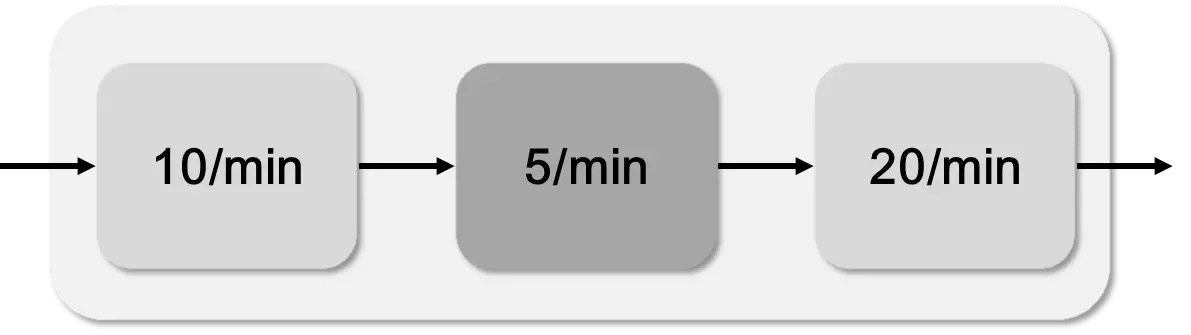
The first machine can process 10 units per minute, the second 5 per minute, and the third 20 per minute. The bottleneck here is the machine in the middle, which is therefore highlighted. In this example, finding the bottleneck is child’s play. In real production processes, of course, it is not that simple, because these processes, as we already know, form a network rather than a simple chain.
The bottleneck is the limiting factor that constrains the entire system. There are two possibilities here: either improve the throughput of the middle machine to 20/min. Then the first machine becomes the limiting factor. Or accept the 5/min and adapt the first and last machines, replacing them with cheaper machines that also run at 5/min. That would reduce costs.
Improving such a sequence is also called process optimization. The important insight is that, in this kind of process optimization, one need only concern oneself with the bottleneck. Improving the other parts would be a pure waste of time. This gives rise to three important questions [Pea15]:
- What does the system look like?
- What is the limiting factor?
- What is the best way to improve this limit?
This sounds very simple, like something from a children’s book, but in practice it apparently is not; otherwise Eliyahu M. Goldratt would not have sold more than 6 million copies of his book “The Goal”.
The Evolution of Bottlenecks
Management consultant Ron Davison used the “Theory of Constraints” to examine human history. In his book “The Fourth Economy”, he described history as a history of bottlenecks among the factors of production [Dav11]. The following table presents the history of these factors:
| Era | Limit | Economy | Intellectual | Institution | Upheaval |
|---|---|---|---|---|---|
| 1300–1700 | Land | Agriculture | Renaissance | Nation-state | Religion |
| 1700–1900 | Capital | Industrial | Enlightenment | Bank | Politics |
| 1900–2000 | Knowledge | Information | Pragmatism | Large corporations | Financial industry |
| Since 2000 | Entrepreneurship | Entrepreneurial | Systems thinking | Individual | Business |
In every age there was a “limit,” a limiting factor of production, and corresponding institutions and organizations that used this factor. Because everyone needed the limiting factor, it often became scarce, and struggles and wars were fought over it. Technological and social progress changed the limiting factor of production. A kind of phase transition then occurred, in which the dominant institution also changed.
Today, all factors are still needed. Economies in different regions, however, use these factors in different proportions. Some parts of the world still depend heavily on agriculture. Other parts, such as major cities and metropolitan areas, depend more on capital and knowledge. Silicon Valley, by contrast, also needs many company founders, so-called “entrepreneurs”.
The following journey through history was compiled from various sources [Dav11, Pea15, BA14, Rid10, Wri01] and Wikipedia.
Land
Let us make a small leap back in time to the first age, when land was the primary factor of production. Agriculture was still simple and technology very basic. The factors of production were land, physical labor, and, for some farmers, an ox for the plow. If no plagues or other diseases occurred, there were always enough people. Land was therefore the limiting factor of production. The more land someone controlled, the richer he could become. Rulers were consequently interested in expanding their landholdings as much as possible. It was the age of the discovery of America, the search for land and natural resources, conquest, and colonial plunder.
The Catholic Church was the dominant power. But this power was crumbling. In England, Henry VIII ruled. He was unable to produce a male heir with his first wife. He wanted to marry his mistress Anne Boleyn, who was pregnant. When the Catholic Church refused him a divorce, he began the English Reformation and founded the Church of England. He made himself its head and expropriated the Catholic Church, having all monasteries looted and demolished. The new dominant institution, the nation-state, abolished the old dominant institution, the Church. Power became secular.
Henry VIII then laid the foundation for England’s further development with new economic laws. He abolished tariffs, standardized weights and measures to improve trade, established legal certainty for property, and limited trade restrictions. More trade makes a better division of labor and specialization possible and, as we have seen, generates prosperity. In 1545 he also permitted interest, which the Catholic Church and the Bible had forbidden. This was the foundation for England’s rise to become the leading nation, a position it retained until the First World War in 1914.
Interest, to add a brief note, expresses the relationship of money at two different points in time. Money is worth X today and X plus interest in one year. If someone has money worth X today, he can invest it himself, for example by buying shares, and in a year make X plus profit. If he lends the money to someone else, he forgoes this profit and wants interest instead. Interest expresses the sacrifice of giving up money in the present. Today, however, the financial system is heavily regulated, as will be explained later in Section 11.3.
Compared with England, Germany was fragmented, inconsistent, and economically handicapped by its patchwork of small states. The Reformation, initiated mainly by Martin Luther, Huldrych Zwingli, and John Calvin from 1517 onward, led, among other things, to the Thirty Years’ War from 1618 to 1648. The Peace of Westphalia in 1648 was an important milestone in the replacement of religious power by secular nation-states, because the Pope was partially deprived of power. Owing to Martin Luther’s “doctrine of the two kingdoms”—that the spiritual and the worldly should be separate—the Church continued over time to lose secular power to the emerging nation-states. The economies of these states were based mainly on land ownership and natural resources. This led to the age of colonialism. Very simplified and abstracted, society had the following structure:
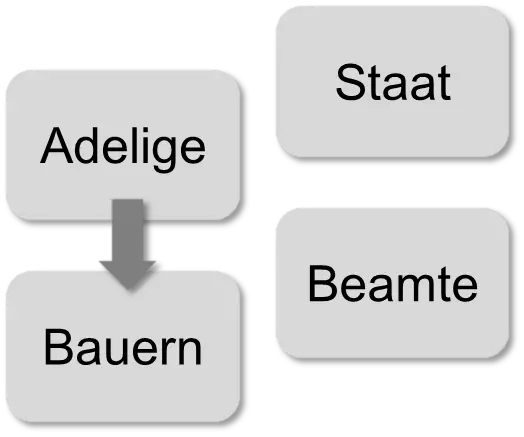
The state was administered by “officials.” The land was largely in the hands of nobles and was worked by peasants. The influence of the Church began to decline. Of course there were also craftsmen, bakers, blacksmiths, and so on at the time, but this is meant to be a very simplified model.
Due to technological development, however, agriculture was slowly displaced by crafts and trade2.
Capital
From 1500 to 1750, the economy was dominated by so-called mercantilism. People believed at the time that there were advantages to “steering” the economy through extensive state intervention. Under mercantilism, there was a so-called guild for every profession. A guild was a kind of interest group and regulated the respective profession in detail. Among other things, the number of approved providers was fixed in order to keep supply artificially scarce and prices artificially high. Jews were often forbidden from joining the guilds, so they had to look for new occupations. They were forced to innovate. Because of the ban on interest, Catholic believers, and also Catholic princes and kings, were forbidden to charge interest. Jews, however, were allowed to do so and therefore founded banks.
From 1700 onward there were many technical inventions. The Industrial Revolution was slowly announcing itself. Mercantilism, however, was bad for the economy. The economy is a complex system and impossible to “steer.” At the same time, nation-states were already poor handlers of money. They therefore often needed loans from banks. Today there are central banks, the Fed in the United States or the ECB in the EU. Through these institutions, states can indirectly “print their own money” by circuitous routes. At that time, however, they still depended on real bankers. The most famous example is the Rothschild family. Nathan Mayer Rothschild (1777 - 1836), for example, financed the Duke of Wellington’s campaigns during the Napoleonic Wars by buying British government bonds. These bonds were then sold within the far-flung family in Vienna, Frankfurt, Paris, and elsewhere. In this way, the wars of the nation-states made the Rothschild family rich [Rid10]. The Rothschild family was an “entrepreneur.”
Even the Prussian king Frederick William III had to borrow money during the wars against Napoleon. What was historically special about this was that Nathan Rothschild made a loan conditional on reforms after the war. It therefore worked according to the principle: “You get the money only if …” A banker was dictating terms to a king; that was something entirely new. The banks were in power. Capital became the limiting factor of production, and the age of “capitalism” had begun.
Important: Bankers became wealthy by financing nation-states. Because states took on debt, banks could profit from it.
Technologically, it was the age of industrialization and great change. By 1769, James Watt (1736 - 1819) had improved the steam engine to the point where it could be used industrially [BA14]. Previously, people had depended on the power of animals and human beings. Now there were factories, mass production, and railways. People’s standard of living rose enormously. This in turn produced strong population growth. Earlier in human history, that had always been a recipe for disaster. Thomas R. Malthus (1766 - 1834) was the first to investigate the problem of “overpopulation.” Any society with strong population growth would later have trouble feeding all those people, or providing enough energy for them, for example in winter. But for the first time in history, enough energy was available to avoid mass death: there was enough coal that could be converted into energy in steam engines [Rid10]. Of course this also caused great pollution, but “alternative” energies had not yet been invented. And people in the past thought only of survival.
The many inventions produced many changes. Not all parts of the economy changed at the same pace. Some parts were legally protected against technological innovation and change. There were winners and losers. The losers usually demand that the new be banned, or at least curtailed.
In a society, those who command the most important factors of production have the most say. In the first age, when land was the most important factor, these were the large landowners, that is, the nobles whose land was worked by peasants. The nobles lost influence to bankers and entrepreneurs when capital became the limiting factor. The entrepreneurs in turn employed workers in factories. Society now looks, in simplified form, like this:
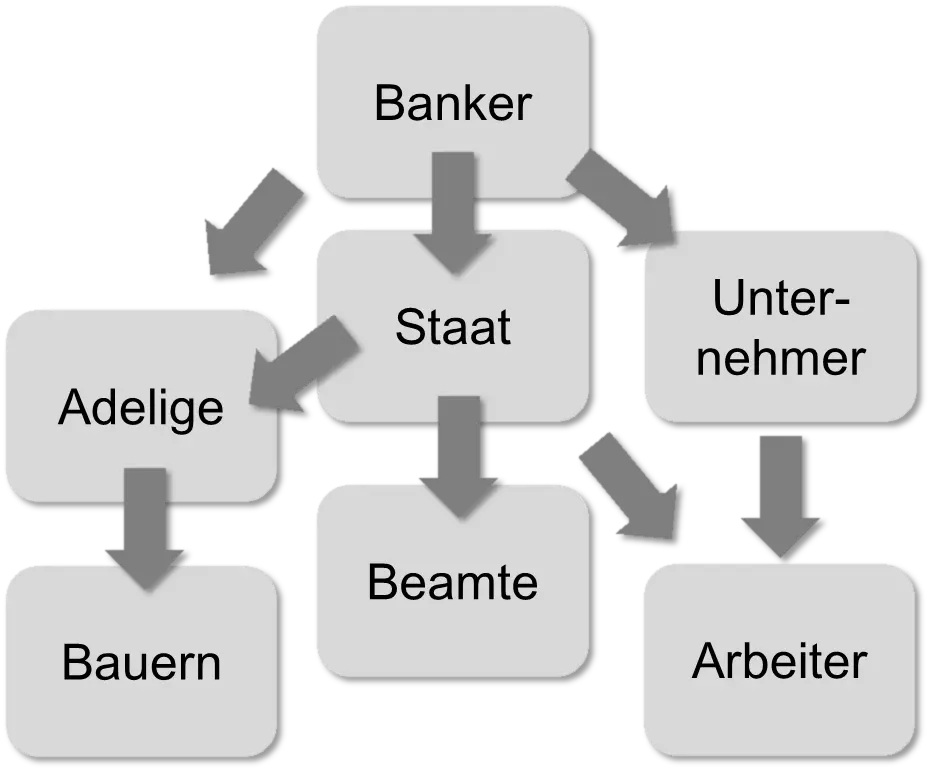
And we can already see that society has become more “complex.” Bankers had different degrees of influence on the other groups. But they were important to everyone because they could lend capital. The important point here is that the nobles, the bankers, the state, and the entrepreneurs were in competition with one another. Power was distributed among these “interest groups.” And there were, of course, bitter “struggles” among these groups.
Technological progress was immense, but operating a factory did not yet require much knowledge. One could buy machines and simply copy production processes. It really was the age of “capitalism,” because capital was the most important factor of production. Looking back today, industrialization is often described negatively: child labor, pollution, and exploitation. People also speak disparagingly of “Manchester capitalism” (often, among Germans, with an undertone of envy because Great Britain was so far ahead at the time). Conditions were of course worse than today; that is easy to see by looking at the main factors in Ian Morris’s “Social Development Index.” But people were often better off than before industrialization, and there were many more people than before [Rid10]. Unfortunately, photography emerged only with industrialization, so humanity has no objective means of comparison with the pre-industrial period.
A worker’s working conditions and wages are determined by his “productivity.” Productivity expresses what value is created in a certain amount of time. This productivity, however, depends on society as a whole. A worker can be only as productive as the machines that support him. The factory depends on transport links and transport options, the number of qualified workers, and so on.
Important: Increasing productivity is an “economic network problem.”
And from today’s perspective, workers’ conditions were very poor because productivity was still very low. Frederick Winslow Taylor (1856 - 1915) provided one example of improving workers’ conditions; he was the first to study workers’ workflows in detail and improve them [Dru94]. Today we would call this “increasing worker productivity.” If workers can accomplish more with the help of machines, better workflows, or better working conditions, they can also be paid more. Taylor called his method “Scientific Management,” and his goal was for workers to benefit from productivity improvements.
At this time, however, various “counter-movements” also formed, aiming at a better society and economy than “capitalism.” These “counter-movements” mainly had the unconstrained vision and tried to solve the economic problem by political means. Karl Marx and Friedrich Engels, for example, wrote the “Communist Manifesto” in 1848. Marx and Engels divided society into two classes that opposed one another and had different interests: the “capitalists” and the “proletariat” of workers and peasants. Unfortunately, they overlooked the roles of the state, the workers, business owners, nobles, and entrepreneurs. Reducing society to two classes is not an accurate model of the society of that time.
Knowledge
But progress generated further progress. In the second half of the 19th century, electricity and internal combustion engines appeared. During the 20th century, the “complexity” of companies, products, and manufacturing processes steadily increased. Simple factories with simple machines became complicated plants. Karl Marx had still feared that workers would become “stupid” because they had to perform ever simpler tasks. Yet technological progress produced complicated machines whose operation and repair already required a considerable amount of knowledge [BA14, Rid10].
Eventually, knowledge became the limiting factor. Management consultant Peter F. Drucker proclaimed “post-capitalism” in 1994 [Dru94]. Capitalism was over. Drucker identifies the “G.I. Bill of Rights” of 1944 in the United States as the starting point; it gave soldiers returning from the Second World War the opportunity to study. Thirty years earlier, after the First World War, this would have been unthinkable, because there were not even enough jobs for people with university degrees. Another milestone came in 1975, when the International Business Machines Corporation (IBM) simply changed banks for a large transaction. At the time this was a sensation. Today, companies compare bank offers and choose the cheapest one for each transaction. Companies have since gained a higher status than banks. In the competition among interest groups, companies had caught up with banks. Knowledge had replaced capital as the limiting factor.
We live not only in a “knowledge and information society,” but also in a “knowledge and information economy.” Of course there are still “capital-intensive” industries in which capital is more important than knowledge. Land is also still needed for agriculture. But knowledge became the limiting factor. Digitalization and the internet have further increased the importance of knowledge. Facebook, for example, is now worth several billion dollars, but started with only 500,000 US dollars of external debt capital. That is less than the price of a condominium in a good location in a major German city. With little capital and the right knowledge, then, one can earn a great deal of money.
Entrepreneurship
Turning knowledge into money, or translating knowledge into concrete products, is the task of the company or the entrepreneur. Peter F. Drucker also provided early signs of the importance of business formation in his 1985 book “Innovation and Entrepreneurship” [Dru85]. The word “entrepreneur” is used in different ways. For Peter F. Drucker, a businessperson is an “entrepreneur” if he does something valuable and new. In his view, an entrepreneur need not be a small company; he also gives the fast-food chain McDonald’s as an example. According to Drucker, an entrepreneur need not even have commercial intentions, since he also counts Wilhelm von Humboldt (1767 - 1835), who “invented” the modern university in 1809. An existing company can also act as an “entrepreneur” if it “invents” something and brings it to market. An “entrepreneur” is therefore an “inventive” businessperson or an “inventive” company. In German, however, the word “entrepreneur” sounds slightly snobbish. Yet the German word “Unternehmer” also has a negative undertone. It is associated with rich men sitting in executive suites in large office chairs, dressed in suits and ties. That sounds too little like innovation, inventive spirit, experimentation, and garage companies. Was Steve Jobs an Unternehmer or an entrepreneur? The first Apple computer was built in a garage. This “entrepreneurial spirit” is not present in the German word “Unternehmer.” Since there is no better word in German, this book therefore also uses “entrepreneur.”
According to Ron Davison, “entrepreneurship” is the bottleneck among the factors of production in the United States today [Dav11]. Knowledge is still scarce, but not as scarce as “entrepreneurial knowledge.” Logically, this is not entirely clean, because “entrepreneurship” is knowledge about companies and therefore a subset of “knowledge.” But there is nevertheless some truth in it. In Southern Europe, for example in Spain and Greece, youth unemployment is high today. Jobs are lacking. Existing companies must create new jobs, or new companies must emerge. There are only two possibilities here: either it is too difficult in these countries to found a company because of legal requirements, or there is a lack of people with knowledge of “entrepreneurship.”
In Germany there are several very strong international companies that contribute greatly to economic output. According to journalist Olaf Gersemann, in 2013 the three companies BMW, Daimler, and Volkswagen alone contributed a good quarter of the profits of the 30 DAX corporations, around a third of their revenues, and almost half of their spending on research and development [Ger14]. In Germany, therefore, large parts of the economy still function without “entrepreneurship.” The large companies pull many people along with them. In other countries, where successful large companies are lacking, this is not the case.
“Entrepreneurial knowledge” cannot be taught purely theoretically at universities or schools. Practical experience is necessary. It is also important that society permit failure. In the United States, many company founders succeed only with their third or fourth startup. They try several business ideas until one works. In many countries, including Germany, the importance of “entrepreneurship” has been recognized. But the focus is often on support with capital (so-called venture capital) or help with legal questions. The limiting factor of production, however, is “knowledge about entrepreneurship.” In school in Germany, one does not learn how to found one’s own company, but only how to become a good employee or worker 3.
-
More information about Ötzi: http://www.mummytombs.com/main.otzi.html. ↩
-
Land today plays only a minor role in politics in Germany. When a “wealth tax” is mentioned, real estate is usually not included. For socialists and communists, land reform was a primary goal before 1918. A fair distribution of land was to be achieved. This did not happen in Germany after both wars: not in 1918 and not in 1949. This is an indication that land was no longer seen as an important factor of production. Today in Germany, large landholdings are even indirectly subsidized in the context of alternative eco-energy: with each wind turbine, one can earn a lot of money through artificially fixed electricity prices. The more land someone has, the more wind turbines can be built. From this perspective, green electricity is therefore not “socially just” at all. ↩
-
In Germany, it was discussed in 2015 whether a subject “Economics” should be introduced in schools. Immediately there was an outcry in the media. The trade unions said “Social Science” would be more important. But if economics is not taught in school, then economic knowledge is “inherited”, i.e., passed on from parents to children. Children from “economically ignorant” families do not learn it in school and also not in the family. This results in greater disadvantage. ↩