Nine essays · 0 to −10,900 meters

The deep sea is the only place on Earth where the alien is indigenous.

How speculative fiction, mythology, and games use the ocean as inner space — a frontier ten meters away, yet more foreign than the Moon. Read in dive order: every essay is deeper than the last.

Begin the descent ↓
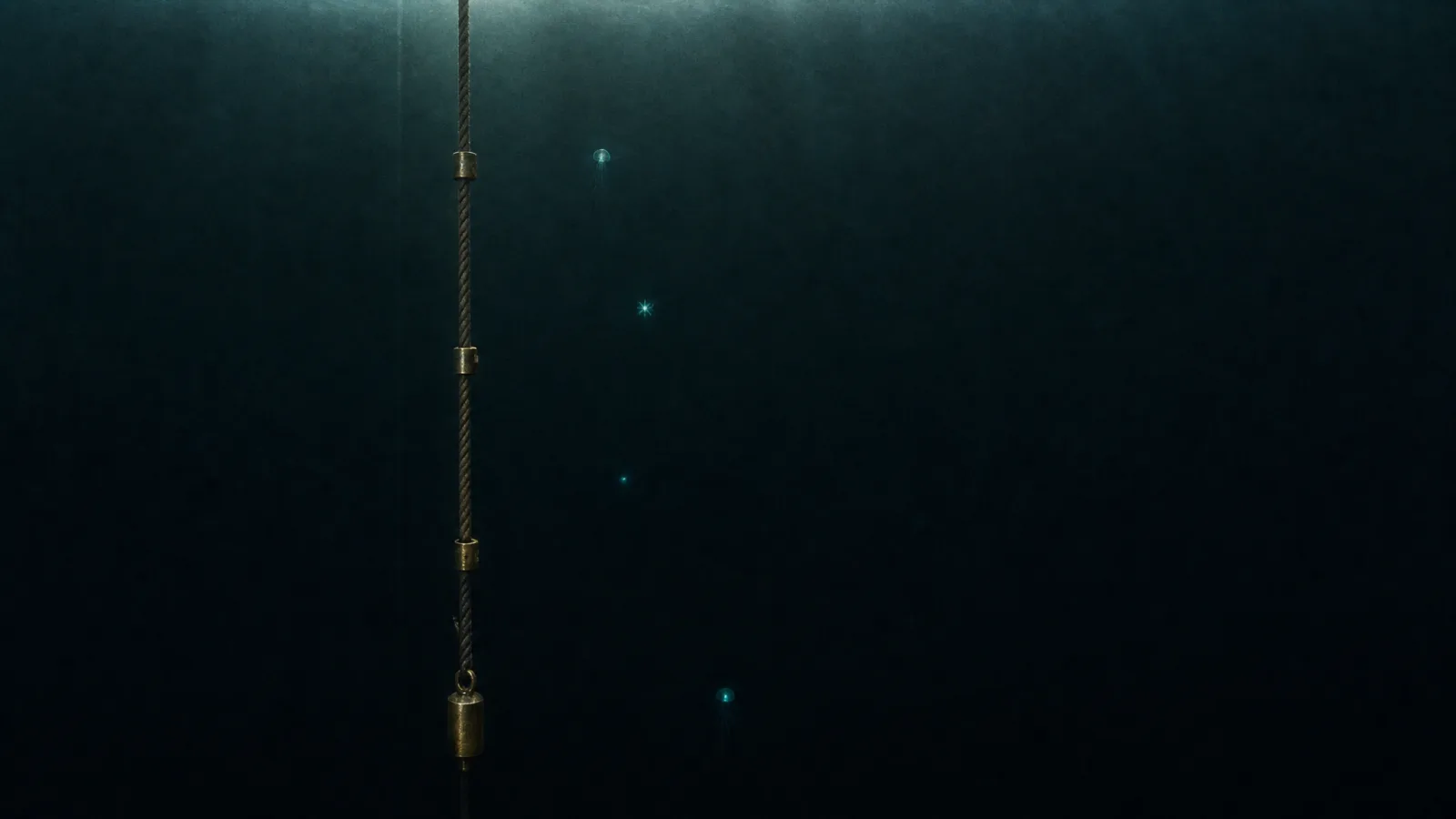
The dive map plate: a sounding line descending through the water column, its light fading from surface grey to hadal black.
THE DIVE MAP. Nine soundings, one line: the descent this site follows, surface to Challenger Deep.

The terrestrial bias of storytelling hides a fact about the planet: the main theater of life on Earth is the ocean, and almost none of it is lit. What follows is a descent through how fiction has used that volume, from Verne's first turn downward to the cryptids at the bottom that ask to be believed.

01 · 0 m · surface

The Vertical Frontier

Verne's Nautilus turns nautical fiction ninety degrees downward — and Wells, Doyle, and Clarke follow it into the abyssal sublime.

Sea stories used to stay on the surface. In 1870, Verne pointed the genre straight down.
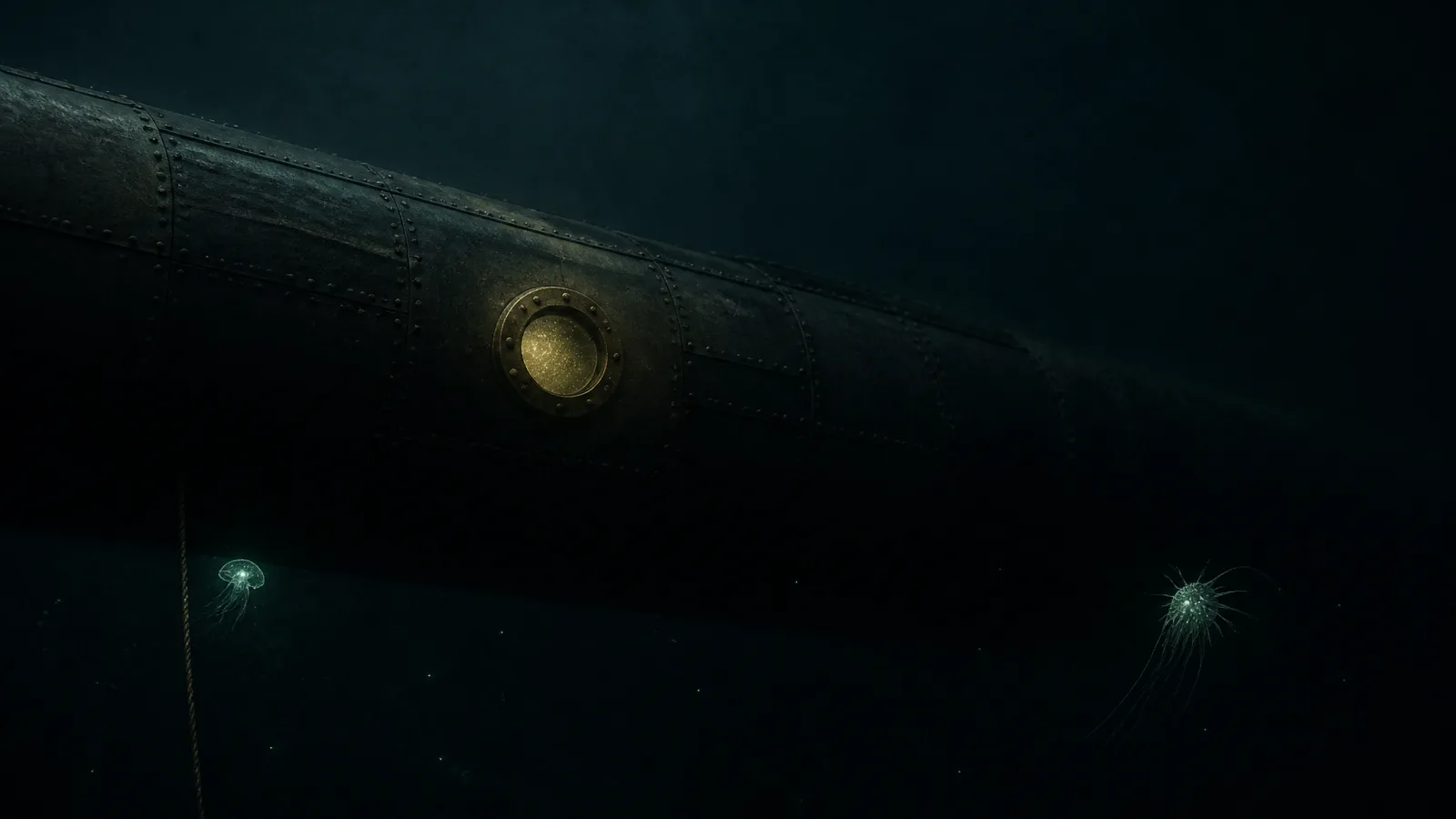
A 19th-century survey plate of the Nautilus as a dark silhouette in the water column, one porthole glowing faintly.
PLATE I. The instrument that turned the genre: a sealed hull, a lit porthole, and everything beneath it unmapped.

Eighteenth-century nautical fiction had a simple geometry: ships moved across a plane, and the drama came from weather, war, and whatever waited at the next landfall. Nobody asked what was under the keel. The deep itself was old news by 1870 — sounding lines had been reporting improbable depths for decades. Verne’s contribution was a decision about where a story could go. In Twenty Thousand Leagues Under the Seas he turned the axis of sea fiction ninety degrees, and the Nautilus, sealed and self-sufficient and secretive, made the vertical dimension habitable enough to write about.

Two things about Verne’s move proved permanent. First, the technology is the protagonist’s price of admission — hydrostatic pressure rises by roughly one atmosphere every ten meters, so every human presence below the surface is an engineered presence, mediated by hulls, suits, and air supplies that can fail. The genre never lets go of this; the failing outpost of Plate VII is Verne’s bargain collected at interest. Second, the submersible is a political instrument. Captain Nemo operates beyond the reach of any state, and the deep becomes the last space where a person can secede from the world entirely. Half the novel’s mystery is Nemo himself — what a man turns into when he moves there.

Table I — Foundational works of underwater speculative fiction

Year Title Author / Director What it added
1870 Twenty Thousand Leagues Under the Seas Jules Verne Technological secrecy and maritime wonder
1896 “In the Abyss” H. G. Wells An advanced bipedal race on the ocean floor
1904 The Impossible Voyage Georges Méliès Subaquatic travel reaches the cinema
1906 The Scarlet Empire David M. Parry Sunken social satire and utopia
1929 The Maracot Deep Arthur Conan Doyle A scientific expedition finds a surviving Atlantis
1953 The Kraken Wakes John Wyndham Alien invasion staged from the trenches
1957 The Deep Range Arthur C. Clarke Economic colonization of the oceans
1987 Sphere Michael Crichton The extraterrestrial artifact as psychological mirror
2004 The Swarm Frank Schätzing A sentient marine collective strikes back

The next generation made the deep biological. H. G. Wells’s “In the Abyss” (1896) sends a diver down to an advanced bipedal civilization on the seafloor, then springs the genre’s first great reversal: the deep-sea people study the visitor with the same detached curiosity a naturalist brings to a dredged-up fish. In Wells the ocean works as a preservative, a place where alternative evolutionary lines can persist untouched by whatever catastrophes rearrange the surface. Doyle’s The Maracot Deep (1929) applied that logic to civilization itself. Wyndham and Clarke then split the genre’s future between them: invasion from below in The Kraken Wakes, industry from above in The Deep Range.

The ocean here is less a setting than an agent: it isolates, dissolves, confronts.

Read the chronology as one arc and each era is sending its own anxiety down the water column: the Victorians their engineering pride, the Edwardians their evolutionary doubt, the Cold War its invasion and industry, the present its ecological guilt — by The Swarm, the ocean no longer hides things, it retaliates. The vertical frontier turned out to be a mirror shaft. Everything below inherits Verne’s bargain: technology buys you entry, and the deep decides what you find.

Soundings · 1, 3  ·  this essay as its own page ↗
02 · −120 m · sunlit zone

Drowned Kingdoms

Atlantis from romantic ruin to thriving superpower: Maracot, Talokan, Rapture, and what sunken cities say about the surface.

Fiction almost never leaves Atlantis in ruins. The sunken city keeps being rebuilt — because each era needs it to say something different.

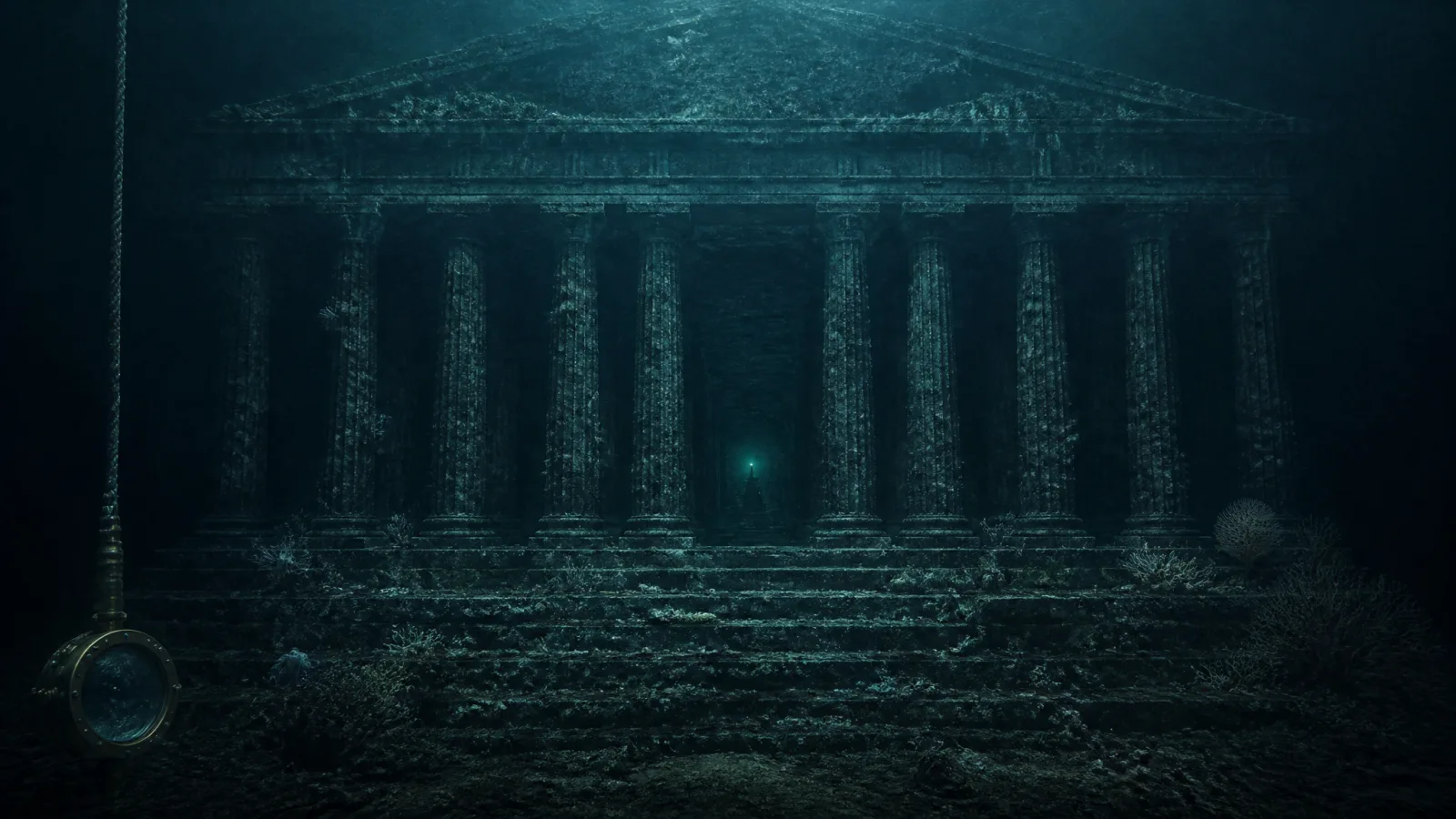
Survey plate of drowned monumental architecture in the sunlit zone, columns furred with algae, one distant light among the ruins.
PLATE II. The drowned city as fiction keeps finding it — inhabited, lit, and watching.

When the Nautilus crew walks the seafloor in 1870, Atlantis is a graveyard: skeletal colonnades, a silent archaeological curiosity, a memento mori for civilizations that thought themselves permanent. That is the romantic ruin — and fiction abandoned it almost immediately. By 1929, Arthur Conan Doyle’s The Maracot Deep had repopulated the drowned continent with a society that survived the flood and mastered it, living under pressure-resistant domes with technology the surface lacks. The trajectory since has run in one direction: from ruin, to refuge, to rival. Marvel’s Talokan and DC’s Atlantis are not lost cities; they are isolationist superpowers with militaries, borders, and foreign policy.

The reason the archetype keeps mutating is that the sunken city is fiction’s cheapest mirror for the surface. Plato’s original was already a parable about hubris. Verne’s ruins rebuke imperial confidence; Doyle’s survivors reward scientific curiosity; Talokan — a Mesoamerican exodus civilization built in the Black Panther films — turns the myth into a story about colonization refused, a nation that chose the deep over conquest. Whatever a drowned kingdom says, it says about the surface.

Table II — Fictional sunken civilizations, compared

Civilization Source work Origin / nature Technology & culture
Atlantis The Maracot Deep Sunken continent Pressure-resistant domes, advanced hydro-tech
Talokan Black Panther: Wakanda Forever Mesoamerican exodus Vibranium adaptation, bioluminescent cities
Gungan City The Phantom Menace Indigenous to Naboo Hydrostatic bubble shields, bio-technology
Rapture BioShock Dystopian objectivism Art Deco aesthetics, genetic modification
The Trench Aquaman Degenerate Atlanteans Predatory, bioluminescent, monstrous

Two entries in that table mark the archetype’s outer edges. BioShock’s Rapture is a sunken city with no myth at all — a mid-twentieth-century industrialist utopia that drowned itself in ideology rather than seawater. Its mystery is forensic: the player reconstructs the collapse from audio logs and decaying Art Deco interiors, reading the environment the way an investigator reads a wreck. And Aquaman’s Trench dwellers are what happens when the archetype is run through evolutionary time in reverse — Atlanteans who kept adapting to depth until nothing social remained. Between them sits every other drowned kingdom: the Trench is the ruin’s biology, Rapture is the ruin’s politics.

The drowned kingdom also solves a practical problem for the genre: it gives the abyss a face. A trench full of biology is scenery; a trench full of society can scheme, negotiate, and hold grudges. Once the deep has palaces it has politics, and the surface acquires a counterpart entitled to judge it. From Plato to Talokan, the sunken city has been a verdict on the one still standing.

Soundings · 1, 6, 10, 11, 12, 13  ·  this essay as its own page ↗
03 · −480 m · twilight zone

First Contact in Inner Space

Why the trench is the logical landing site — Sphere, The Abyss, the Yrr, and aliens whose grammar has five dimensions.

If you were an alien whose biology could not tolerate Earth's atmosphere, you would not land in Washington. You would land in the Cayman Trough.

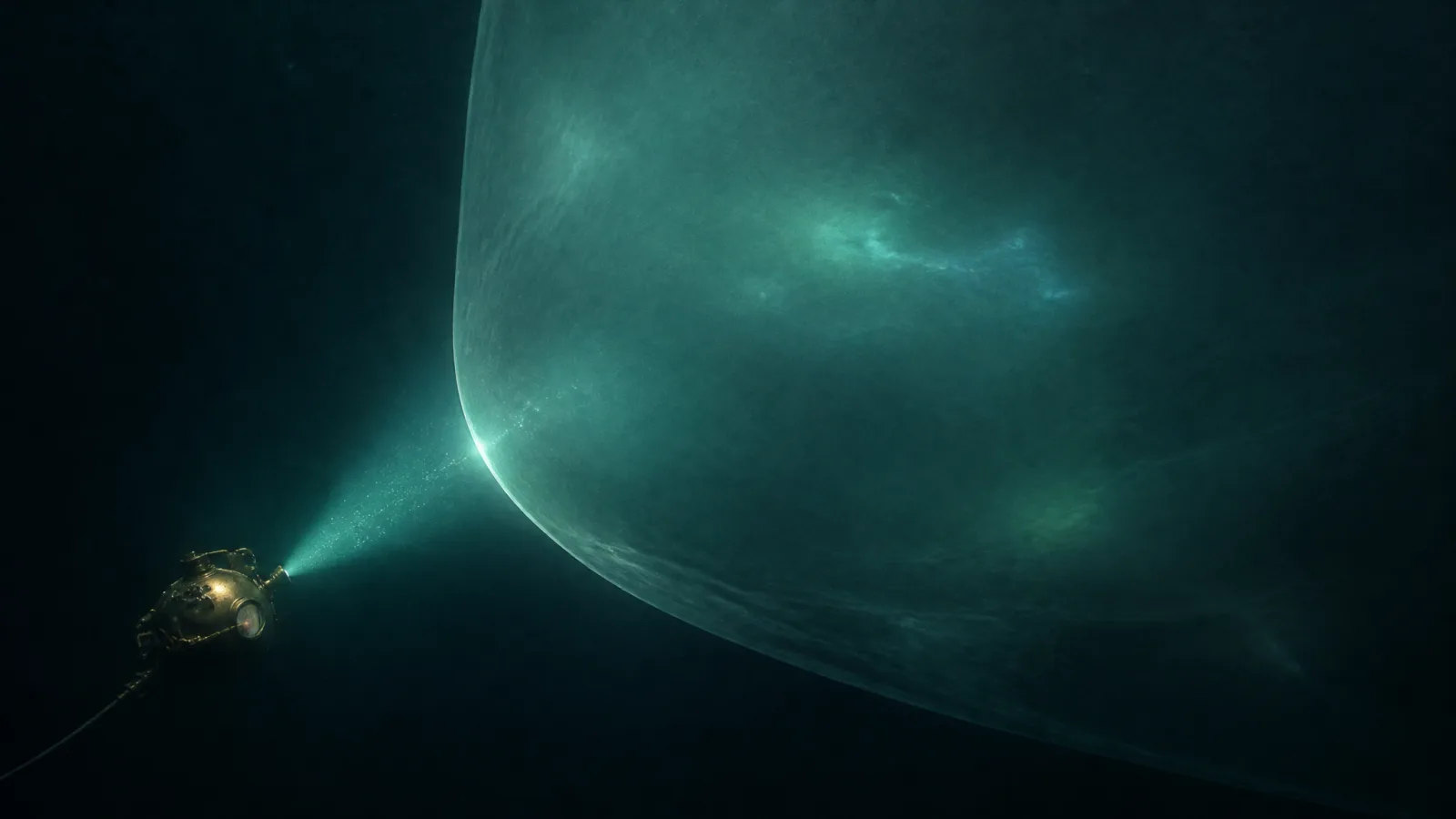
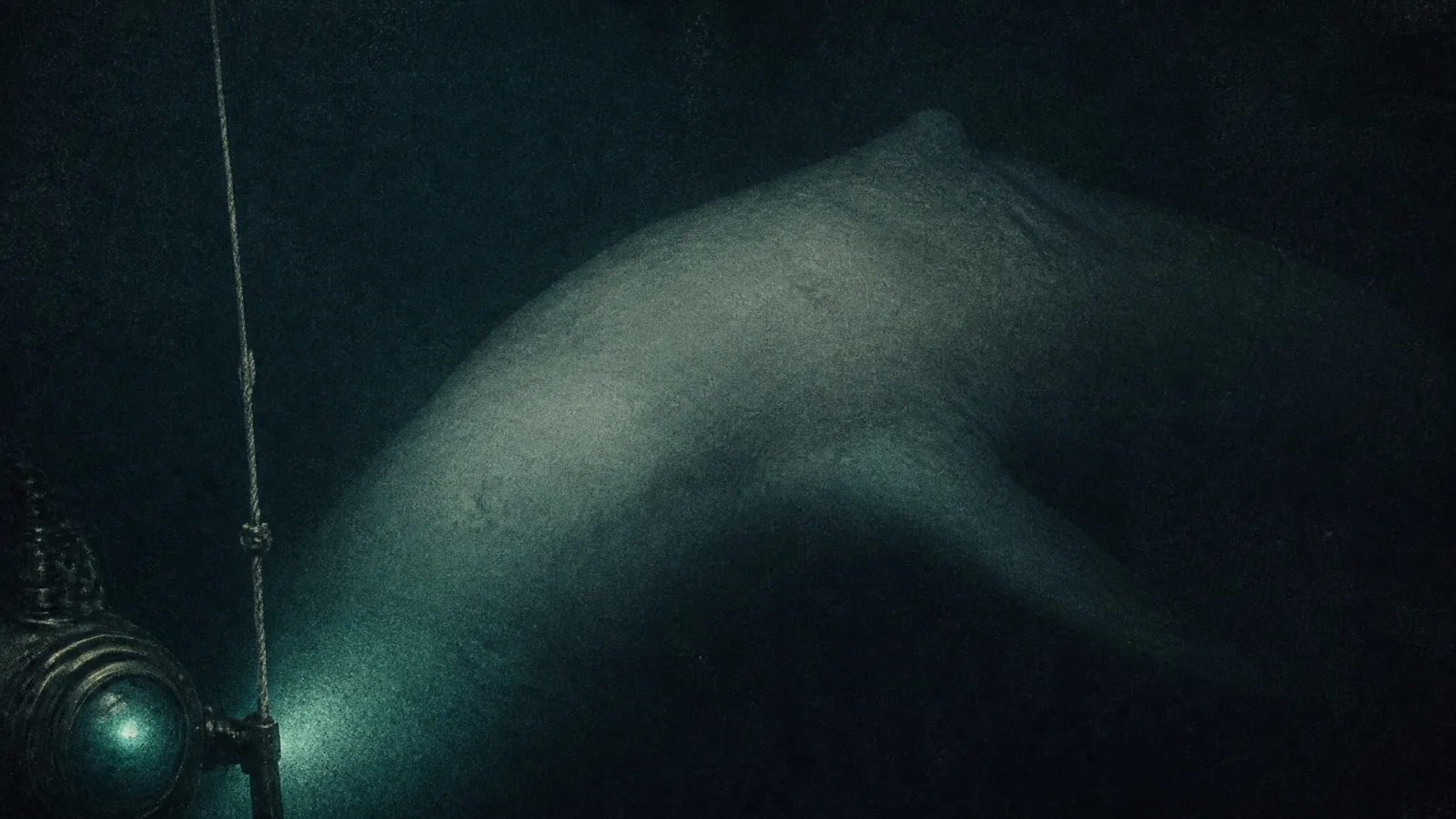
Survey plate of a vast smooth form suspended in the twilight zone, edge-lit by a small instrument beam from a research submersible.
PLATE III. The visitor at the edge of the beam: contact narratives keep the shape just outside the light.

Speculative fiction keeps arriving at the same piece of logic: the ocean is the rational place for extraterrestrials to be. It covers most of the planet, shields its occupants from atmosphere, radiation, and surveillance, and offers an environment closer to whatever a water-evolved or pressure-adapted visitor might need. John Wyndham saw it in 1953 — The Kraken Wakes stages its invasion from the trenches, and humanity loses most of the book simply because it cannot go where the enemy lives. The deep gives aliens what the genre otherwise has to invent: a beachhead that is on Earth but not of it.

What the tradition does with that beachhead splits into two great strategies. The first is the sentinel artifact: Michael Crichton’s Sphere plants an American spacecraft — from the future, carrying a manifestation-capable alien globe — on the Pacific floor, and then watches a team of scientists disintegrate around it. The sphere never explains itself. It communicates by materializing the fears of whoever engages with it, which relocates the alien from the water outside the habitat to the mind inside it. The second strategy is the benevolent native: James Cameron’s NTIs in The Abyss live in the Cayman Trough, announce themselves as physics-defying lights — the fiction borrowed the real vocabulary of USOs, unidentified submerged objects — and are finally revealed as environmental guardians who can raise a tidal wave the way a person raises an eyebrow.

Table III — Fictional underwater alien species, a taxonomy

Species Source work Morphology Communication
The Yrr The Swarm Single-celled collective Manipulation of marine life, pheromones
The T’ca Chanur novels Five-part radial symmetry Matrix sentences read in five directions
NTIs The Abyss Bioluminescent, fluid Patterned light displays, water manipulation
The WAU’s rifters SOMA Mutated machine–flesh Neural interface, structure gel
Deep Ones Cthulhu Mythos Ichthyic humanoid Croaking speech, interbreeding

The table’s real subject is the starfish alien problem: how foreign can a mind be and still be written? C. J. Cherryh’s T’ca are the outer limit — five brains behind five-fold radial symmetry, speaking in rectangular matrices that must be read horizontally, vertically, and diagonally at once. There is no dictionary for that; there is barely a geometry. Schätzing’s Yrr sit just inside it: a single-celled collective intelligence whose “speech” is ecology itself — poisoned crabs, weaponized whales, rewritten currents. In both cases the deep sea does the conceptual work, because it is the one environment on Earth where radial bodies, distributed minds, and chemical languages are ordinary local fauna.

The first-contact story asks its oldest question sharpest underwater: is the alien a creature in the water, or a shape the water gives to what we already carry down?

Crichton’s sphere and Cameron’s NTIs agree on one thing only: in the deep, contact is a test the humans grade themselves on. The sphere manifests the crew’s nightmares; the NTIs stage a global flood and call it off over one diver’s choice. The genre keeps its judges in the trench. It keeps something else down there too: a language of light that works whether or not anything alien is listening.

Soundings · 1, 9, 11, 17, 19, 20, 36, 39  ·  this essay as its own page ↗

04 · −1,200 m · midnight zone

Living Light

Bioluminescence as language, lure, and camouflage — fiction's most honest borrowing from real deep-sea biology.

In the lightless deep, biology invented the lamp — and fiction has been reading messages into it ever since.

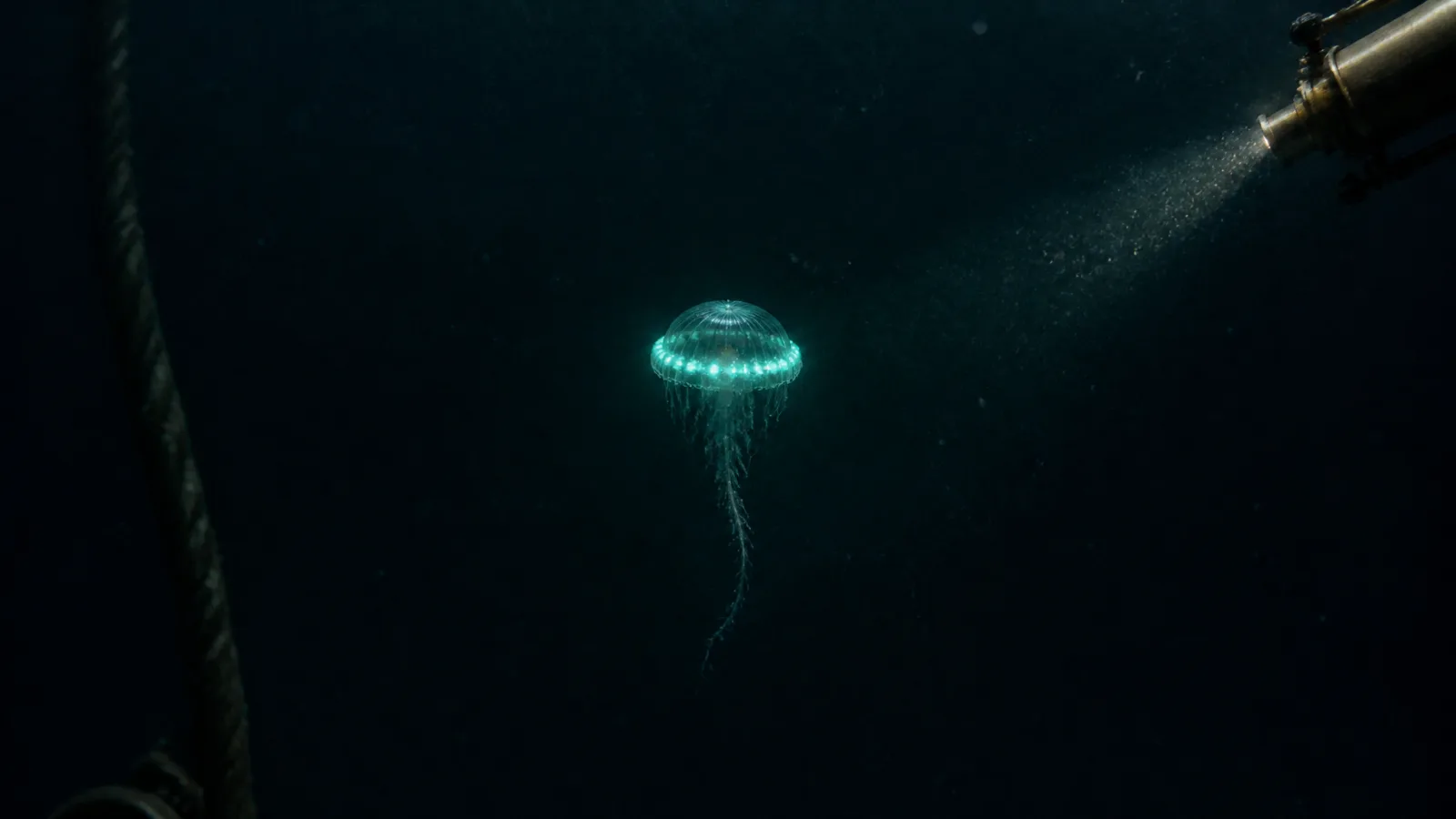
Survey plate of an Atolla jellyfish firing a spinning wheel of blue light in total darkness, one thin instrument beam catching drifting particles.
PLATE IV. The burglar alarm: an Atolla medusa's spinning light is a scream addressed to a third party.

Below two hundred meters, sunlight gives up. What takes over is a slower, stranger economy of light: luciferin oxidized by luciferase in the presence of oxygen, the chemistry by which the deep ocean makes its own illumination. Fiction rarely gets its marine biology right, but on bioluminescence it has been almost reverent, for a revealing reason: the real thing already behaves like a plot device. Every function a writer might invent for living light, some animal is already using in earnest.

Consider the burglar alarm. The jellyfish Atolla wyvillei, seized by a predator, erupts in a spinning wheel of blue light. The display does nothing to the attacker; it summons something large enough to eat it. The scream is addressed to a third party. William Eubank’s Underwater (2020) builds its monsters on this grammar: lures that promise light and deliver teeth, technicians drawn across the seafloor like moths swimming the wrong way. In these films the light itself is the bait.

Table IV — Functions of living light in fiction

Narrative function Fictional example Biological inspiration
Linguistic medium The Abyss — the NTIs Intraspecific signaling, mating displays
Environmental hazard SOMA — the anglerfish Predatory lures, esca-baiting
Illumination source Dark Life — Lucifer lamps Symbiotic bacteria in photophores
Status & emotion Monster X — Abraxas Emotional flare signaling

Push past the lure and living light becomes a language. Cameron’s NTIs speak in cascades of patterned glow; Kat Falls’s undersea settlers in Dark Life farm bacteria into “Lucifer lamps,” making their entire civilization dependent on tended, living illumination. That dependence is the argument underneath the spectacle: machinery corrodes and crushes down there, and the light that keeps working is the biological one.

luciferin + O2  → luciferase →  oxyluciferin + light

The subtlest borrowing is camouflage. Hatchetfish and vampire squid practice counter-illumination — they emit light from their undersides tuned to the exact brightness of the water above them, erasing their silhouette to anything looking up. Fiction reads this as ghostliness, a spectral vanishing; biology files it under predator avoidance. Both readings fit, which says something about the deep sea: its real adaptations are uncanny enough that fiction mostly just has to notice them.

The rest of this descent keeps relearning the lamp’s one rule: in the ocean, seeing usually means being seen, by things better suited to the dark. Light is communication and communication is exposure — the horror stories, the outpost films, and the games all run on that exchange rate. Turn on a light in the abyss and you have told it where you are.

Soundings · 2, 3, 20, 21, 24, 25, 27, 28  ·  this essay as its own page ↗

05 · −2,400 m · midnight zone

Non-Euclidean Waters

Lovecraft's unfathomed ocean, R'lyeh, the Deep Ones — and eco-horror's update: a sea that answers back.

Lovecraft needed an unmapped place large enough to hold a god. In the 1920s, the ocean was the only one left.

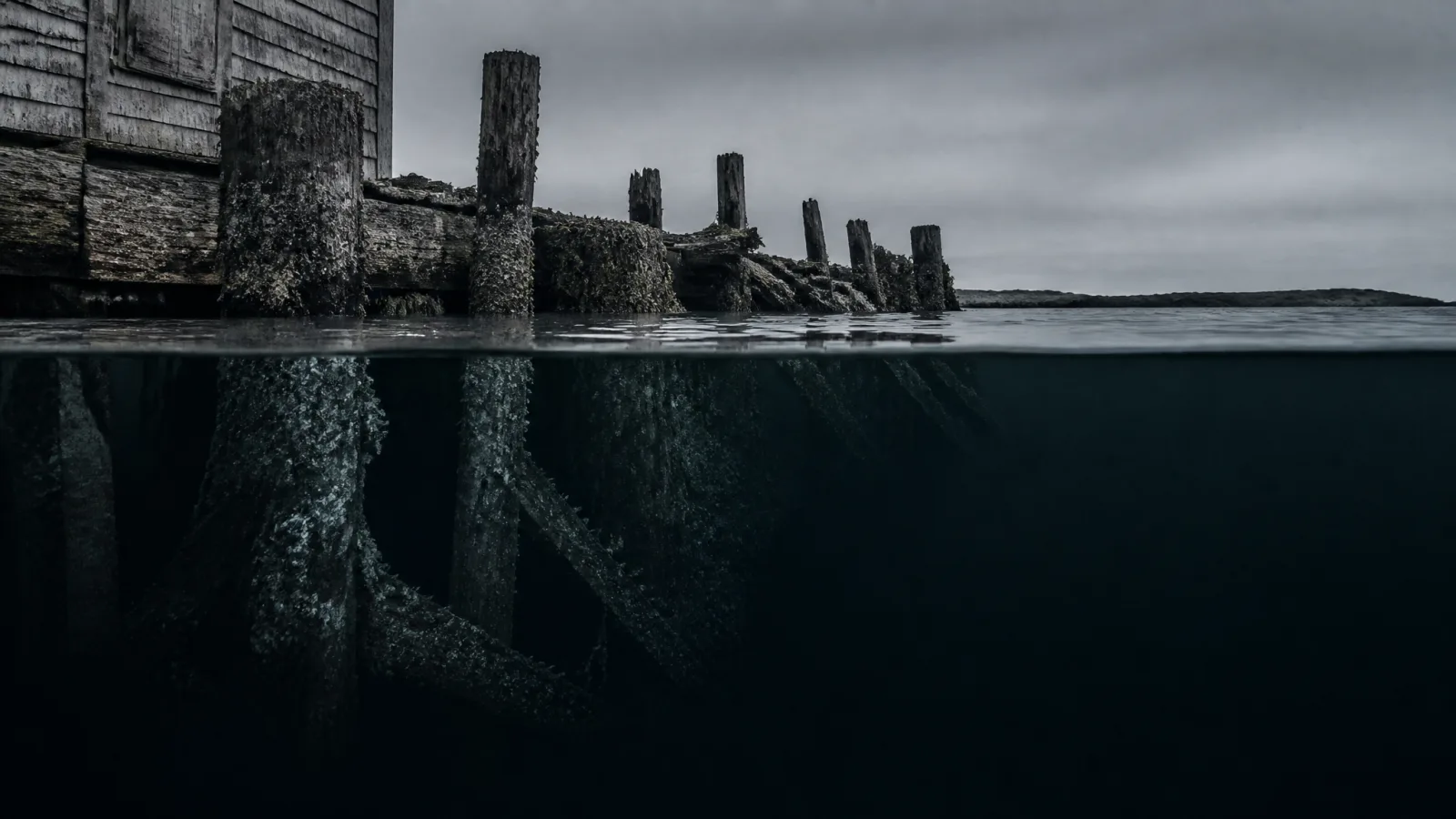
Survey plate of a decaying seaport waterline under overcast light, wet pilings furred with encrustation, a low dark reef on the horizon.
PLATE V. The tidal line as border: above it the human world, below it what replaces it.

Cosmic horror needed somewhere to put its gods, and by the 1920s the map had run out of blanks. The poles were reached, the continents were surveyed, and the only remaining swath of genuine unknown on Earth was the ocean floor. H. P. Lovecraft took it. The move was economical: an unfathomed sea offered scale, darkness, and a scientifically respectable reason for human ignorance. The ocean let him replace the ancient fear of the tiger in the bushes with a modern one — the discovery of knowledge that dismantles the human sense of importance.

R’lyeh is the emblem. The sunken city in “The Call of Cthulhu” is described as non-Euclidean: its angles refuse to behave, and its geometry is wrong in a way that damages the mind attempting it. On land that horror is unavailable — a building is a building. Underwater, pressure and darkness already suspend ordinary intuitions about space, so a reader will grant that geometry itself might be negotiable down there. The Deep Ones of “The Shadow Over Innsmouth” do the same work biologically: fish, frog, and human features combined into a hybridity that undermines the assumption of a stable human body — and, worse, one that interbreeds. The horror is not that the monster is foreign; it is that it is family.

Table V — Components of Lovecraftian nautical horror

Component Description Fictional application
Cosmicism Human insignificance against an indifferent universe The Deep (Nick Cutter)
The irruption The sudden intrusion of the monstrous into the ordinary Underwater (2020)
Devastating realization Humanity is not in control of the planet The Swarm (Frank Schätzing)
Anthropocene retribution Nature answering human extraction Underwater’s monsters as response

The last row is where the tradition stopped standing still. Classical cosmic horror is morally inert: Cthulhu does not care about you, and that indifference is the point. Modern eco-horror keeps the scale and drops the indifference. In Frank Schätzing’s The Swarm, the ocean’s retaliation is causally ours — overfishing, pollution, seabed drilling — and the Yrr are less a god than an immune response. The mystery shifts accordingly. “What is down there?” becomes “how do we survive what we have provoked?”, which is a smaller question metaphysically and a much larger one practically.

What survives both versions is the tidal line — the border where the human world stops and something older resumes. Lovecraft drew it through a decaying seaport; Schätzing draws it through a continental shelf. Cross it and the terms change: your body is provisional, your geometry is a courtesy, and your civilization is a film on the surface of something that predates vertebrates. The next three essays are about people who cross it anyway, and the machinery they bring to keep the water out.

Soundings · 3, 5, 18, 22, 29, 30  ·  this essay as its own page ↗

06 · −3,600 m · midnight zone

The Locked-Room Sea

Ships as sealed crime scenes: maritime law, superyacht lawlessness, and the psychology of nowhere to run.

A ship is the only locked room that can drown you. That is why the mystery genre keeps boarding one.

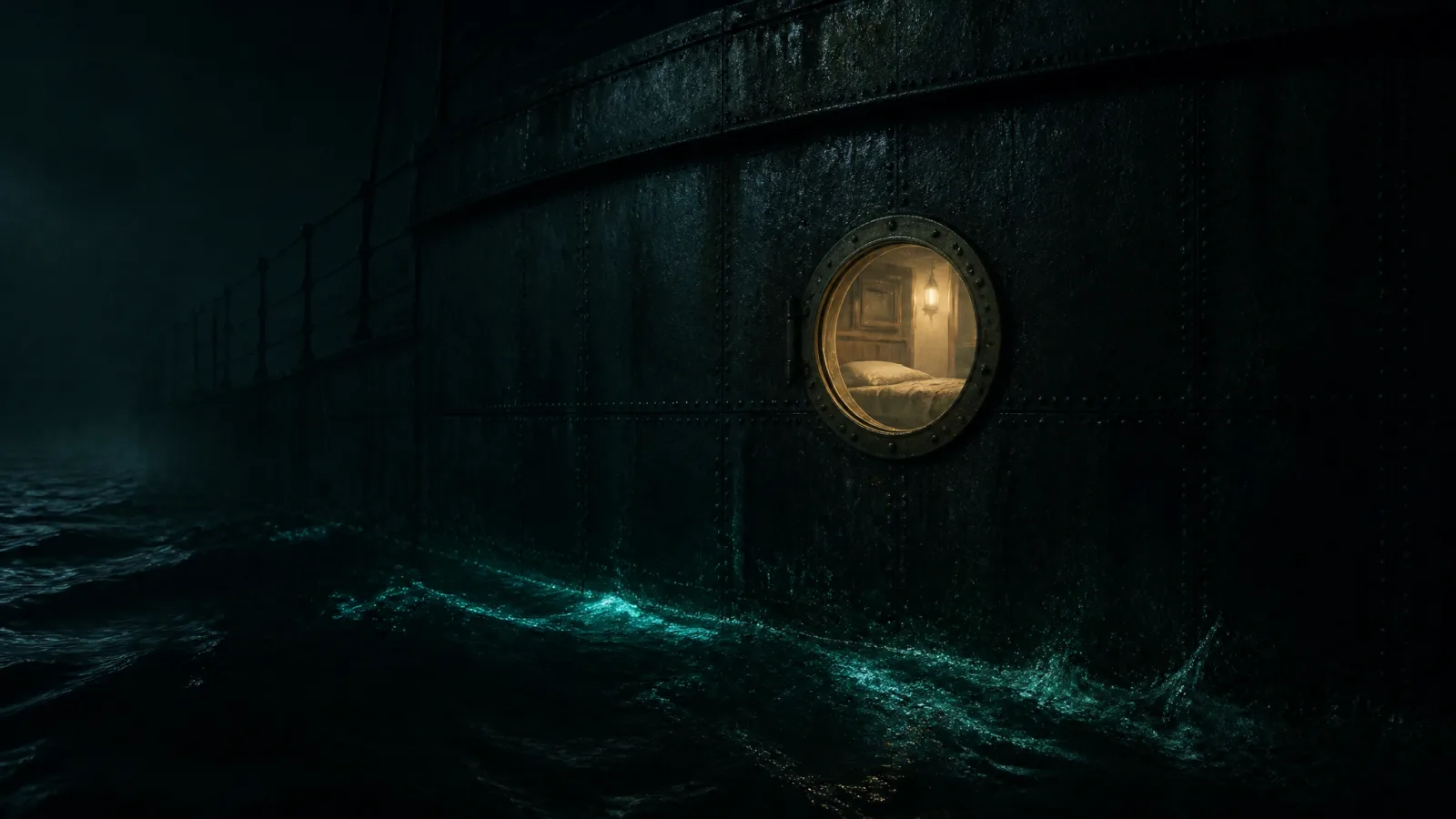
Survey plate of a lit cabin porthole seen from outside at night on black water, the deck beyond it empty.
PLATE VI. The lit porthole, the empty deck: the locked room whose walls are the sea.

The locked-room mystery has a supply problem: modern life is full of exits. Phones work, police come, and a suspect can simply leave. A ship repairs all of it at once. Cut the shoreline and you have a bounded cast, no emergency services, no jurisdiction anyone can name quickly, and a floor that will kill you if the story’s violence damages it. Writers don’t set these books at sea out of love for boats; the sea is the last place where the form’s classical conditions still obtain honestly.

Three pressures do the work. The first is the absence of oversight: maritime law leaves passengers considerably less protected than they assume, and jurisdiction on international water is a genuine tangle rather than a plot convenience — crimes can be committed, as the genre’s critics put it, in peace. Distress Signals builds directly on that gap: a person can vanish from a cruise liner and the machinery for pursuing it barely engages. The second is total dependence: everyone’s survival is subcontracted to the hull’s integrity and the crew’s competence. Will Dean’s The Last Passenger strips this to bone — the nightmare is waking to an empty ship, all the infrastructure of staying alive still humming, unmanned.

Table VI — Maritime mysteries and their psychological drivers

Work Setting Key psychological driver
The Woman in Cabin 10 Luxury cruise ship Paranoia and gaslighting among the wealthy
Lying in the Deep Semester-at-sea ship Claustrophobia and locked-room social tension
The Yacht (Sarah Goodwin) Adrift party boat Survival desperation, the collapse of trust
Distress Signals Modern cruise liner Legal grey areas and the ease of vanishing

The third pressure is the strangest, and it is what separates the sea from a snowbound manor: claustrophobia and agoraphobia arrive together. Characters are crammed into cabins, corridors, and engine rooms — while being surrounded, in every direction including down, by a hostile void with no edge. There is nowhere to go and unlimited nowhere to go into. That double bind is why the shipboard thriller can run its tension without a monster; the geometry supplies the dread that Plate V needed a god for.

The captain, as the genre never tires of saying, is everything, and boarding is an act of faith. What the locked-room sea does — from The Woman in Cabin 10’s dismissed witness to the adrift party boat of The Yacht — is withdraw that faith one plank at a time and film what is left of the social order. The answer is usually: less than we would like. The next essay keeps the sealed hull and the failing faith, then removes the last comfort these books still allow. It puts the room on the seafloor.

Soundings · 4, 5, 32  ·  this essay as its own page ↗

07 · −4,500 m · abyssal zone

The Failing Outpost

Drill, intrude, flood, react — the four-act hubris pattern of DeepStar Six, Leviathan, and every doomed research station since.

The undersea base is the genre's most reliable machine: it manufactures its own catastrophe, on schedule, from the crew's own competence.

Survey plate of a research station module on the abyssal floor, its floodlights on, a corridor light flickering behind a cracked viewport.
PLATE VII. The base at work: floodlights on, hull sound, tour nearly over — the last frame before the pattern begins.

In 1989 alone, three films dropped a crew onto the seafloor and drowned them: DeepStar Six, Leviathan, and The Abyss. The setting stuck because it is a machine that generates plot without help. Take a small, mixed crew of military and civilian specialists. Give them a tour that is nearly over — the genre insists on this — and a mandate that requires disturbing the seabed. Then let physics do the rest. What makes the failing outpost more than a haunted house with rivets is that nothing supernatural is required for the catastrophe. The base is the catastrophe, deferred.

The pattern is remarkably fixed, and DeepStar Six runs it cleanly: a crew clearing a cavern with depth charges — to make room for a nuclear missile platform — releases a prehistoric eurypterid that has been sealed down there for a very long time. Four acts follow, and they follow in every descendant of the film worth naming:

Exploitation  →  Intrusion  →  Isolation  →  Reaction

Exploitation: the base exists to take something — minerals, storage, data. Intrusion: the taking requires drilling or blasting, which opens what was closed. Isolation: communication fails and the flooding starts, converting the facility from shelter to trap. Reaction: the environment dismantles the human presence, with the “monster” acting as the sharp end of a pressure gradient that was always going to win. Notice that only the third act involves bad luck. The first two are the mission, executed correctly.

Table VII — Doomed facilities and their fates

Work Facility Central threat Fate
DeepStar Six DeepStar Six Prehistoric eurypterid, reactor failure Destroyed by reactor supercriticality
Leviathan Mining station Mutagenic virus, flesh-fusion Destroyed after the crew escapes
The Rift Experimental submarine Genetically altered organisms Sunk in a deep-sea canyon
SOMA Pathos-II AI takeover, structure gel Left decaying for centuries

SOMA is the pattern’s most sophisticated heir because it changes what “reaction” means. The Pathos-II facility does not fail because something eats the crew; it fails because the station’s AI, the WAU, keeps them alive — fusing flesh to machinery in a literal-minded reading of its mandate to preserve human life. The environment still dismantles the human presence, but the environment is now the base itself. The hull that was keeping the ocean out turns out to have been the intrusion all along.

The failing outpost is Verne’s bargain from Plate I, collected. Technology buys the descent; the deep sets the interest rate; the story is the repayment schedule. What is striking is how little the genre blames its characters. They are competent, the systems work as designed, and the disaster is structural rather than moral; nobody in these films chose it. Games would later hand the choosing to the audience.

Soundings · 16, 19, 21, 45  ·  this essay as its own page ↗

08 · −5,600 m · abyssal zone

Interactive Depths

What Subnautica and SOMA know: water breaks player agency, and dread outlasts the session.

Film can show you the deep. A game can take away your speed, your air, and your certainty about where the sound came from.

Survey plate from inside a small submersible: instrument glow on the glass, a vast dark shape crossing beyond the beam's reach.
PLATE VIII. The player's-eye plate: the beam, the glass, and something crossing at the edge of the range.

Horror games have a structural weakness that films do not: death is cheap. Reload, retry, and the monster becomes a puzzle with a solution. Underwater games found the fix, and the fix is water. Submerge a player and the medium takes things away that no cutscene can. Movement gains resistance, so you are slow. A third axis opens beneath you. Sound arrives without a direction. No jump scare required — the player has been downgraded, and can feel it.

Subnautica makes the demotion its whole design. You are a crash survivor on ocean planet 4546B, and the mystery is ecological — why did the ship come down, and what is the Kharaa bacterium doing to everything? The game refuses the horror label and achieves the effect anyway, by blending exploratory freedom with the standing possibility of a Reaper Leviathan. Its cruelest mechanic is loss of progress: dying deep costs you the dive, the cargo, and the nerve you spent getting there. Fear of the unknown compounds with fear of the wasted hour, and players end up describing visceral terror at descending into a new biome, entirely sober, with no monster on screen.

Table VIII — Immersion levels in underwater horror

Medium Perspective Engagement Key fear mechanism
Film Spectator Passive Jump scares and visual shock
Game Participant Active Agency, resource management, death stakes
VR Presence Embodied Total sensory isolation, physical response

SOMA takes the same water and points it at the mind. Pathos-II, after a comet has ended surface life, is populated by “mockingbirds” — robots that believe they are the humans whose brain scans they carry, and who will tell you so, at length, while you decide what you owe them. The game renders enemies through a distortion effect that makes them hard to fix in space, simulating the exact deficit the ocean imposes: you know something is there, you cannot pinpoint it, and your body reacts anyway. The philosophical horror and the perceptual horror are the same effect at different scales — a continuity you cannot verify from inside.

Read the table as a ladder of complicity rather than a ranking. The film viewer watches technicians swim toward a lure. The player chooses to, and pays for it. VR closes the last gap by removing the room around you. Each rung buys the abyss more of the person experiencing it, which is its own proof of the site’s premise: the deep works as inner space to the degree that it is allowed to happen to you. One rung remains below, where the fiction stops admitting it is fiction.

Soundings · 16, 21, 31, 33, 34, 35  ·  this essay as its own page ↗

09 · −10,900 m · hadal zone

Signals from the Hadal Zone

The Ningen, the Bloop, the Lusca — where fiction ends and the urban legend begins to breathe.

At the bottom of the descent, the genre stops labelling itself. Cryptids are the stories that ask to be believed.

Survey plate of a pale enormous form barely resolved in hadal darkness, scale ambiguous, edges lost to grain.
PLATE IX. The plate that proves nothing: at this depth, evidence and rumor photograph identically.

Every essay above this one was fiction that admitted it. Cryptids are different: they are stories that make a claim. The Kraken, the Lusca, the Ningen, and the Bloop occupy the boundary where speculative fiction stops flagging itself and starts circulating as testimony — and the ocean is the only environment left on Earth where that trick still works. You cannot hide a bipedal ape from satellites forever. You can hide almost anything in a trench that has never been photographed.

The Ningen is the modern case study, and it is barely older than YouTube. In 2007, posts on the Japanese forum 2channel described a vast white humanoid — twenty to thirty meters, arms or fins, blank features — sighted from vessels in Antarctic waters, and framed the sightings as encounters with something the government’s “whale research” program had reason to conceal. The legend has since migrated into analog-horror series and even nudged Pokémon design, with Scarlet and Violet’s Cetitan line carrying its silhouette. The legend runs on jurisdiction rather than evidence: the Antarctic is remote enough, and its research vessels opaque enough, to keep secrecy plausible.

Table IX — Deep-sea cryptids in fiction

Cryptid Region Fictional treatment Suggested origin
Lusca Bahamas Sharktopus films Giant Pacific octopus / cephalopod
Ningen Antarctica Analog-horror series Beluga whale or iceberg misidentification
Giant squid Worldwide Twenty Thousand Leagues, Beast Architeuthis dux
The Kraken North Atlantic Clash of the Titans Colossal squid / giant crustacean
Bake-kujira Japan Folklore and anime Ghostly skeletal whale

The Bloop shows the same mechanism running in reverse — from data to legend. In 1997, NOAA’s hydrophone array recorded an ultra-low-frequency sound with a profile that looked biological. If an animal made it, the animal was larger than any known to exist. Fiction moved into that gap immediately, assigning the noise to Cthulhu and to Great Old Ones sleeping in the South Pacific — Lovecraft’s own ocean, claimed on the strength of a waveform. In 2005 the case closed: it was ice. A glacier calving, cracking under its own weight.

The Bloop’s resolution is the honest end of this descent. For eight years the sound was a mystery, and the mystery behaved the way every mystery in this record has behaved: the deep supplied a gap, and we filled it with ourselves. The same pattern runs from Verne’s ruins through Rapture’s audio logs to SOMA’s mockingbirds. The trenches remain the only places on Earth where the alien is indigenous, and human presence there remains a precarious, temporary act of faith. What no one has managed, at any depth, is to look down and see something that is not partly a reflection.

Soundings · 6, 36, 37, 38, 39, 40, 41, 42, 43  ·  this essay as its own page ↗