Plate IV · −1,200 m · midnight zone
Living Light
In the lightless deep, biology invented the lamp — and fiction has been reading messages into it ever since.
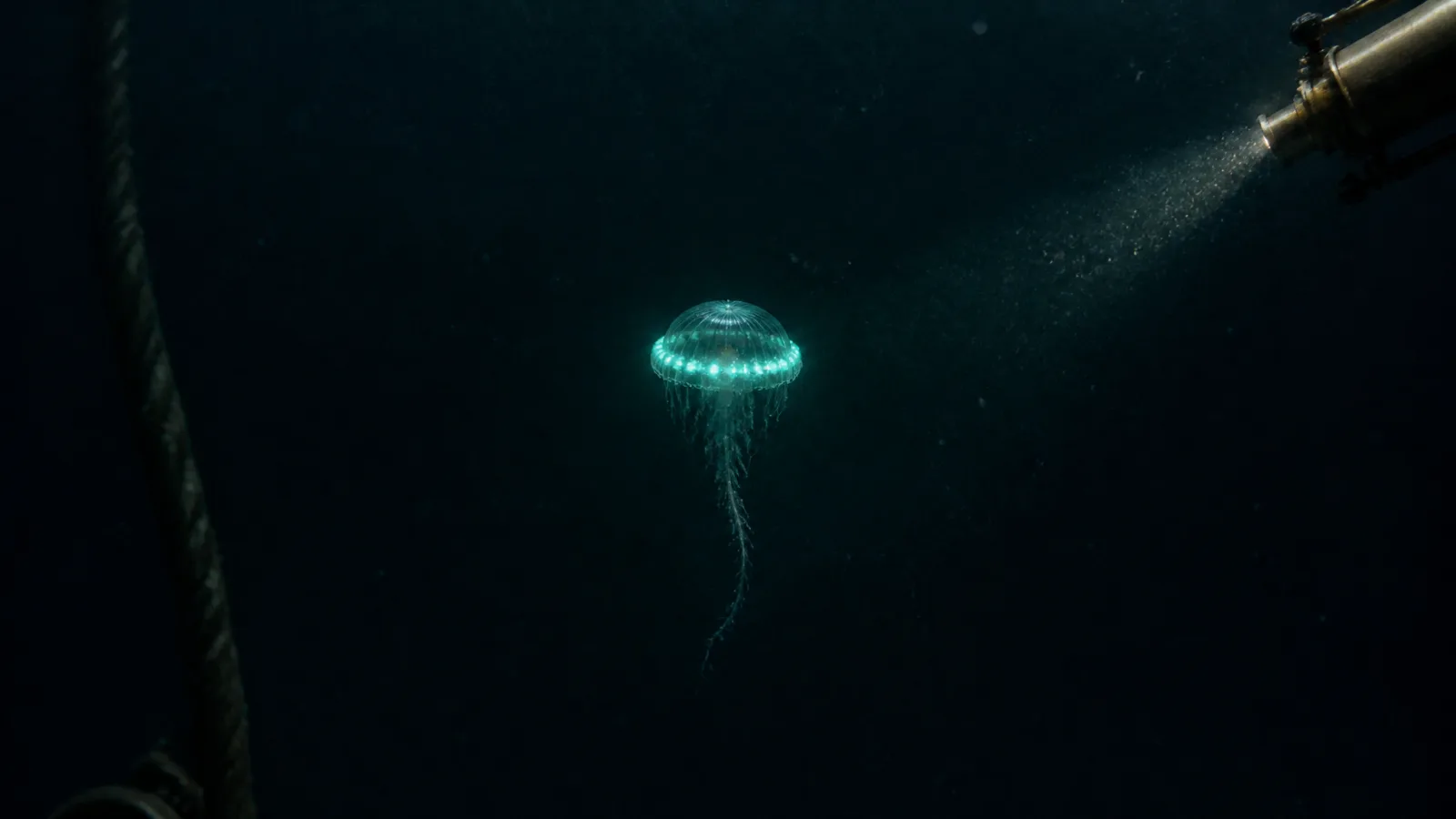
Below two hundred meters, sunlight gives up. What takes over is a slower, stranger economy of light: luciferin oxidized by luciferase in the presence of oxygen, the chemistry by which the deep ocean makes its own illumination. Fiction rarely gets its marine biology right, but on bioluminescence it has been almost reverent, for a revealing reason: the real thing already behaves like a plot device. Every function a writer might invent for living light, some animal is already using in earnest.
Consider the burglar alarm. The jellyfish Atolla wyvillei, seized by a predator, erupts in a spinning wheel of blue light. The display does nothing to the attacker; it summons something large enough to eat it. The scream is addressed to a third party. William Eubank’s Underwater (2020) builds its monsters on this grammar: lures that promise light and deliver teeth, technicians drawn across the seafloor like moths swimming the wrong way. In these films the light itself is the bait.
Table IV — Functions of living light in fiction
| Narrative function | Fictional example | Biological inspiration |
|---|---|---|
| Linguistic medium | The Abyss — the NTIs | Intraspecific signaling, mating displays |
| Environmental hazard | SOMA — the anglerfish | Predatory lures, esca-baiting |
| Illumination source | Dark Life — Lucifer lamps | Symbiotic bacteria in photophores |
| Status & emotion | Monster X — Abraxas | Emotional flare signaling |
Push past the lure and living light becomes a language. Cameron’s NTIs speak in cascades of patterned glow; Kat Falls’s undersea settlers in Dark Life farm bacteria into “Lucifer lamps,” making their entire civilization dependent on tended, living illumination. That dependence is the argument underneath the spectacle: machinery corrodes and crushes down there, and the light that keeps working is the biological one.
The subtlest borrowing is camouflage. Hatchetfish and vampire squid practice counter-illumination — they emit light from their undersides tuned to the exact brightness of the water above them, erasing their silhouette to anything looking up. Fiction reads this as ghostliness, a spectral vanishing; biology files it under predator avoidance. Both readings fit, which says something about the deep sea: its real adaptations are uncanny enough that fiction mostly just has to notice them.
The rest of this descent keeps relearning the lamp’s one rule: in the ocean, seeing usually means being seen, by things better suited to the dark. Light is communication and communication is exposure — the horror stories, the outpost films, and the games all run on that exchange rate. Turn on a light in the abyss and you have told it where you are.