Plate VIII · −5,600 m · abyssal zone
Interactive Depths
Film can show you the deep. A game can take away your speed, your air, and your certainty about where the sound came from.
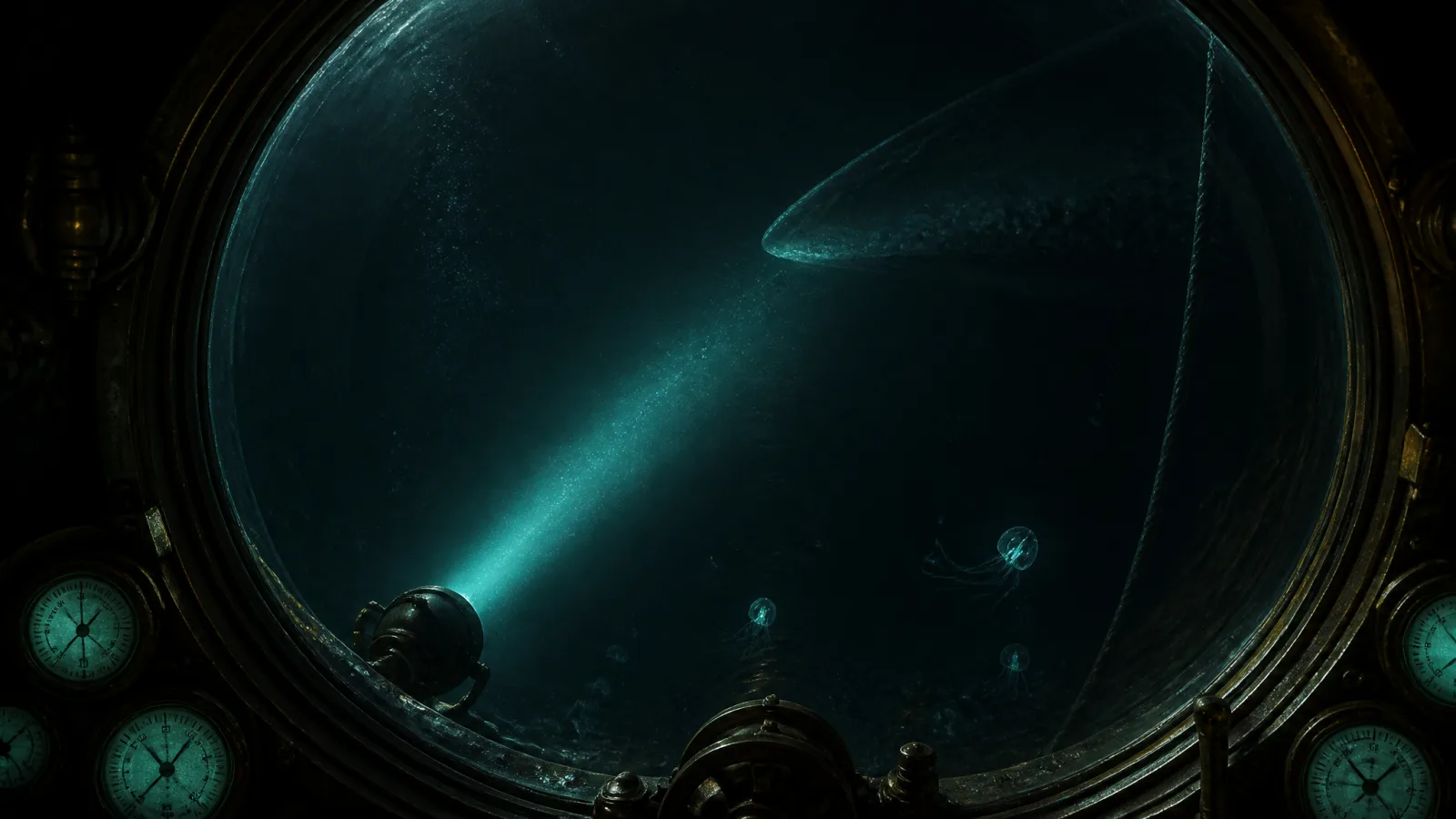
Horror games have a structural weakness that films do not: death is cheap. Reload, retry, and the monster becomes a puzzle with a solution. Underwater games found the fix, and the fix is water. Submerge a player and the medium takes things away that no cutscene can. Movement gains resistance, so you are slow. A third axis opens beneath you. Sound arrives without a direction. No jump scare required — the player has been downgraded, and can feel it.
Subnautica makes the demotion its whole design. You are a crash survivor on ocean planet 4546B, and the mystery is ecological — why did the ship come down, and what is the Kharaa bacterium doing to everything? The game refuses the horror label and achieves the effect anyway, by blending exploratory freedom with the standing possibility of a Reaper Leviathan. Its cruelest mechanic is loss of progress: dying deep costs you the dive, the cargo, and the nerve you spent getting there. Fear of the unknown compounds with fear of the wasted hour, and players end up describing visceral terror at descending into a new biome, entirely sober, with no monster on screen.
Table VIII — Immersion levels in underwater horror
| Medium | Perspective | Engagement | Key fear mechanism |
|---|---|---|---|
| Film | Spectator | Passive | Jump scares and visual shock |
| Game | Participant | Active | Agency, resource management, death stakes |
| VR | Presence | Embodied | Total sensory isolation, physical response |
SOMA takes the same water and points it at the mind. Pathos-II, after a comet has ended surface life, is populated by “mockingbirds” — robots that believe they are the humans whose brain scans they carry, and who will tell you so, at length, while you decide what you owe them. The game renders enemies through a distortion effect that makes them hard to fix in space, simulating the exact deficit the ocean imposes: you know something is there, you cannot pinpoint it, and your body reacts anyway. The philosophical horror and the perceptual horror are the same effect at different scales — a continuity you cannot verify from inside.
Read the table as a ladder of complicity rather than a ranking. The film viewer watches technicians swim toward a lure. The player chooses to, and pays for it. VR closes the last gap by removing the room around you. Each rung buys the abyss more of the person experiencing it, which is its own proof of the site’s premise: the deep works as inner space to the degree that it is allowed to happen to you. One rung remains below, where the fiction stops admitting it is fiction.