Plate IX · −10,900 m · hadal zone
Signals from the Hadal Zone
At the bottom of the descent, the genre stops labelling itself. Cryptids are the stories that ask to be believed.
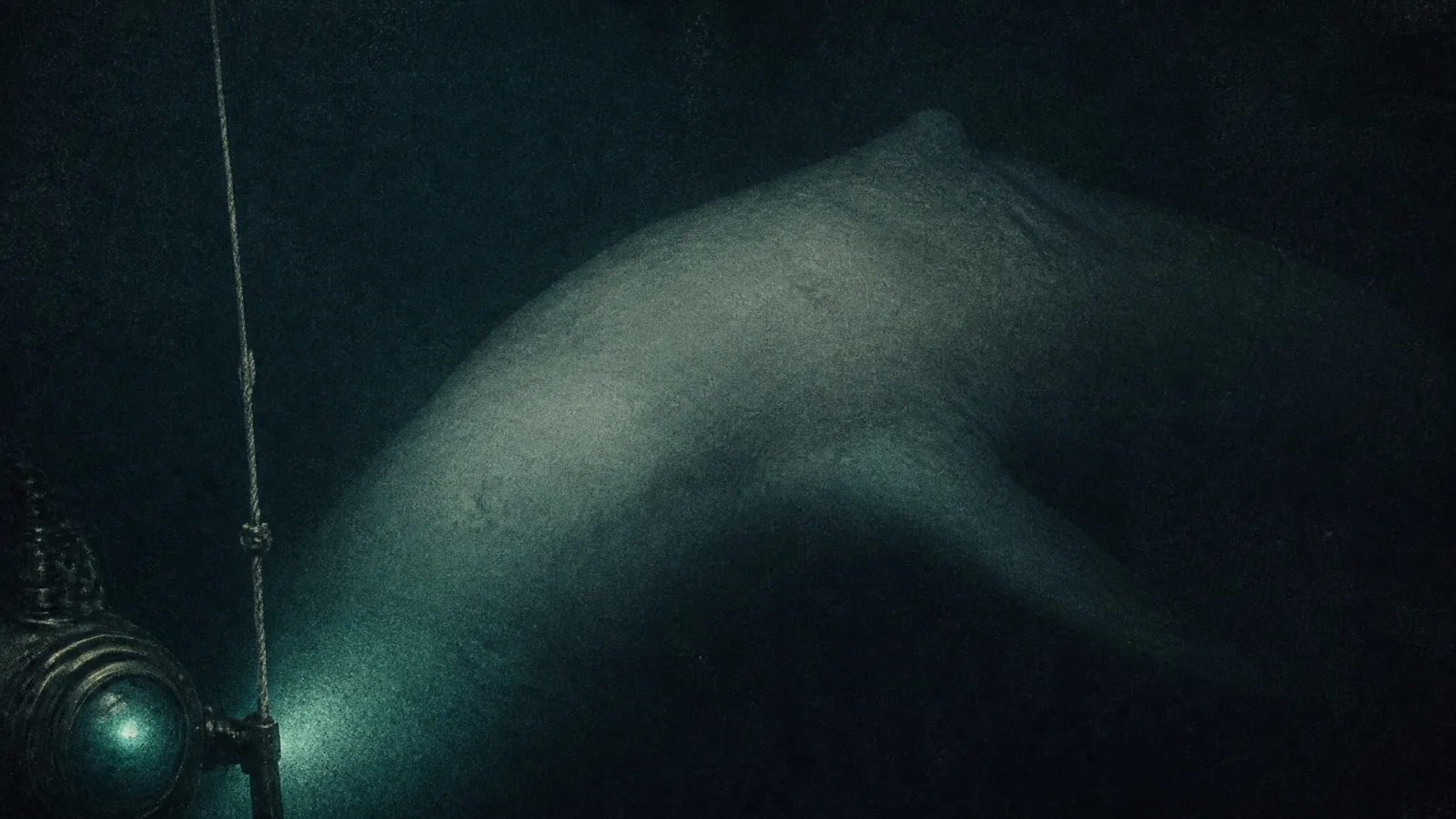
Every essay above this one was fiction that admitted it. Cryptids are different: they are stories that make a claim. The Kraken, the Lusca, the Ningen, and the Bloop occupy the boundary where speculative fiction stops flagging itself and starts circulating as testimony — and the ocean is the only environment left on Earth where that trick still works. You cannot hide a bipedal ape from satellites forever. You can hide almost anything in a trench that has never been photographed.
The Ningen is the modern case study, and it is barely older than YouTube. In 2007, posts on the Japanese forum 2channel described a vast white humanoid — twenty to thirty meters, arms or fins, blank features — sighted from vessels in Antarctic waters, and framed the sightings as encounters with something the government’s “whale research” program had reason to conceal. The legend has since migrated into analog-horror series and even nudged Pokémon design, with Scarlet and Violet’s Cetitan line carrying its silhouette. The legend runs on jurisdiction rather than evidence: the Antarctic is remote enough, and its research vessels opaque enough, to keep secrecy plausible.
Table IX — Deep-sea cryptids in fiction
| Cryptid | Region | Fictional treatment | Suggested origin |
|---|---|---|---|
| Lusca | Bahamas | Sharktopus films | Giant Pacific octopus / cephalopod |
| Ningen | Antarctica | Analog-horror series | Beluga whale or iceberg misidentification |
| Giant squid | Worldwide | Twenty Thousand Leagues, Beast | Architeuthis dux |
| The Kraken | North Atlantic | Clash of the Titans | Colossal squid / giant crustacean |
| Bake-kujira | Japan | Folklore and anime | Ghostly skeletal whale |
The Bloop shows the same mechanism running in reverse — from data to legend. In 1997, NOAA’s hydrophone array recorded an ultra-low-frequency sound with a profile that looked biological. If an animal made it, the animal was larger than any known to exist. Fiction moved into that gap immediately, assigning the noise to Cthulhu and to Great Old Ones sleeping in the South Pacific — Lovecraft’s own ocean, claimed on the strength of a waveform. In 2005 the case closed: it was ice. A glacier calving, cracking under its own weight.
The Bloop’s resolution is the honest end of this descent. For eight years the sound was a mystery, and the mystery behaved the way every mystery in this record has behaved: the deep supplied a gap, and we filled it with ourselves. The same pattern runs from Verne’s ruins through Rapture’s audio logs to SOMA’s mockingbirds. The trenches remain the only places on Earth where the alien is indigenous, and human presence there remains a precarious, temporary act of faith. What no one has managed, at any depth, is to look down and see something that is not partly a reflection.