Plate I · 0 m · surface
The Vertical Frontier
Sea stories used to stay on the surface. In 1870, Verne pointed the genre straight down.
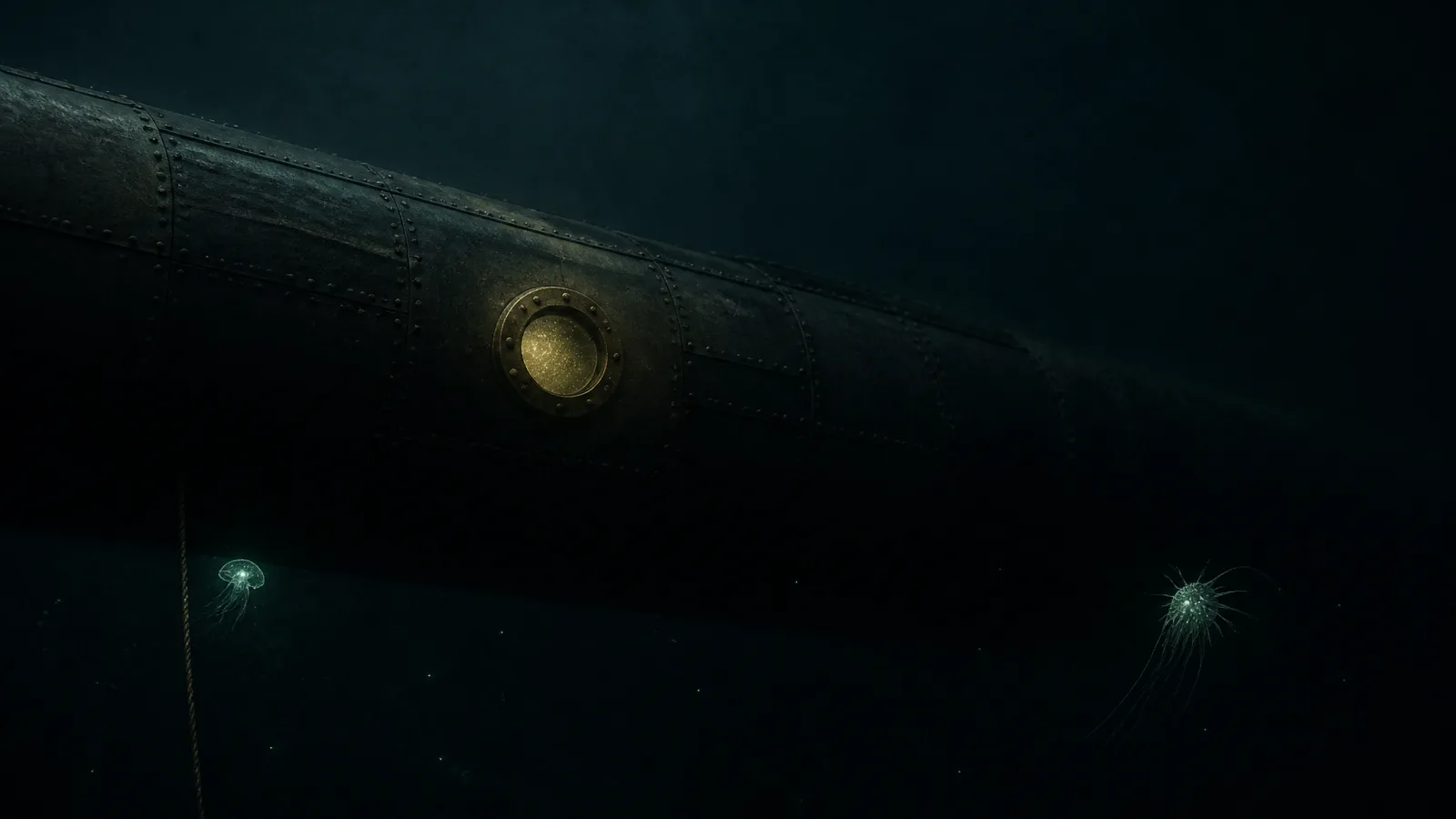
Eighteenth-century nautical fiction had a simple geometry: ships moved across a plane, and the drama came from weather, war, and whatever waited at the next landfall. Nobody asked what was under the keel. The deep itself was old news by 1870 — sounding lines had been reporting improbable depths for decades. Verne’s contribution was a decision about where a story could go. In Twenty Thousand Leagues Under the Seas he turned the axis of sea fiction ninety degrees, and the Nautilus, sealed and self-sufficient and secretive, made the vertical dimension habitable enough to write about.
Two things about Verne’s move proved permanent. First, the technology is the protagonist’s price of admission — hydrostatic pressure rises by roughly one atmosphere every ten meters, so every human presence below the surface is an engineered presence, mediated by hulls, suits, and air supplies that can fail. The genre never lets go of this; the failing outpost of Plate VII is Verne’s bargain collected at interest. Second, the submersible is a political instrument. Captain Nemo operates beyond the reach of any state, and the deep becomes the last space where a person can secede from the world entirely. Half the novel’s mystery is Nemo himself — what a man turns into when he moves there.
Table I — Foundational works of underwater speculative fiction
| Year | Title | Author / Director | What it added |
|---|---|---|---|
| 1870 | Twenty Thousand Leagues Under the Seas | Jules Verne | Technological secrecy and maritime wonder |
| 1896 | “In the Abyss” | H. G. Wells | An advanced bipedal race on the ocean floor |
| 1904 | The Impossible Voyage | Georges Méliès | Subaquatic travel reaches the cinema |
| 1906 | The Scarlet Empire | David M. Parry | Sunken social satire and utopia |
| 1929 | The Maracot Deep | Arthur Conan Doyle | A scientific expedition finds a surviving Atlantis |
| 1953 | The Kraken Wakes | John Wyndham | Alien invasion staged from the trenches |
| 1957 | The Deep Range | Arthur C. Clarke | Economic colonization of the oceans |
| 1987 | Sphere | Michael Crichton | The extraterrestrial artifact as psychological mirror |
| 2004 | The Swarm | Frank Schätzing | A sentient marine collective strikes back |
The next generation made the deep biological. H. G. Wells’s “In the Abyss” (1896) sends a diver down to an advanced bipedal civilization on the seafloor, then springs the genre’s first great reversal: the deep-sea people study the visitor with the same detached curiosity a naturalist brings to a dredged-up fish. In Wells the ocean works as a preservative, a place where alternative evolutionary lines can persist untouched by whatever catastrophes rearrange the surface. Doyle’s The Maracot Deep (1929) applied that logic to civilization itself. Wyndham and Clarke then split the genre’s future between them: invasion from below in The Kraken Wakes, industry from above in The Deep Range.
The ocean here is less a setting than an agent: it isolates, dissolves, confronts.
Read the chronology as one arc and each era is sending its own anxiety down the water column: the Victorians their engineering pride, the Edwardians their evolutionary doubt, the Cold War its invasion and industry, the present its ecological guilt — by The Swarm, the ocean no longer hides things, it retaliates. The vertical frontier turned out to be a mirror shaft. Everything below inherits Verne’s bargain: technology buys you entry, and the deep decides what you find.