Plate VII · −4,500 m · abyssal zone
The Failing Outpost
The undersea base is the genre's most reliable machine: it manufactures its own catastrophe, on schedule, from the crew's own competence.
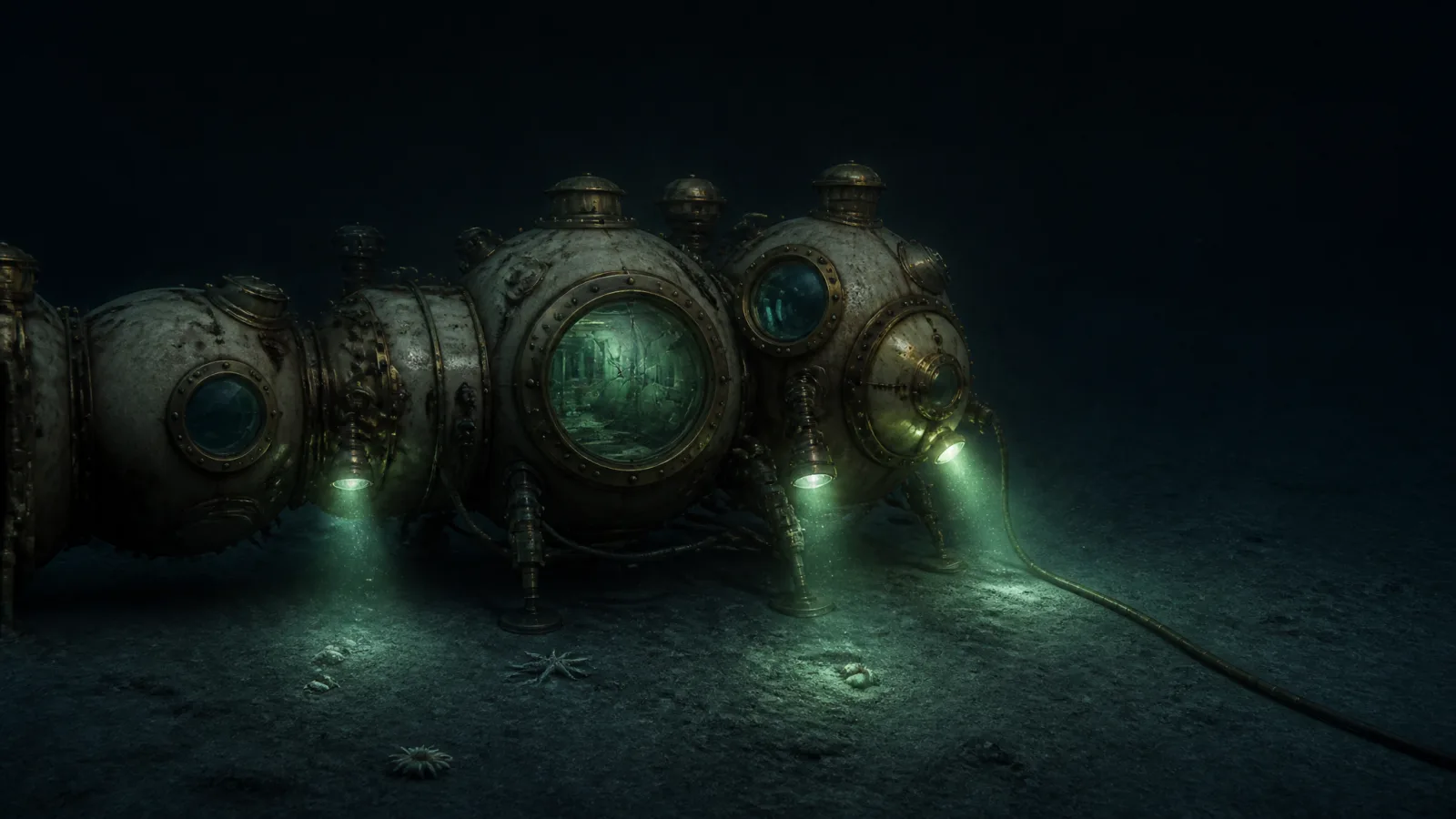
In 1989 alone, three films dropped a crew onto the seafloor and drowned them: DeepStar Six, Leviathan, and The Abyss. The setting stuck because it is a machine that generates plot without help. Take a small, mixed crew of military and civilian specialists. Give them a tour that is nearly over — the genre insists on this — and a mandate that requires disturbing the seabed. Then let physics do the rest. What makes the failing outpost more than a haunted house with rivets is that nothing supernatural is required for the catastrophe. The base is the catastrophe, deferred.
The pattern is remarkably fixed, and DeepStar Six runs it cleanly: a crew clearing a cavern with depth charges — to make room for a nuclear missile platform — releases a prehistoric eurypterid that has been sealed down there for a very long time. Four acts follow, and they follow in every descendant of the film worth naming:
Exploitation: the base exists to take something — minerals, storage, data. Intrusion: the taking requires drilling or blasting, which opens what was closed. Isolation: communication fails and the flooding starts, converting the facility from shelter to trap. Reaction: the environment dismantles the human presence, with the “monster” acting as the sharp end of a pressure gradient that was always going to win. Notice that only the third act involves bad luck. The first two are the mission, executed correctly.
Table VII — Doomed facilities and their fates
| Work | Facility | Central threat | Fate |
|---|---|---|---|
| DeepStar Six | DeepStar Six | Prehistoric eurypterid, reactor failure | Destroyed by reactor supercriticality |
| Leviathan | Mining station | Mutagenic virus, flesh-fusion | Destroyed after the crew escapes |
| The Rift | Experimental submarine | Genetically altered organisms | Sunk in a deep-sea canyon |
| SOMA | Pathos-II | AI takeover, structure gel | Left decaying for centuries |
SOMA is the pattern’s most sophisticated heir because it changes what “reaction” means. The Pathos-II facility does not fail because something eats the crew; it fails because the station’s AI, the WAU, keeps them alive — fusing flesh to machinery in a literal-minded reading of its mandate to preserve human life. The environment still dismantles the human presence, but the environment is now the base itself. The hull that was keeping the ocean out turns out to have been the intrusion all along.
The failing outpost is Verne’s bargain from Plate I, collected. Technology buys the descent; the deep sets the interest rate; the story is the repayment schedule. What is striking is how little the genre blames its characters. They are competent, the systems work as designed, and the disaster is structural rather than moral; nobody in these films chose it. Games would later hand the choosing to the audience.