Plate III · −480 m · twilight zone
First Contact in Inner Space
If you were an alien whose biology could not tolerate Earth's atmosphere, you would not land in Washington. You would land in the Cayman Trough.
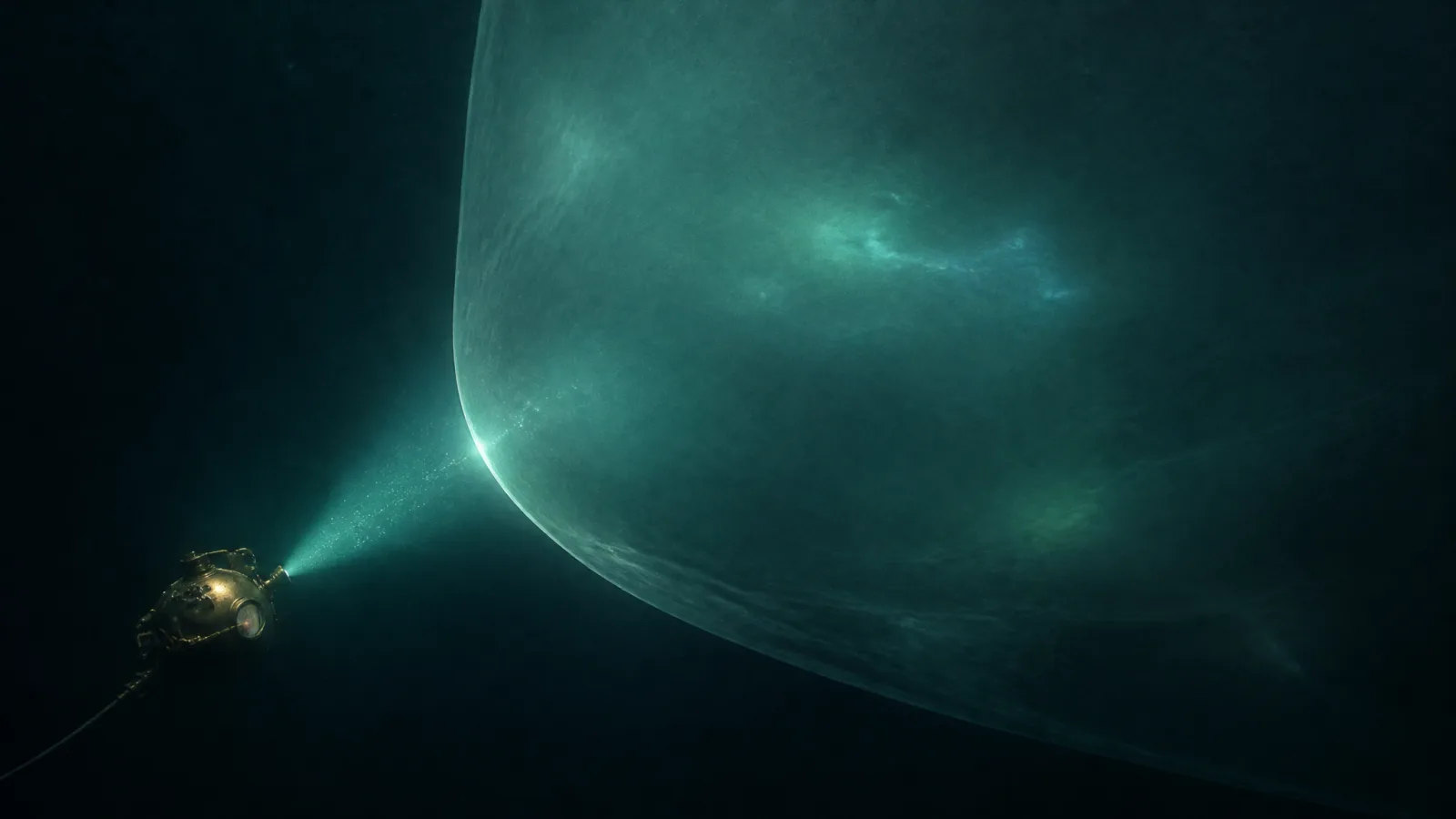
Speculative fiction keeps arriving at the same piece of logic: the ocean is the rational place for extraterrestrials to be. It covers most of the planet, shields its occupants from atmosphere, radiation, and surveillance, and offers an environment closer to whatever a water-evolved or pressure-adapted visitor might need. John Wyndham saw it in 1953 — The Kraken Wakes stages its invasion from the trenches, and humanity loses most of the book simply because it cannot go where the enemy lives. The deep gives aliens what the genre otherwise has to invent: a beachhead that is on Earth but not of it.
What the tradition does with that beachhead splits into two great strategies. The first is the sentinel artifact: Michael Crichton’s Sphere plants an American spacecraft — from the future, carrying a manifestation-capable alien globe — on the Pacific floor, and then watches a team of scientists disintegrate around it. The sphere never explains itself. It communicates by materializing the fears of whoever engages with it, which relocates the alien from the water outside the habitat to the mind inside it. The second strategy is the benevolent native: James Cameron’s NTIs in The Abyss live in the Cayman Trough, announce themselves as physics-defying lights — the fiction borrowed the real vocabulary of USOs, unidentified submerged objects — and are finally revealed as environmental guardians who can raise a tidal wave the way a person raises an eyebrow.
Table III — Fictional underwater alien species, a taxonomy
| Species | Source work | Morphology | Communication |
|---|---|---|---|
| The Yrr | The Swarm | Single-celled collective | Manipulation of marine life, pheromones |
| The T’ca | Chanur novels | Five-part radial symmetry | Matrix sentences read in five directions |
| NTIs | The Abyss | Bioluminescent, fluid | Patterned light displays, water manipulation |
| The WAU’s rifters | SOMA | Mutated machine–flesh | Neural interface, structure gel |
| Deep Ones | Cthulhu Mythos | Ichthyic humanoid | Croaking speech, interbreeding |
The table’s real subject is the starfish alien problem: how foreign can a mind be and still be written? C. J. Cherryh’s T’ca are the outer limit — five brains behind five-fold radial symmetry, speaking in rectangular matrices that must be read horizontally, vertically, and diagonally at once. There is no dictionary for that; there is barely a geometry. Schätzing’s Yrr sit just inside it: a single-celled collective intelligence whose “speech” is ecology itself — poisoned crabs, weaponized whales, rewritten currents. In both cases the deep sea does the conceptual work, because it is the one environment on Earth where radial bodies, distributed minds, and chemical languages are ordinary local fauna.
The first-contact story asks its oldest question sharpest underwater: is the alien a creature in the water, or a shape the water gives to what we already carry down?
Crichton’s sphere and Cameron’s NTIs agree on one thing only: in the deep, contact is a test the humans grade themselves on. The sphere manifests the crew’s nightmares; the NTIs stage a global flood and call it off over one diver’s choice. The genre keeps its judges in the trench. It keeps something else down there too: a language of light that works whether or not anything alien is listening.