Plate V · −2,400 m · midnight zone
Non-Euclidean Waters
Lovecraft needed an unmapped place large enough to hold a god. In the 1920s, the ocean was the only one left.
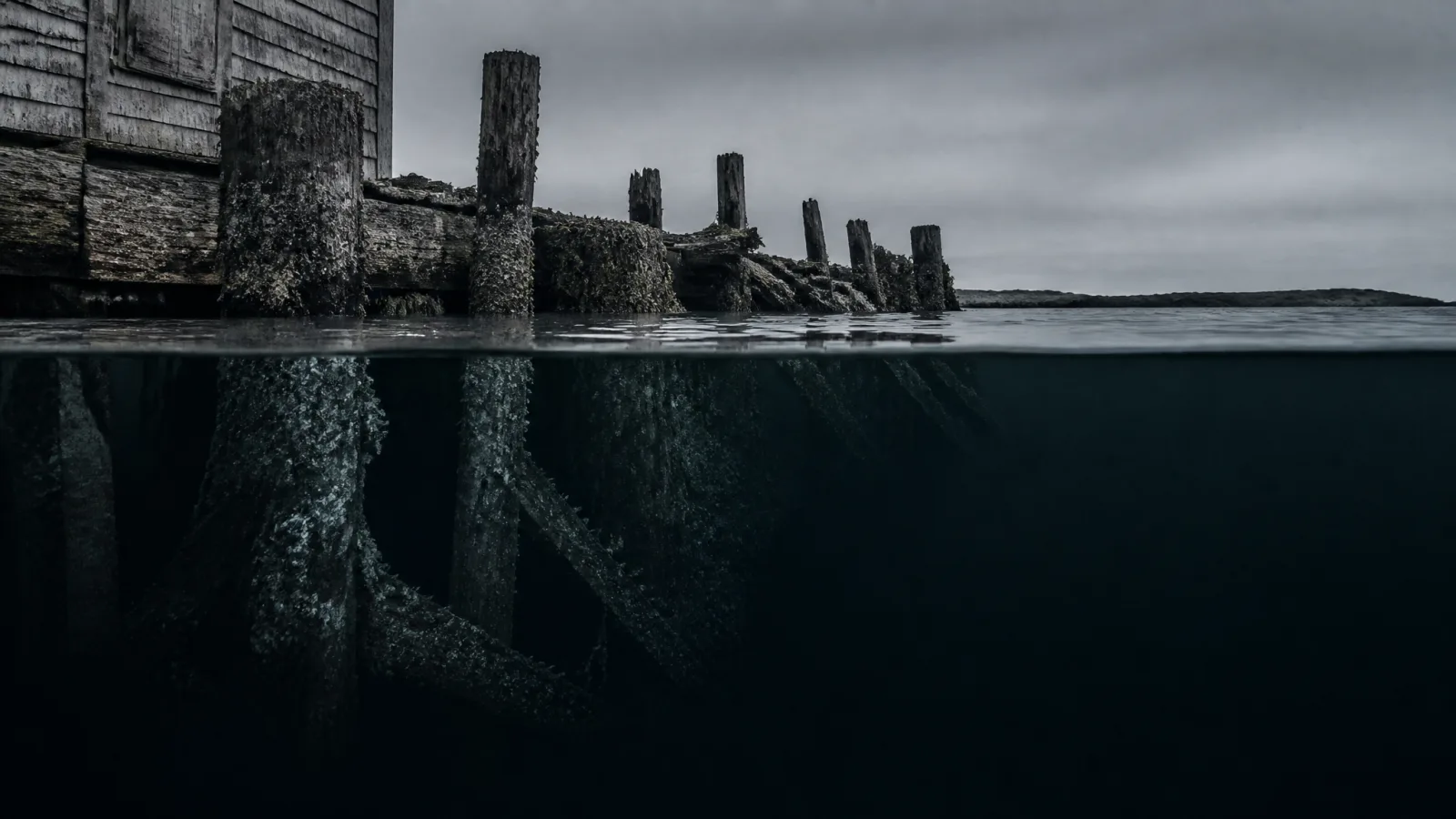
Cosmic horror needed somewhere to put its gods, and by the 1920s the map had run out of blanks. The poles were reached, the continents were surveyed, and the only remaining swath of genuine unknown on Earth was the ocean floor. H. P. Lovecraft took it. The move was economical: an unfathomed sea offered scale, darkness, and a scientifically respectable reason for human ignorance. The ocean let him replace the ancient fear of the tiger in the bushes with a modern one — the discovery of knowledge that dismantles the human sense of importance.
R’lyeh is the emblem. The sunken city in “The Call of Cthulhu” is described as non-Euclidean: its angles refuse to behave, and its geometry is wrong in a way that damages the mind attempting it. On land that horror is unavailable — a building is a building. Underwater, pressure and darkness already suspend ordinary intuitions about space, so a reader will grant that geometry itself might be negotiable down there. The Deep Ones of “The Shadow Over Innsmouth” do the same work biologically: fish, frog, and human features combined into a hybridity that undermines the assumption of a stable human body — and, worse, one that interbreeds. The horror is not that the monster is foreign; it is that it is family.
Table V — Components of Lovecraftian nautical horror
| Component | Description | Fictional application |
|---|---|---|
| Cosmicism | Human insignificance against an indifferent universe | The Deep (Nick Cutter) |
| The irruption | The sudden intrusion of the monstrous into the ordinary | Underwater (2020) |
| Devastating realization | Humanity is not in control of the planet | The Swarm (Frank Schätzing) |
| Anthropocene retribution | Nature answering human extraction | Underwater’s monsters as response |
The last row is where the tradition stopped standing still. Classical cosmic horror is morally inert: Cthulhu does not care about you, and that indifference is the point. Modern eco-horror keeps the scale and drops the indifference. In Frank Schätzing’s The Swarm, the ocean’s retaliation is causally ours — overfishing, pollution, seabed drilling — and the Yrr are less a god than an immune response. The mystery shifts accordingly. “What is down there?” becomes “how do we survive what we have provoked?”, which is a smaller question metaphysically and a much larger one practically.
What survives both versions is the tidal line — the border where the human world stops and something older resumes. Lovecraft drew it through a decaying seaport; Schätzing draws it through a continental shelf. Cross it and the terms change: your body is provisional, your geometry is a courtesy, and your civilization is a film on the surface of something that predates vertebrates. The next three essays are about people who cross it anyway, and the machinery they bring to keep the water out.