Plate II · −120 m · sunlit zone
Drowned Kingdoms
Fiction almost never leaves Atlantis in ruins. The sunken city keeps being rebuilt — because each era needs it to say something different.
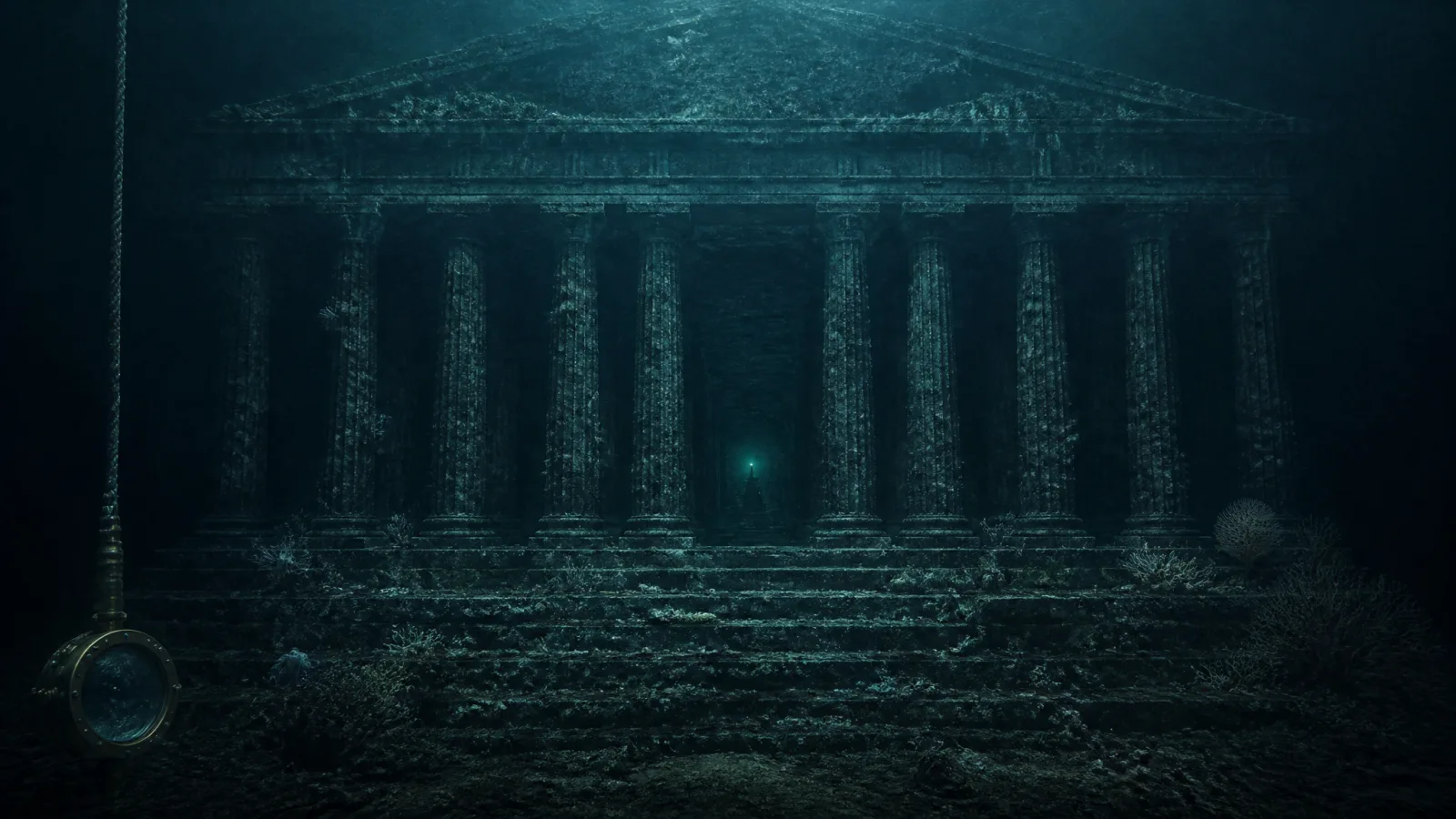
When the Nautilus crew walks the seafloor in 1870, Atlantis is a graveyard: skeletal colonnades, a silent archaeological curiosity, a memento mori for civilizations that thought themselves permanent. That is the romantic ruin — and fiction abandoned it almost immediately. By 1929, Arthur Conan Doyle’s The Maracot Deep had repopulated the drowned continent with a society that survived the flood and mastered it, living under pressure-resistant domes with technology the surface lacks. The trajectory since has run in one direction: from ruin, to refuge, to rival. Marvel’s Talokan and DC’s Atlantis are not lost cities; they are isolationist superpowers with militaries, borders, and foreign policy.
The reason the archetype keeps mutating is that the sunken city is fiction’s cheapest mirror for the surface. Plato’s original was already a parable about hubris. Verne’s ruins rebuke imperial confidence; Doyle’s survivors reward scientific curiosity; Talokan — a Mesoamerican exodus civilization built in the Black Panther films — turns the myth into a story about colonization refused, a nation that chose the deep over conquest. Whatever a drowned kingdom says, it says about the surface.
Table II — Fictional sunken civilizations, compared
| Civilization | Source work | Origin / nature | Technology & culture |
|---|---|---|---|
| Atlantis | The Maracot Deep | Sunken continent | Pressure-resistant domes, advanced hydro-tech |
| Talokan | Black Panther: Wakanda Forever | Mesoamerican exodus | Vibranium adaptation, bioluminescent cities |
| Gungan City | The Phantom Menace | Indigenous to Naboo | Hydrostatic bubble shields, bio-technology |
| Rapture | BioShock | Dystopian objectivism | Art Deco aesthetics, genetic modification |
| The Trench | Aquaman | Degenerate Atlanteans | Predatory, bioluminescent, monstrous |
Two entries in that table mark the archetype’s outer edges. BioShock’s Rapture is a sunken city with no myth at all — a mid-twentieth-century industrialist utopia that drowned itself in ideology rather than seawater. Its mystery is forensic: the player reconstructs the collapse from audio logs and decaying Art Deco interiors, reading the environment the way an investigator reads a wreck. And Aquaman’s Trench dwellers are what happens when the archetype is run through evolutionary time in reverse — Atlanteans who kept adapting to depth until nothing social remained. Between them sits every other drowned kingdom: the Trench is the ruin’s biology, Rapture is the ruin’s politics.
The drowned kingdom also solves a practical problem for the genre: it gives the abyss a face. A trench full of biology is scenery; a trench full of society can scheme, negotiate, and hold grudges. Once the deep has palaces it has politics, and the surface acquires a counterpart entitled to judge it. From Plato to Talokan, the sunken city has been a verdict on the one still standing.