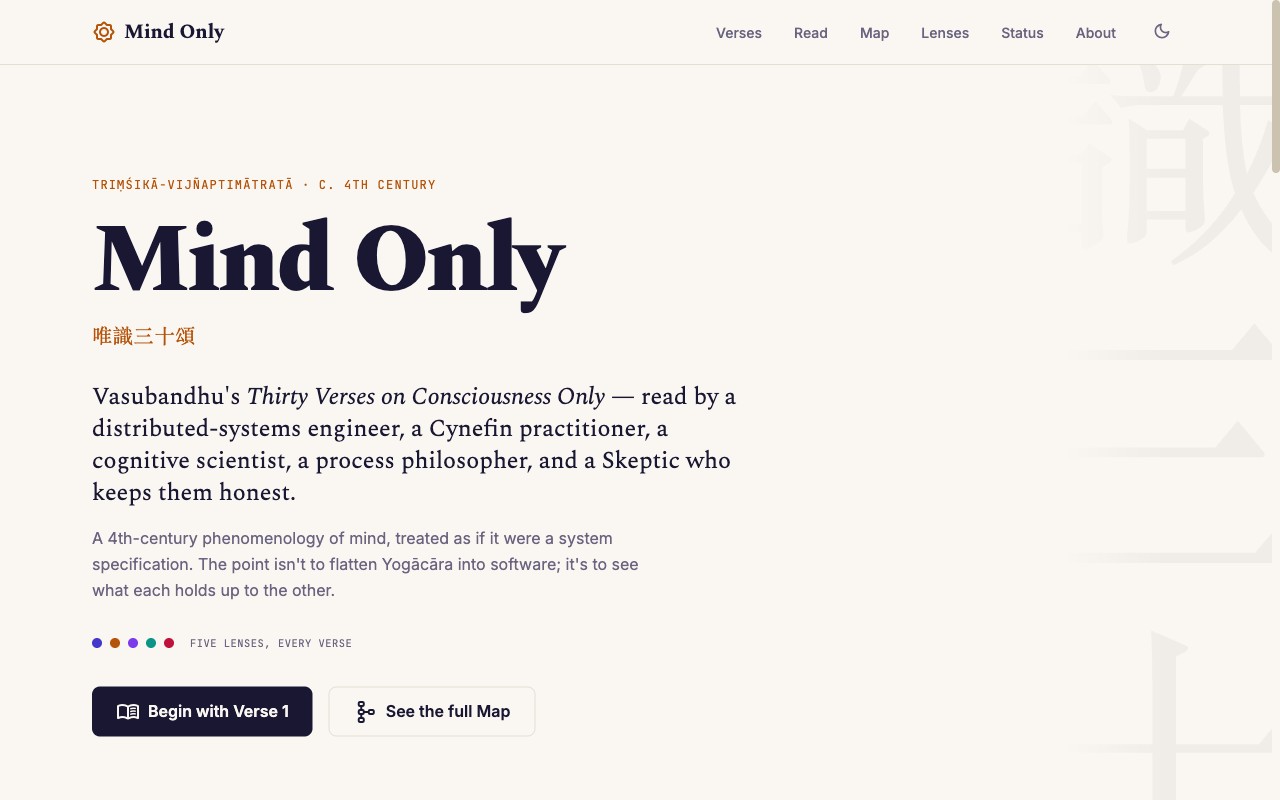
For a while now I’ve been building small websites with AI; each is a focused site about a single topic, with its own voice. I’ve collected them on a new AI Sites page.
One topic, one site
The pattern is always the same. I get curious about something (a Buddhist text on the nature of mind, where AI development is actually heading, what a language model produces when you just let it write), and instead of cramming it into private markdown files or a blog post here, I give it a home of its own. A dedicated site lets the topic set the rules for its typography, its structure, and how it wants to be read.
So far three of them are worth visiting:
- Mind Only — Vasubandhu’s Thirty Verses on Consciousness Only, a 4th-century text, read through five modern lenses: distributed systems, Cynefin, predictive processing, process philosophy, and a Skeptic who keeps the readings honest. The site tracks human review per verse and lens, so you can see exactly how far along each reading is.
- Realistic Futures of AI — a research knowledge base on plausible AI development paths from 2025 to 2040, updated weekly and grounded in constraints rather than hype.
- AI-Generated — an experimental record of what happens when language models are asked to write essays, draw pictures, and tell stories. Lightly edited, always credited.
How the work actually divides
By now everyone knows AI can write code and prose. The more interesting question is how to scale the work and let the AI work on its own as much as possible.
P.S.
This article was written with the help of Claude Opus 4.8 xhigh.