Announcing NKP 0.1: Static Analysis for Kotlin Projects
I’m excited to share the first MVP release of NKP (aNalysis of Kotlin Programs), a command-line tool for analyzing Kotlin codebases and uncovering architectural insights.
All posts in Software Engineering in chronological order with newest first.
I’m excited to share the first MVP release of NKP (aNalysis of Kotlin Programs), a command-line tool for analyzing Kotlin codebases and uncovering architectural insights.
I’ve written a new article for JavaSpektrum: “Java im Technology Radar – Totgesagte leben länger”. The piece looks back at Java’s journey through the eyes of the Thoughtworks Technology Radar...
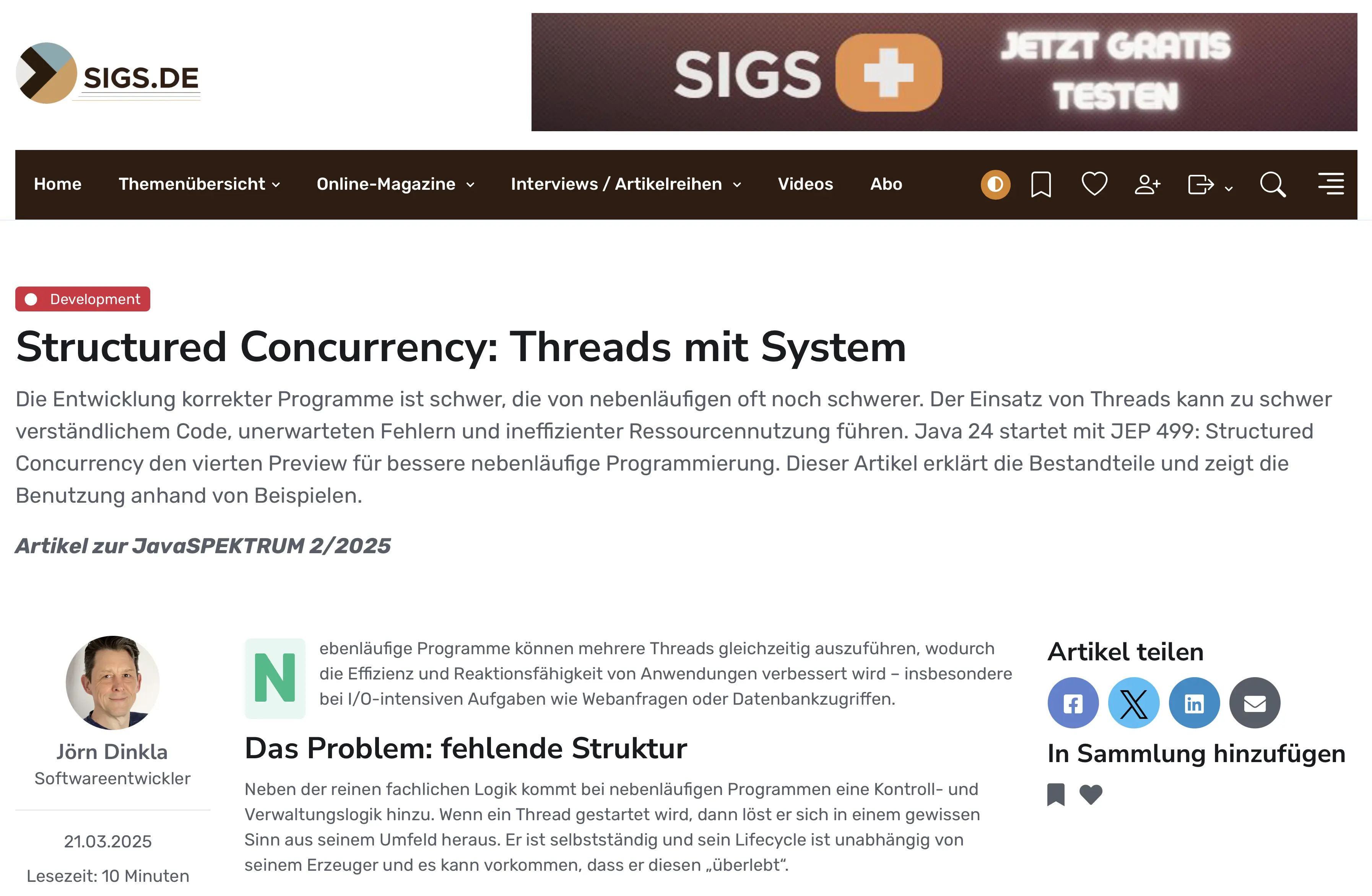
I’ve written an article for JavaSpektrum 2/2025 about Structured Concurrency in Java 24. The article covers JEP 499, Java’s fourth preview of Structured Concurrency, which aims to make concurrent programming...
As an external consultant in an Enabling Team for Cloud Architecture, I supported several teams and noticed that software development quality was lacking. This surprised me because the client was...
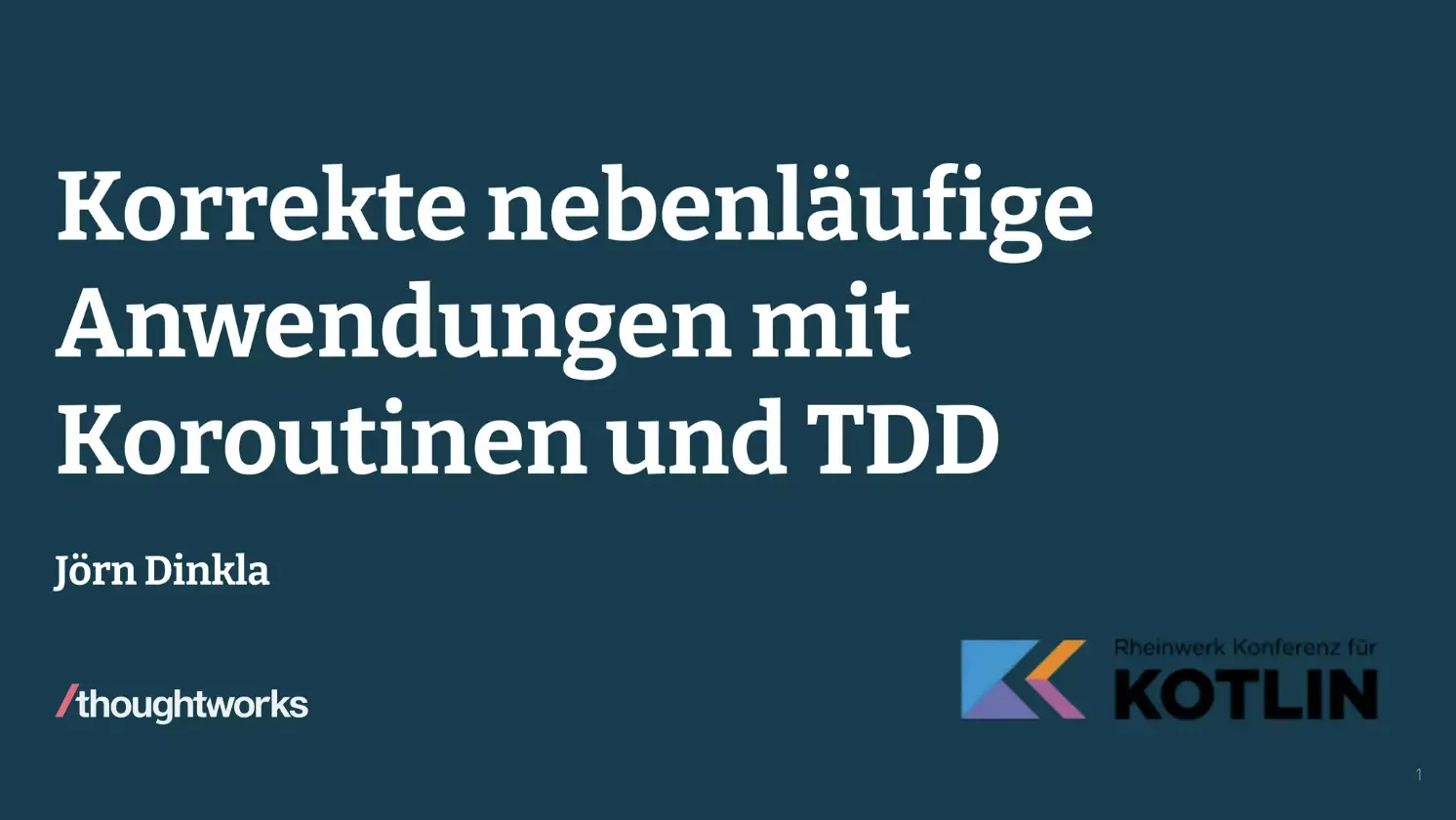
Concurrent and asynchronous applications can be written in Kotlin with coroutines in a precise and structured way. Unfortunately, concurrency often increases the complexity and it is difficult to create bug-free...
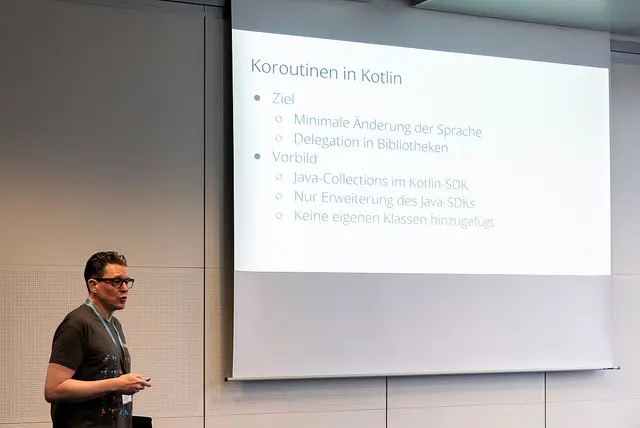
In my talk “Nebenläufigkeit mit Koroutinen strukturieren” at the KKon 2021 Warmup I explained how to structure and organize concurrent programs with coroutines in Kotlin.
During the chrismas holiday I started a new ray tracer in Kotlin while following the book “The Ray Tracer Challenge.
I updated my website so that it looks new and shiny and provides faster and easier access.
At a client of ThoughtWorks I gave a talk about refactoring in line with the book “Mikado Method”. The book describes a method to plan and perform non-trivial refactorings of...
At a client of ThoughtWorks I gave a talk about the advantages of Kotlin.
At a client of ThoughtWorks I gave a short presentation about three different ways of state management in React.
In the article “Verteilte Systeme: weniger warten, asynchron arbeiten” (distributed systems: less waiting, asychronous working) in the german magazine iX Developer Moderne Softwareentwicklung - code(), build(), deploy() I explain the...
I continued to work on migrating my ray tracer to Kotlin. Now the scenes can be specified with a Kotlin DSL and all Groovy code is gone.
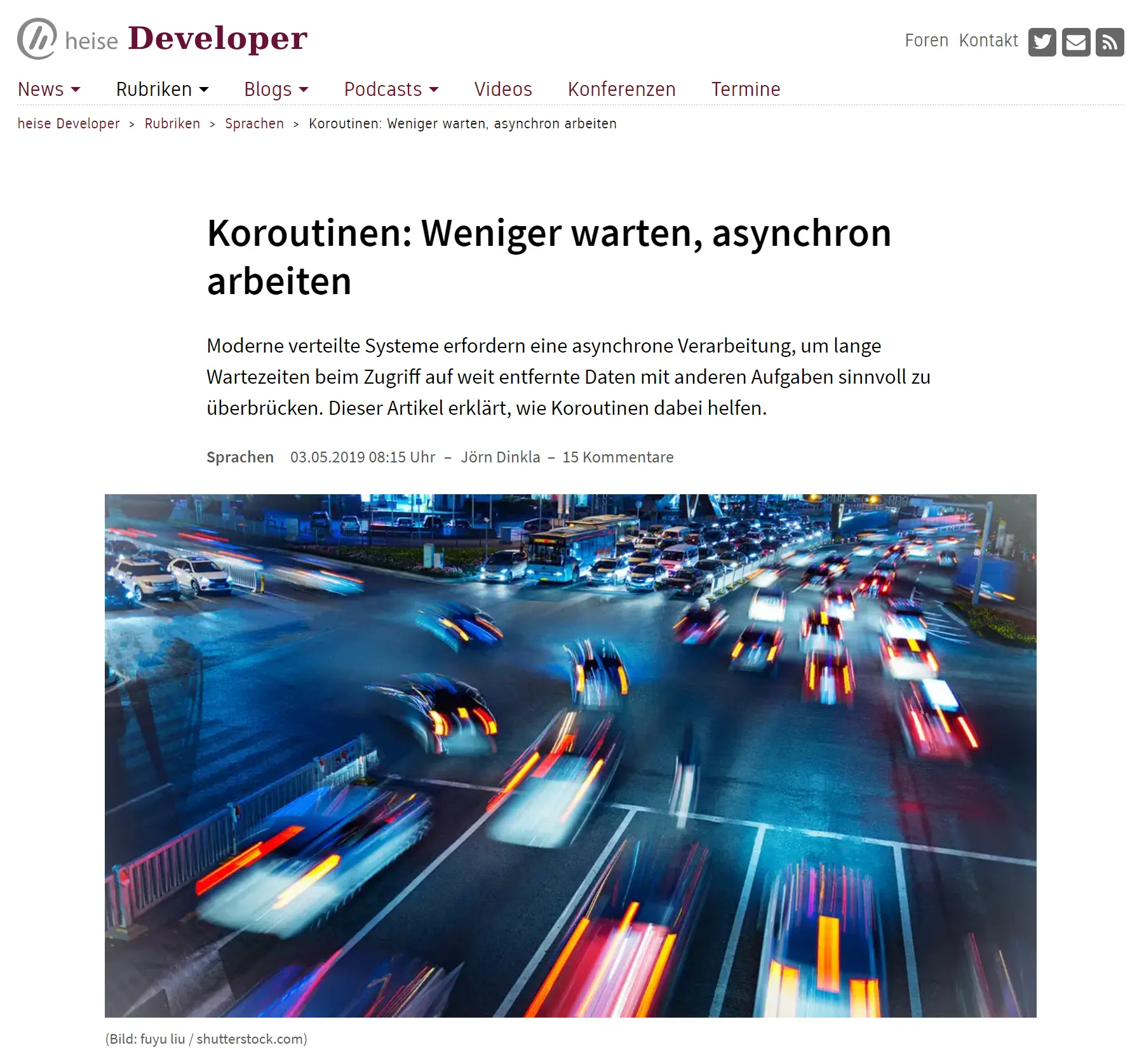
In the article “Weniger warten, asynchron arbeiten” (less waiting, asychronous working) published by heise Developer I explain the theoretical background of coroutines and how to use them in Kotlin and...
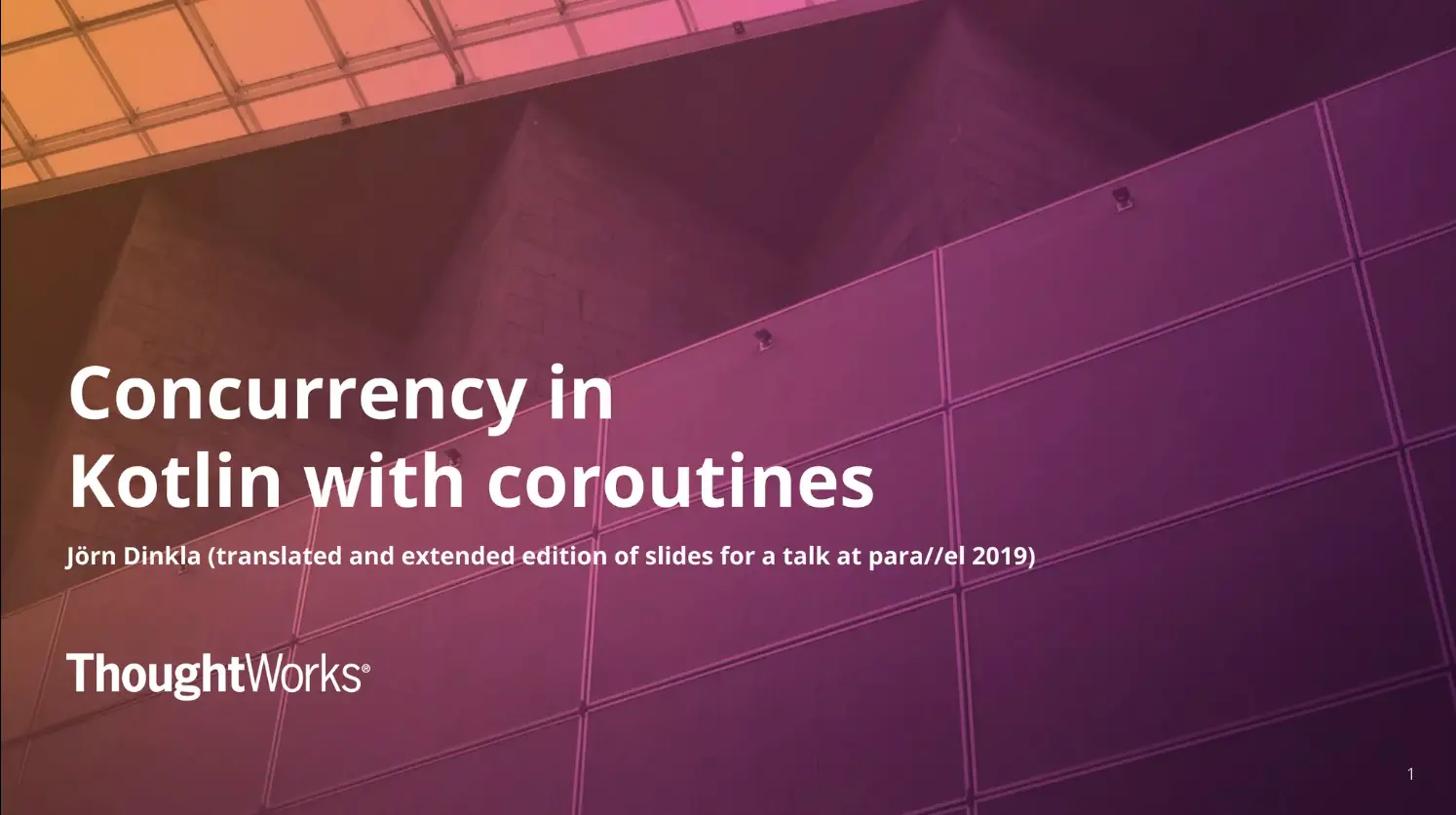
Coroutines are a “new” way to handle concurrency on the JVM. I gave an introduction to coroutines in Kotlin at Thoughtworks. This is basically the translation of the german slides....
Coroutines are a “new” way to handle concurrency on the JVM. At the para//el 2019 conference, I gave an introduction to coroutines in Kotlin.
The fusion of Object Oriented Programming (OOP) and Functional Programming (FP) languages has become increasingly popular in recent years, with many programming languages now offering features and constructs from both...
I continued to work on migrating my ray tracer to Kotlin.
After reading the wonderful book Kotlin in Action I started to migrate my ray tracer from Java and Groovy to Kotlin.
In my first project for ThoughtWorks the backend is written in Clojure. Since the project was in Berlin, I visited the EuroClojure 2017 which takes place in Berlin this year,...
After long considerations i decided to quit being a freelancer and joined ThoughtWorks in Hamburg, Germany.
Today I released an updated version of the library of geometric algorithms.
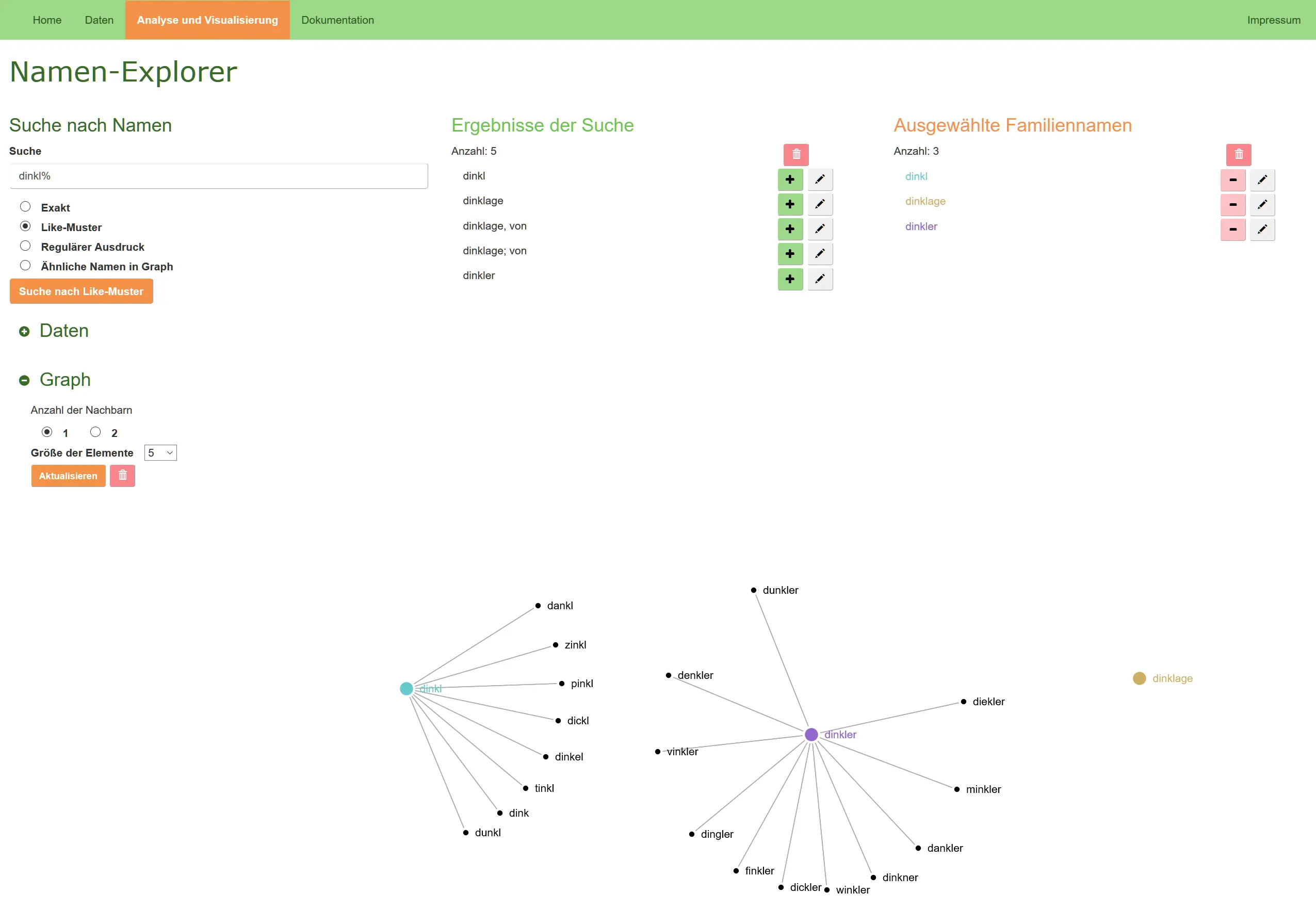
As part of the cultural hackathon Coding da Vinci Nord 2016, I built a web application for the analysis and visualization of the distribution of family names. I used (among...
In my opinion, the Spock Framework is currently the most convenient testing framework for the Java platform. Since it is built on the Groovy language, it is very expressive.
I bought the book in early access (MEAP) and decided to help as a reviewer.
While I was reading the excellent book by Kevin Suffern "Ray tracing from the ground up", I implemented a ray tracer in Java and wrote a DSL in Groovy, to...
The topic of covariance and contravariance is explained in many places (including Wikipedia). This post is my attempt to explain it in my own words, using Scala.
I explain "covariance and contravariance" with some simple Scala examples.
Scala is an important milestone in the fusion of functional and object-oriented programming. This fusion is not yet complete, but rather a “discovery process” that will continue for a few...
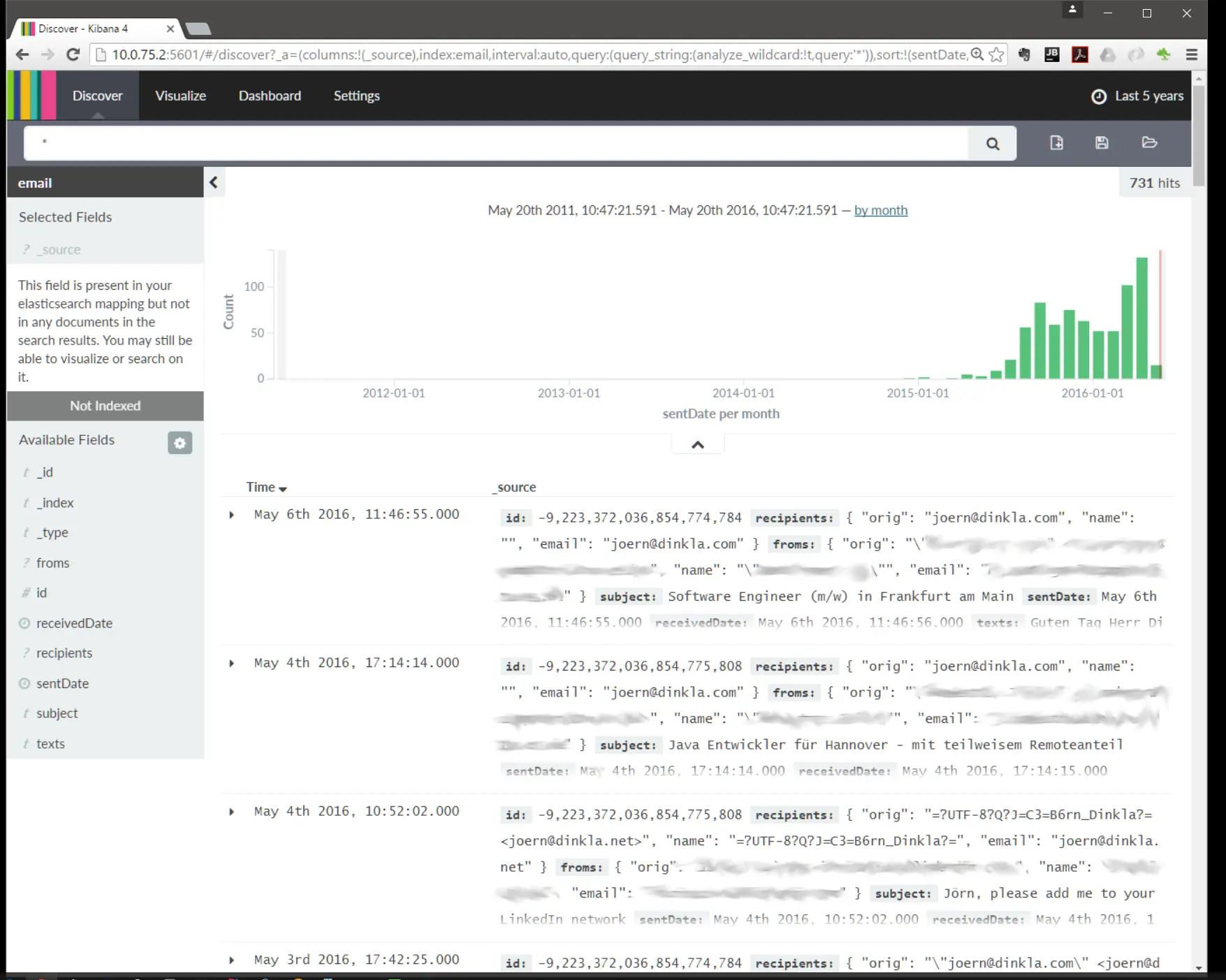
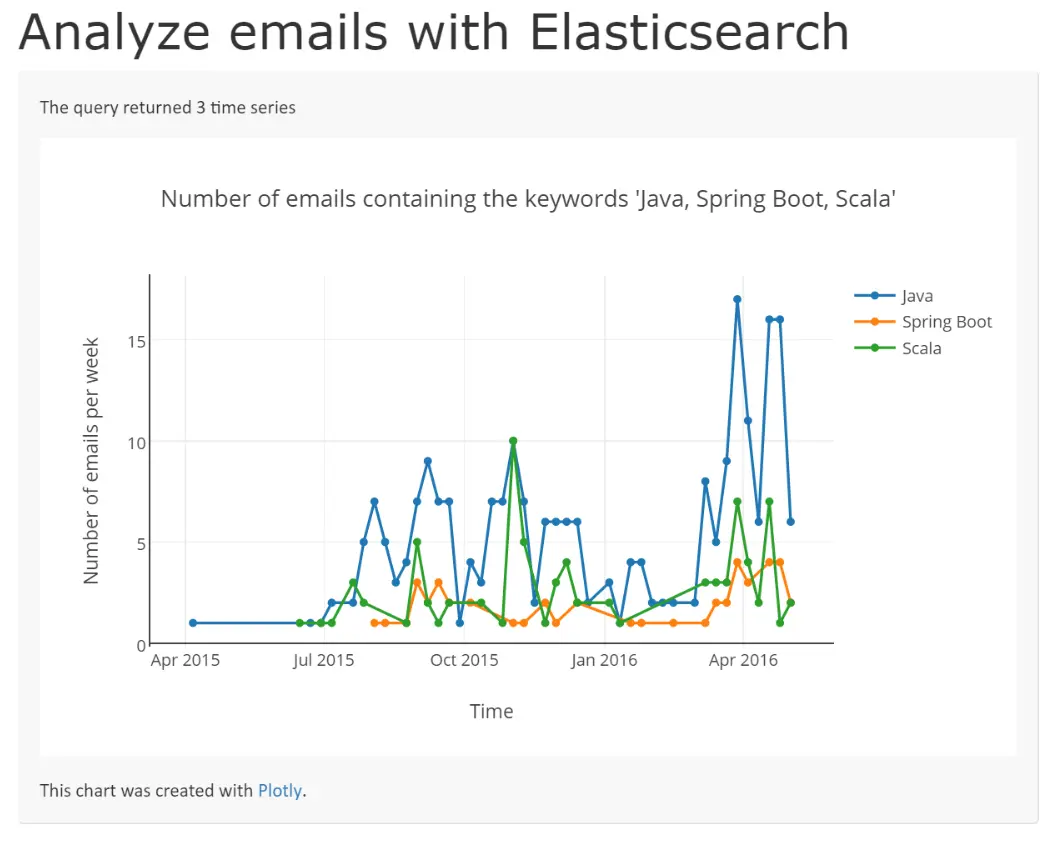
This is the last part in a series of four. It shows how to analyse the emails with Kibana.
This is the third part in a series of four. It explains the technical background.
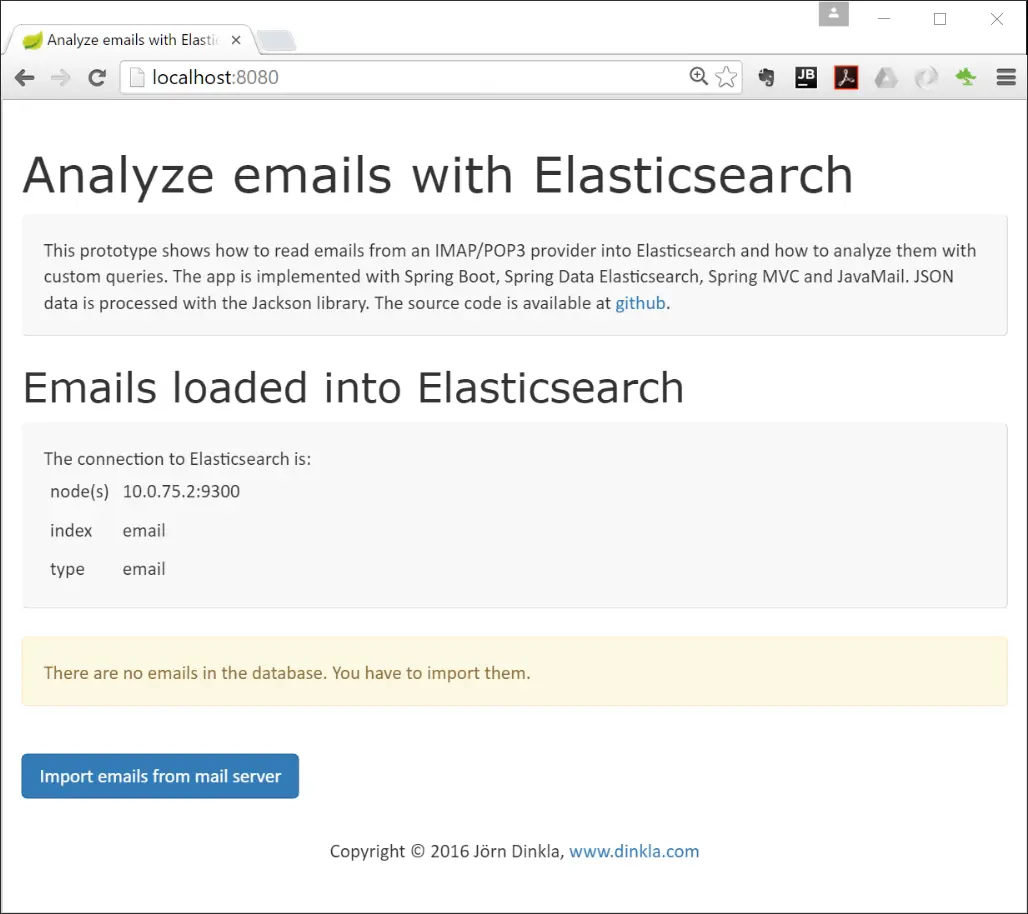
This is the second part in a series of four. It shows installation and usage.
This article shows how to use Elastiksearch database with Spring Boot. It is the first in a series of four.
During my talk at the parallel 2015 conference i was asked how one can measure traffic on the PCI express bus. For multi GPU computing it is very important to...
JavaScript has a prototype-based approach to object orientation. This makes it very different from the common object-oriented programming languages, such as Java, C++, and Ruby.
With Babel you can test many features of the upcoming next version of JavaScript called ECMAScript 6 now.
I wanted to learn some frameworks for parallel computing and i decided to implement a simple ray tracer as a "visual benchmark".
I have been using git for a few years now, but I wanted to gain more background knowledge and learn about more complex workflows. The book “Git in Practice” succeeded...
“Understanding PaaS” is a very small booklet about the basics of cloud computing. It can be read to get a very quick introduction to the topic. It is written more...
“MongoDB: The Definitive Guide” is a well-rounded overview of MongoDB from both a developer and a DBA perspective. At least as far as I can tell as a MongoDB beginner...
I bought the book in early access (MEAP) and decided to help as a reviewer.
If there is such a thing as “sophisticated” literature, then there is now also “sophisticated” code. “If Hemingway Wrote JavaScript” contains many funny and educational examples.
“Using OpenMP” is a good introduction and contains a few good performance tips.
If you want to bring a bit of systematism to your parallel programming skills, “Structured Parallel Programming: Patterns for Efficient Computation” is the book to start with.
I had already read the second edition back in 1992. Since then, a lot has changed for the better, both with C++ and this “classic.”
In this small book, the creator of C++ provides an overview of the new features in C++ 11 and the STL.
Anyone wanting to learn Grails cannot ignore “The Definitive Guide to Grails 2”.
I read “Learn You a Haskell for Great Good” to refresh my knowledge of Haskell. During my studies in the nineties, I was an enthusiastic functional programmer. I wrote my...
The book “97 Things Every Programmer Should Know” consists of 97 sections by different authors regarding frequently occurring questions in software development.
“API Design for C++” is an excellent introduction to the implementation of APIs with C++.
“Patterns for Parallel Programming” is an important work for ‘parallel programmers’.
These slides are for a course about parallel computing.
“Head First jQuery” is written in the “Head First” style and is aimed at beginners and career changers who already have a basic knowledge of HTML and CSS, as well...
The book “Getting Started with Roo” is just over 50 pages long and provides a brief and high-level introduction to using Spring ROO.
Programming parallel and concurrent programs with shared memory and threads is complicated and very error-prone. Approaches such as Software Transactional Memory (STM), message-passing architectures, and actor models have been developed...
With the title “The Art of Concurrency”, high expectations are set that are not met. The subtitle “A Thread Monkey’s Guide to Writing Parallel Applications” is more fitting for the...
“This book will help you become a better programmer” is the first sentence in the introduction of the book “Der Pragmatische Programmierer”. And I believe that it is true.
“Ray Tracing from the Ground Up” is an excellent book for beginners and advanced readers. You can tell that the author has spent many years working on the subject and...
During the christmas holidays i tried out Scala and TestNG with Gradle.
On April 1st, Sony released an update for the PlayStation 3 that discontinued support for Linux. This move angered many, sparking intense reactions and discussions.
This training teaches test-driven development with a focus on JUnit 4. Other frameworks such as JUnit 3 and TestNG are briefly introduced as well (as of 2009).
This training on Subversion covers practical version control workflows.
Apache Ant offers a lot of capabilities that many teams never end up using. This training dives into Ant’s more advanced features (as of 2009).
I wrote the Groovy EMF builder and the Groovy UML2 builder. These tools use the builder concept of the programming language Groovy to ease the processing of Eclipse Modelling Framework...
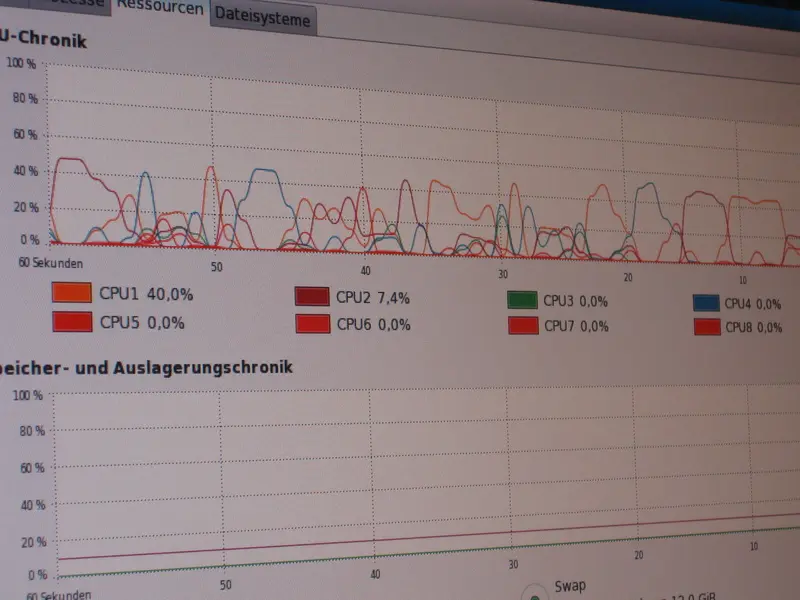
I have got a new computer. As alway i build it myself. How much faster is it?
The functional programming language Haskell provides a very easy way of parallelization.
I tested my ray tracer on Intel Core i7 920 @2.67 MHz.
I tested my ray tracer on my Mac Book Pro.
I wanted to learn about the cell broadband engine in the Playstation 3 and wrote a parallel ray tracer for it.
Almost 10 years after the initial release, i released an updated version of the library of geometric algorithms in Haskell. It now builds with Cabal and requires the Glasgow Haskell...
Memoization is a well known optimization technique to avoid repeated calculations. With dynamic programming languages like Groovy it is possible to extend the behaviour of an already exisiting class at...
JRuby provides access to Java packages, so it is possible to use packages created with the Eclipse Modeling Framework (EMF).
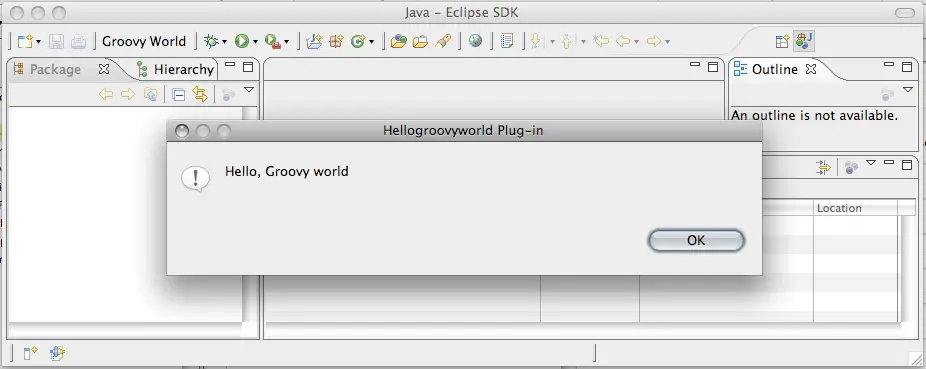
Writing plugins for Eclipse with other languages than Java is not officially supported, but there is a way to write an Eclipse plugin with Groovy only.
I participated at Eclipse BugDays in July, August, September, October, and November 2007 and helped debugging the Eclipse projects JDT, PDE/UI, and ECF.
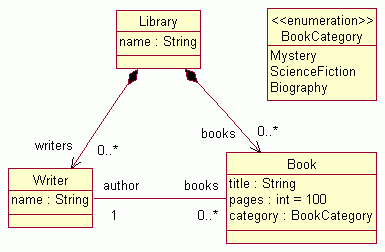
The UML2 project provides an EMF based implementation of the UML 2.x metamodel in Java. With the EMFBuilder it is possible to create and process UML2 models.
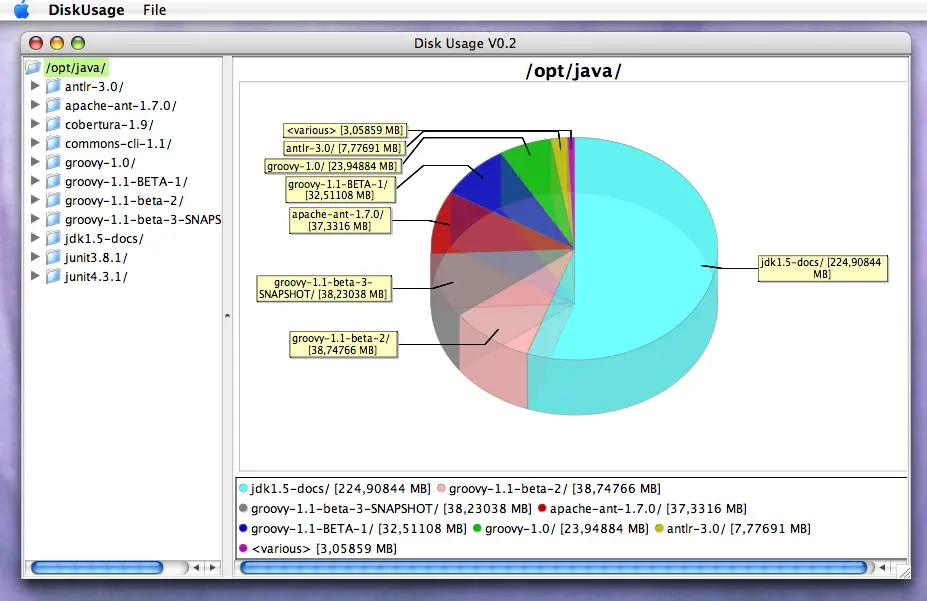
While i was cleaning up my hard disk on my Linux in 2007, i needed a program that displays the disk usage graphically. I didn't find a suitable one on...
This article shows how Groovy can be used with the Eclipse Modeling Framework (EMF).
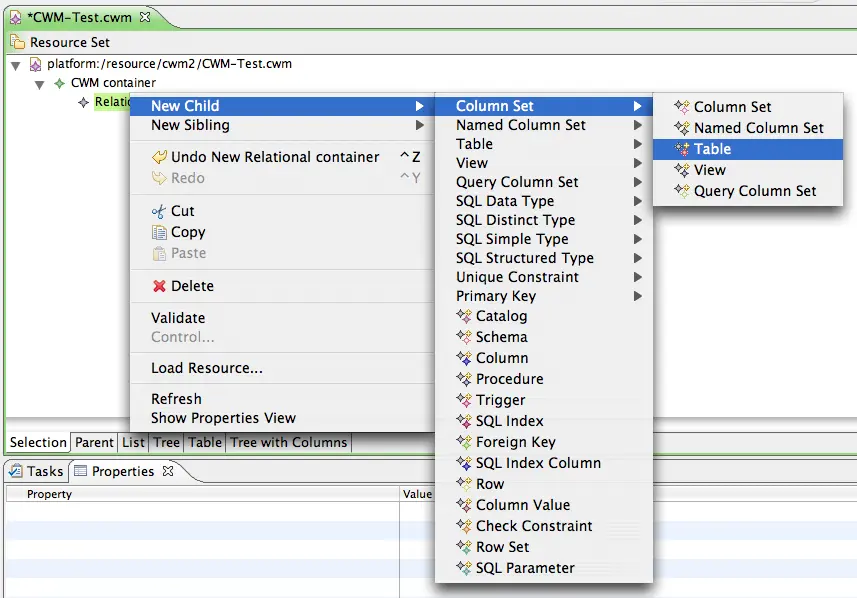
The Common Warehouse Metamodel (CWM) is a standard by the Object Management Group (OMG). The intention of CWM is to define a standard for metadata in Data Warehouses and Business Intelligence applications.
Here’s my second solution for the quiz No 74. It generates text with a first or higher order Markov chains. See also the first order version.
Here’s my solution for the quiz No 74. It generates text with a first order Markov chain.
When i first heard of the Eclipse Modeling Framework (EMF) i got really excited, i tried it out and i wanted to use it.
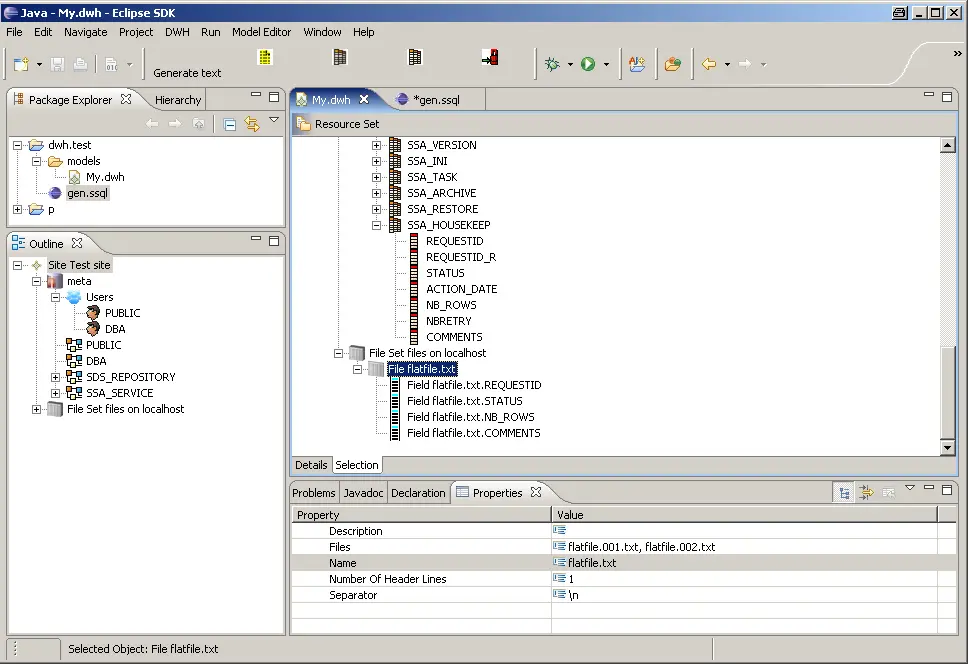
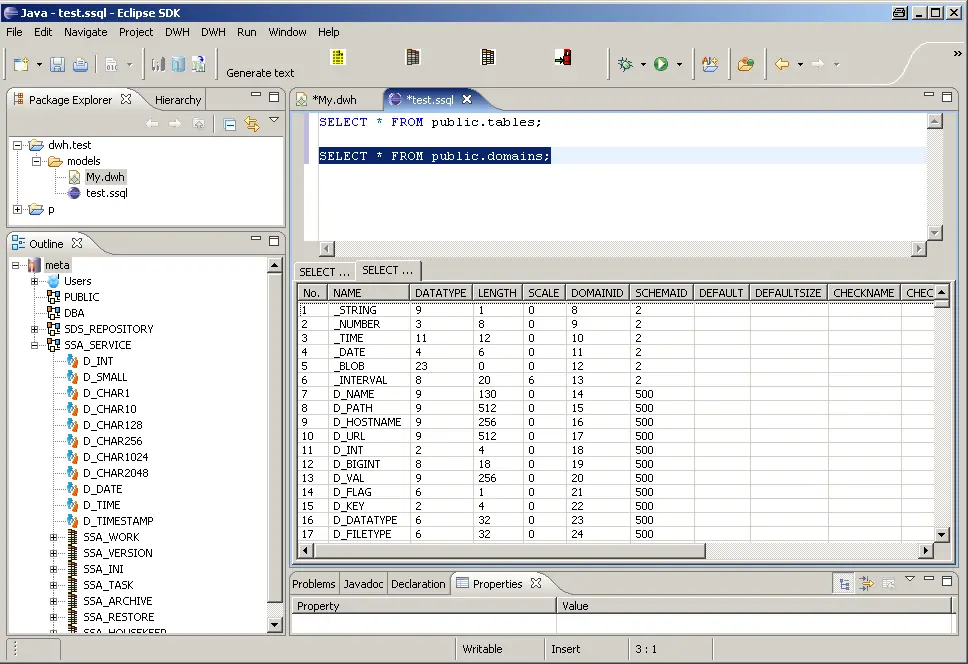
I wanted to find out how hard it is to build a language editor in Eclipse. Back then I didn’t know of any open-source SQL editor (and there wasn’t one...
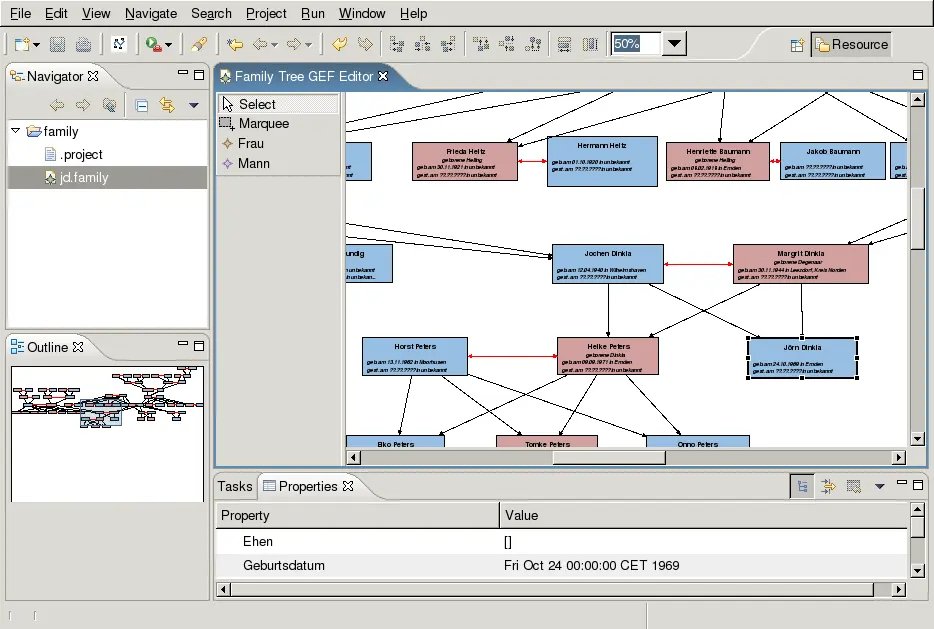
Over Christmas 2004, I built an EMF plugin for family trees. Around Easter 2005, I finally found the time to develop a GEF-based editor for it.
In my diploma thesis I investigate functional programming and geometric algorithms
In this seminar paper (1996), written during my graduate studies in computer science, I cover scheduling algorithms for distributed real-time systems.
A seminar paper on optimal parallel algorithms for prefix sums and list ranking.
Programming TrueColor graphics with the Diamond Speedstar 24x