The Poet · Life & Legend
Who Was Homer?
- Legend ancient tradition
- Disputed open argument
- Evidence datable material
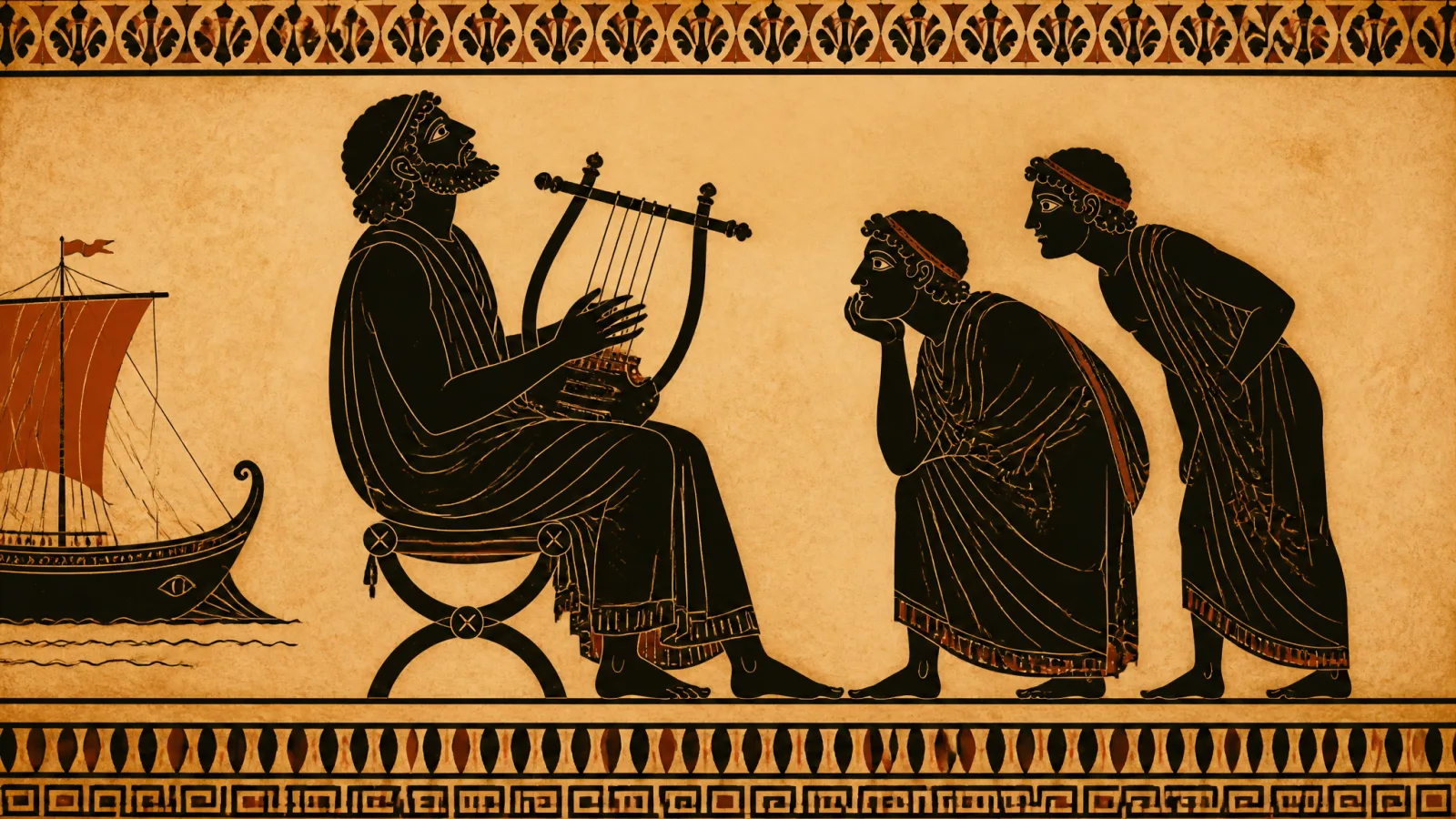
No contemporary record of Homer exists. Everything specific (the birth by the river Meles at Smyrna, a mother named Cretheis, the birth-name Melesigenes, the blindness, the wandering) belongs to legend, assembled centuries after the poems by biographers who were writing literature, not history. The chief ancient sources, a Life of Homer passed off under Herodotus' name and the Contest of Homer and Hesiod, survive in versions from around the second century CE. By the Byzantine period some twenty cities claimed him as a son; the traditional list of seven runs Smyrna, Rhodes, Colophon, Salamis, Chios, Argos, Athens.
Seven cities vied for Homer dead, through which the living Homer begged his bread.
traditional epigram
Blind, born Melesigenes at Smyrna, connected to Chios, where a guild of rhapsodes — the Homeridae — claimed descent from him. The blindness is probably modeled on Demodocus, the blind bard inside the Odyssey. Chios has the strongest ancient claim; none of it is verifiable.
The Homeric Question
For two centuries the argument ran between Analysts, who read the poems as patchworks stitched by many hands and hunted inconsistencies as seams (the founding text is Friedrich August Wolf's Prolegomena ad Homerum, 1795), and Unitarians, who argued from artistic unity for a single master poet. Milman Parry dissolved the terms of that debate. In work culminating in his 1930 Harvard research, he showed that Homeric diction is a system of formulas: fixed noun-epithet combinations like "swift-footed Achilles" and "wine-dark sea," deployed with an economy (one formula per metrical slot) that only a long oral tradition could have produced. To test it, Parry and his student Albert Lord recorded South Slavic guslar singers (epic performers to the one-stringed gusle) in Yugoslavia in 1933–35, gathering over 12,000 texts; Lord's The Singer of Tales (1960) became the classic statement. The working vocabulary of Homeric scholarship comes from this turn: formula, epithet, type-scene (recurring arming, feasting, supplication scenes), and ring composition (A-B-C-B-A structuring).
What remains genuinely open: whether writing was used at the moment of composition; how fixed the text was before Alexandria; and whether the Iliad and the Odyssey are by the same poet. Gregory Nagy argues for gradual crystallization through performance with no single author at all; Martin L. West argued for a writing poet of the seventh century — and for two different poets.
The current consensus, stated carefully: the poems are the product of a long oral-formulaic tradition, given monumental form in the eighth or seventh century BCE, plausibly by one exceptional poet for the Iliad, and possibly a different one for the Odyssey. The question "did Homer exist?" has become "how did an oral tradition become these two fixed texts?": a question about a process, with a person only dimly visible inside it.
How the poems are dated
No single find dates Homer; three lines of evidence converge. The language itself is a Kunstsprache (an artificial literary idiom never spoken by anyone): predominantly Ionic with an Aeolic layer and fossilized Mycenaean survivals, showing the diction accreted over centuries. The Greek alphabet appears in the eighth century. And the earliest substantial inscriptions already know epic: a cup from Pithekoussai jokes about Nestor's great cup from Iliad Book 11 within a generation or two of the poems' likely composition.
- c. 850 BCE Herodotus places Homer 'not more than 400 years before my time' Legend
- 8th century BCE The Greek alphabet is adapted from Phoenician — Barry Powell argued: perhaps to record hexameter verse Evidence
- c. 750–650 BCE The Iliad, then the Odyssey, take monumental form — 8th or 7th century remains argued Disputed
- c. 740 BCE The Dipylon oinochoe: a hexameter line in Attic ink, one of the two oldest substantial Greek inscriptions Evidence
- c. 735–720 BCE 'Nestor's Cup' from Pithekoussai jokes about Iliad Book 11 — the epic was already known well enough to parody Evidence
The Dipylon oinochoe (Athens, c. 740 BCE) and "Nestor's Cup" (Pithekoussai, c. 735–720 BCE) are the two oldest substantial Greek alphabetic texts — and the second is already parodying the Iliad. Whatever Homer was, Homeric material was circulating by then.
Two roads lead on from here: the Iliad and the Odyssey for what the poems actually say, and transmission for how they survived to be read at all.