The Evidence · Bronze Age
Troy & History
- Legend ancient tradition
- Disputed open argument
- Evidence datable material
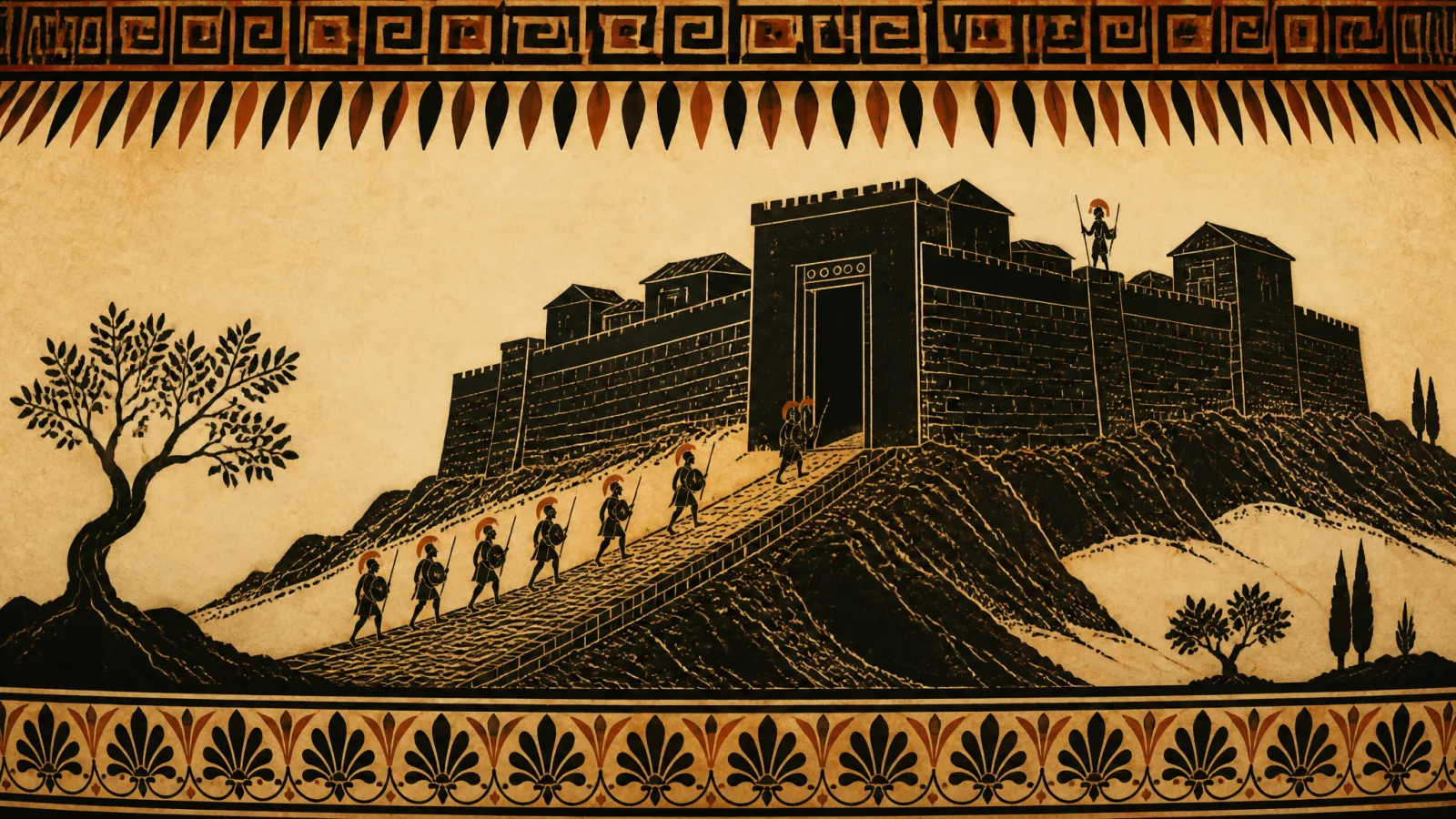
The defensible position fits in one sentence: Troy is real; Late Bronze Age conflict over Wilusa is documented; Homer's specific war is unproven. Everything else on this page is the evidence behind those three clauses.
Digging Hisarlik
The mound of Hisarlik in northwest Turkey has been excavated for a century and a half, and each generation's Troy has been different. Heinrich Schliemann dug from 1870, identified the mound as Troy, and claimed "Priam's Treasure" — from a layer far too early. His successor Wilhelm Dörpfeld championed the imposing citadel of Troy VI; Carl Blegen (Cincinnati, 1930s) argued for Troy VIIa, destroyed by war around 1180 BCE. Then Manfred Korfmann (Tübingen, 1988–2012) changed the scale of the question: his team revealed a lower city of more than 200,000 square meters, making Troy a major Anatolian center rather than a hilltop fort. Korfmann began as an agnostic — excavating "an Anatolian site in its own right" — and ended concluding the burden of proof had shifted to the skeptics.
The Hittite file
Troy's neighbors kept archives. Cuneiform tablets from Hattusa, the Hittite capital, name a western vassal city Wilusa — matching the Greek Wilios/Ilios, the older form of "Ilium" (the poems' meter still remembers the lost initial sound, the digamma Ϝ) — and a sea power Ahhiyawa, widely equated with the Achaeans, Homer's usual name for the Greeks. The Alaksandu treaty (c. 1280s BCE) binds a king of Wilusa whose name echoes Paris' alternate name, Alexandros; the Tawagalawa letter (c. 1250 BCE) recalls past Hittite–Ahhiyawan friction over Wilusa itself.
- c. 1400–1200 BCE Linear B palace bureaucracies at their height — a redistributive world quite unlike Homer's warrior-aristocrats Evidence
- c. 1280s BCE The Alaksandu treaty binds Wilusa's king to the Hittite crown — his name echoes Paris' alternate name, Alexandros Evidence
- c. 1250 BCE The Tawagalawa letter records past Hittite–Ahhiyawan friction over Wilusa Evidence
- c. 1180 BCE A destruction layer at Troy VIIa — a strong candidate for a 'Trojan War' event Evidence
- 1184 BCE The traditional date for Troy's fall, computed in antiquity from genealogies Legend
A real city at Hisarlik with a destruction layer around 1180 BCE; real Late Bronze Age geopolitics, in writing, involving Wilusa and Ahhiyawa. War over this place, in roughly the right era, is documented.
The equations Wilusa = Troy and Ahhiyawa = Achaeans are widely but not universally accepted — and as the Hittitologist Trevor Bryce cautions, no tablet documents the ten-year siege Homer describes. The specific war remains unproven.
The world behind the poems
Whatever happened at Troy, the society Homer describes is not the society that fought there. The Linear B tablets (deciphered by Michael Ventris in 1952) show Mycenaean Greece (c. 1400–1200 BCE) as a bureaucratic, palace-centered redistributive economy — inventories, rations, allotments — nothing like the poems' world of independent warrior-aristocrats trading gifts and insults. Some names and objects survive the gap: the boar's-tusk helmet the Iliad describes is genuine Bronze Age equipment, and several divine names already appear on the tablets. But the poems also contain cremation, iron, and other habits of centuries later. Moses Finley's The World of Odysseus (1954) placed the poems' society in the "Dark Age" of the tenth–ninth centuries; many scholars now prefer to call the picture a poetic amalgam — a stratified memory, like the site itself.
The date 1184 BCE for Troy's fall — computed by ancient scholarship working backward from genealogies — is tradition, not archaeology. It happens to sit close to the Troy VIIa destruction layer, which is part of its charm and none of its proof.
Between the destruction layer and the poem lie four centuries of singers; the Homeric Question asks what happened in them. The poem's own journey onward, from Athens to Alexandria to your shelf, runs through transmission.