The Poems · II
The Odyssey
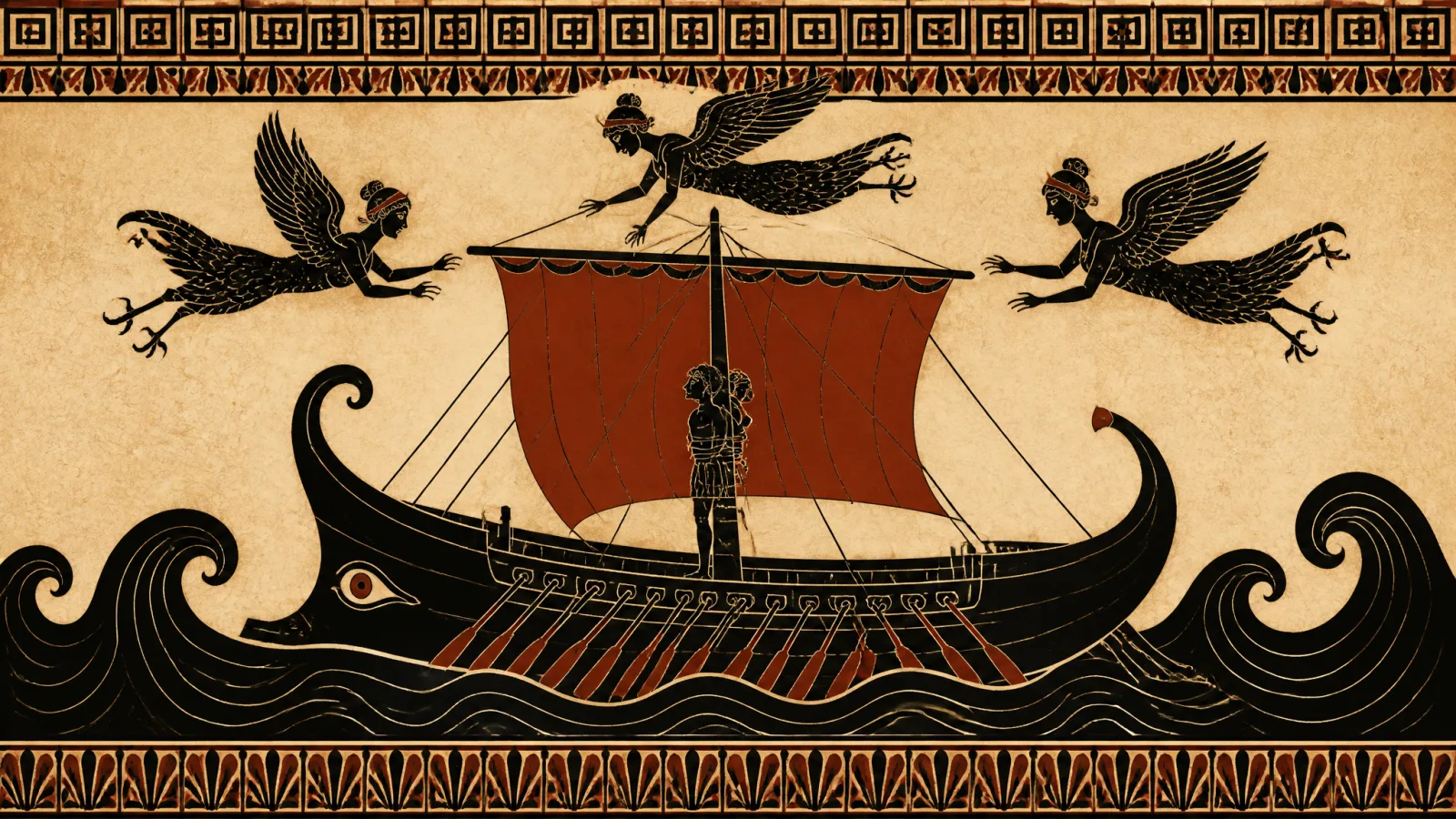
Where the Iliad is a tragedy compressed into fifty-one days, the Odyssey is a homecoming stretched across ten years: about 12,100 lines in twenty-four books, built around nostos (νόστος, the homecoming): the last, hardest return of the last Greek still missing. It is also the more modern-feeling poem: nested narrators, flashbacks, a hero who survives by mētis (μῆτις, cunning intelligence) rather than force, and a marriage as its final battlefield.
Tell me, O Muse, of that ingenious hero who travelled far and wide after he had sacked the famous town of Troy. Many cities did he visit, and many were the nations with whose manners and customs he was acquainted. Odyssey, Book 1 — trans. Samuel Butler (1900) · public domain
The architecture
| Books | Movement |
|---|---|
| 1–4 | Telemachy — the son goes looking for the father |
| 5–8 | Calypso to the Phaeacians — the hero surfaces |
| 9–12 | Apologoi — Odysseus narrates the wanderings |
| 13–20 | Ithaca in disguise — the household tested |
| 21–24 | Bow, slaughter, recognition — the homecoming completed |
The poem moves in named blocks. The Telemachy (Books 1–4): Odysseus' son Telemachus, raised fatherless among his mother's parasitic suitors, travels for news. Books 5–8: Odysseus, long captive with the nymph Calypso, is released and washes up among the Phaeacians. The Apologoi (Books 9–12): at a Phaeacian banquet, Odysseus himself narrates the famous wanderings: the Cicones, the Lotus-Eaters, the Cyclops Polyphemus, Aeolus' bag of winds, the cannibal Laestrygonians, Circe, the journey to the dead, the Sirens, Scylla and Charybdis, the fatal Cattle of the Sun. Then the second half filmmakers usually skip: back on Ithaca in disguise (13–16), tested and abused in his own palace (17–20), the contest of the bow and the slaughter of the suitors (21–22), the recognition by Penelope (23), and the settlement with the dead suitors' families (24).
What it is about
The Odyssey is a systematic study of xenia (ξενία, the guest-host bond): the Phaeacians and the swineherd Eumaeus honor it, the Cyclops eats his guests, and the suitors — guests devouring a household — violate it so thoroughly that their slaughter reads, in the poem's ethics, as justice. Identity is the other engine: Odysseus is "Nobody" in the Cyclops' cave, a beggar in his own hall, and is recognized in stages — by his dog Argos, by the old nurse Eurycleia through a scar, and finally by Penelope, who tests him with the secret only the two of them share: their marriage bed is built around a living olive tree and cannot be moved. Penelope's loyalty, tested for twenty years, is the poem's quiet counterweight to every marvel.
Reading it now
Note what the poem does not do: it does not end at the reunion. Book 24 settles the blood-feud the killings started (the ancient world took consequences seriously), and even in Book 23, husband and wife exchange stories before they sleep. For a first read in plain prose, Samuel Butler's public-domain version is hard to beat; the translations page maps the alternatives. For what filmmakers keep doing to this poem — and what Christopher Nolan just did — see Homer on screen.