The Poems · I
The Iliad
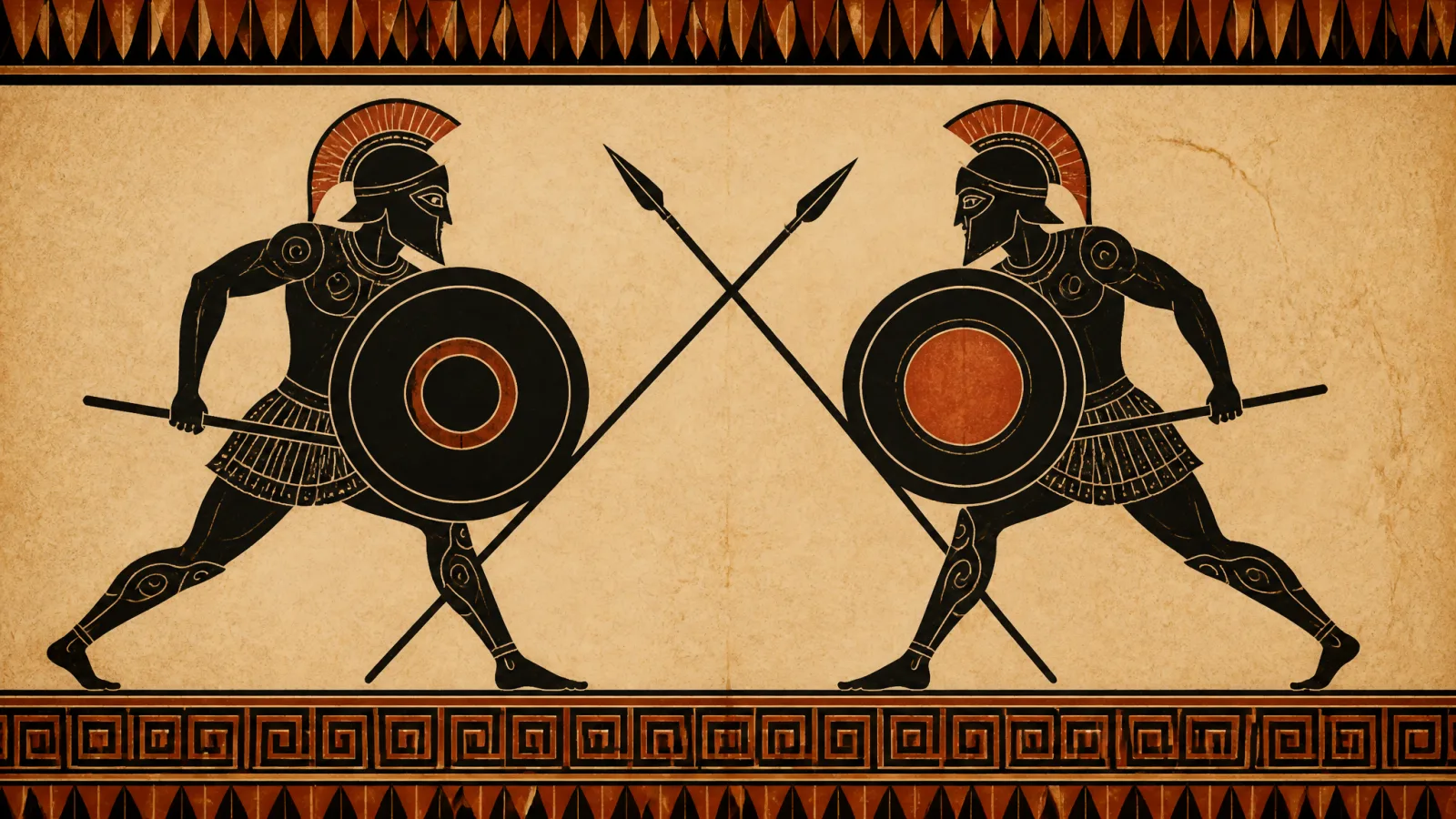
The Iliad is not the story of the Trojan War. Its twenty-four books cover about fifty-one days of the war's tenth year, and its subject is announced in the poem's first word: mēnis (μῆνις, "wrath") — the wrath of Achilles. Troy does not fall in it; the Wooden Horse never appears. The poem's roughly 15,700 hexameter lines are spent on something narrower and deeper: what one man's rage costs everyone around him, and what it finally costs him.
Sing, O goddess, the anger of Achilles son of Peleus, that brought countless ills upon the Achaeans. Iliad, Book 1 — trans. Samuel Butler (1898) · public domain
The arc, wrath to ransom
Agamemnon seizes Achilles' war-prize Briseis and with her his honor; Achilles withdraws from the fighting, and the Greeks bleed for it. His companion Patroclus puts on Achilles' armor to save the camp and is killed by Hector. Achilles returns — no longer for honor but for revenge — kills Hector, and drags the corpse behind his chariot. Then comes the ending nobody would predict from the first book: in Book 24, old king Priam crosses the battlefield at night to beg back his son's body, and the killer and the bereaved father weep together. The poem closes not with victory but with a funeral, and one of literature's great scenes of shared mortality.
What it is about
The heroic economy runs on two currencies: timē (τιμή, present honor and status) and kleos (κλέος, undying fame won through deeds and death). Achilles' tragedy is that he holds both currencies and finds them worthless against a short life; the Iliad keeps fate, the gods — Hera, Athena and Poseidon for the Greeks, Apollo, Aphrodite and Ares for Troy, Zeus arbitrating — and human mortality in a single frame. The gods are immortal and therefore, the poem keeps implying, less serious than the people; only beings who can die have something at stake.
Set pieces worth knowing by name
The Catalogue of Ships (Book 2), a formal muster of the Greek world; the duel of Paris and Menelaus; Hector's farewell to Andromache (Book 6), the war seen from inside a marriage; the Shield of Achilles (Book 18), the great ekphrasis (an extended verbal description of an artwork) in which the smith-god forges the whole cosmos — cities at peace and at war — onto one piece of armor; the funeral games for Patroclus (Book 23); and the ransom of Hector (Book 24). Among the Greeks: Achilles, Agamemnon, Odysseus, Ajax, Diomedes, old Nestor. In Troy: Hector, Priam, Hecuba, Paris, Andromache, Helen.
The Iliad assumes you know how the war began and how it will end — that material lived in other epics, now lost. Whether any of it happened is the question the archaeology of Troy can partly answer. And which English Iliad to read is a real choice — the translations differ more than you'd think.