The Evidence · The Text's Journey
Transmission
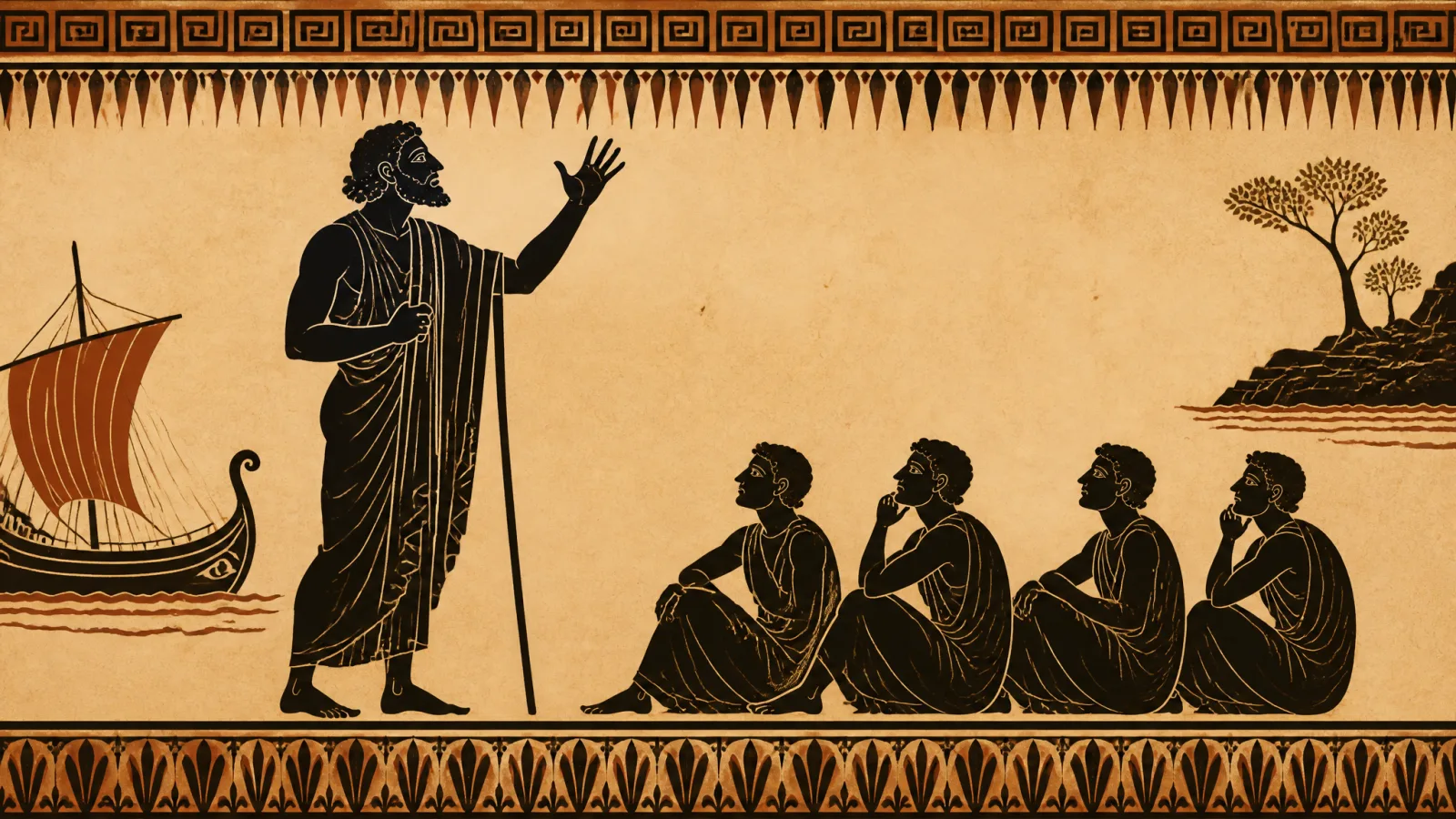
Every Homer you can buy descends from a chain of performers, editors, and copyists nearly three thousand years long — and the chain is visible, link by link. The poems were carried first by rhapsodes (professional reciters, literally "song-stitchers"), among them the Homeridae of Chios, who claimed the poet as an ancestor; by the sixth century BCE the epics were fixtures of Athens' great Panathenaic festival. A persistent ancient tradition credits the tyrant Peisistratus with commissioning a definitive Athenian text — the "Peisistratean recension" — though most modern scholars doubt any formal recension took place.
Alexandria makes the text
The decisive editing happened at the Library of Alexandria. Zenodotus of Ephesus (early third century BCE) was the first editor, and possibly the source of the familiar division into twenty-four books; Aristophanes of Byzantium refined the work; and above all Aristarchus of Samothrace (c. 216–144 BCE) produced the text that became the ancient standard. His method still reads as modern scholarship: lines he judged doubtful were marked with a critical sign, the obelos (ὀβελός, a horizontal spit-mark in the margin), rather than deleted. Hundreds of surviving papyri show "wild" texts — extra lines, variant readings — circulating before the Alexandrians, and increasing standardization after them.
- 6th century BCE The 'Peisistratean recension' in Athens — most modern scholars doubt any formal recension occurred Disputed
- early 3rd century BCE Zenodotus of Ephesus, first editor at the Library of Alexandria, possibly behind the 24-book division Evidence
- c. 216–144 BCE Aristarchus of Samothrace — his text becomes the ancient standard; doubtful lines marked with the obelos, not deleted Evidence
- 10th century CE The Venetus A is written — the single most important Iliad manuscript, its margins preserving Aristarchus at second hand Evidence
- 1488 The first printed Greek Homer appears in Florence Evidence
- 1795 Friedrich August Wolf's Prolegomena ad Homerum opens the modern Homeric Question Evidence
- 1933–35 Milman Parry and Albert Lord record South Slavic guslars — over 12,000 texts — and remake the Question Evidence
One book carries the tradition
Aristarchus' own editions are lost. We know his work largely through scholia — layers of ancient marginal commentary — and the greatest carrier of those is a single volume: the Venetus A (Marcianus Graecus 454), a tenth-century Byzantine manuscript of the Iliad now in Venice, whose margins preserve over a thousand references to Aristarchus. It is the most important Iliad manuscript in existence, and you can leaf through it: the Homer Multitext project has photographed it in high resolution (see resources).
Losing and refinding Homer
Greek tragedy grew out of Homeric material; Virgil's Aeneid answered it in Latin. In Byzantium the tradition never broke — Eustathius of Thessalonica wrote vast twelfth-century commentaries — but the Latin West lost the Greek language and with it the poems, making do for centuries with Latin summaries and the pseudo-eyewitness accounts of "Dares" and "Dictys." Petrarch owned a Greek Homer he could not read. The Renaissance closed the gap: the first printed Greek Homer appeared in Florence in 1488, and the poems have not been out of print since. The modern critical landmark is Martin L. West's Teubner editions (Iliad 1998–2000; Odyssey 2017) — the latest links in Aristarchus' chain.
The chain ends in your hands: pick an English translation and read tonight. Or turn the same evidence around and ask who stood at the chain's beginning — the Homeric Question.