The Poems · The Lost Shelf
Beyond the Epics
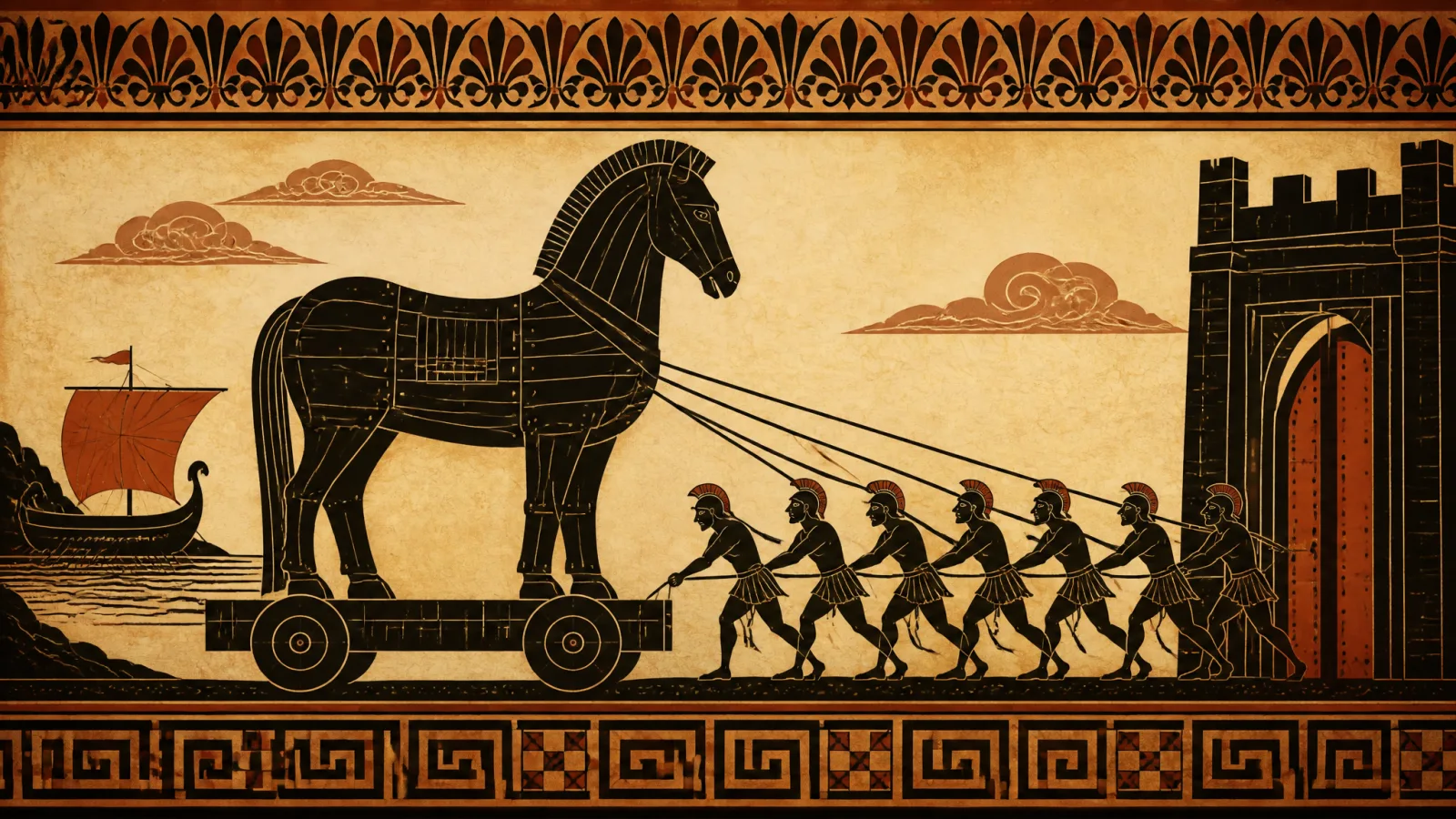
The Iliad and the Odyssey were never the whole story: they were the two survivors of a shelf. Six other epics, the Trojan cycle, once carried the war from its causes to its last aftershock. All are lost, surviving only in fragments and in a late prose summary (the Chrestomathy attributed to "Proclus"). In the order of the story they told:
- Cypria (11 books, attributed to Stasinus) — the origins of the war through its first nine years.
- Aethiopis (5 books, Arctinus of Miletus) — the Amazon Penthesilea and the Ethiopian king Memnon; the death of Achilles.
- Little Iliad (4 books, Lesches) — the judgment of Achilles' arms; the building of the Wooden Horse.
- Iliou Persis, the Sack of Troy (2 books, Arctinus) — the destruction of the city.
- Nostoi, the Returns (5 books, Agias or Eumelus) — the other Greeks' homecomings, including Agamemnon's murder.
- Telegony (2 books, Eugammon of Cyrene) — Odysseus' last adventures and his death at the hands of Telegonus, his son by Circe.
The cycle is why the Iliad can begin in year ten and the Odyssey can assume you know who Agamemnon is: the audience carried the rest. Already Aristotle, in the Poetics, observed that the Iliad and Odyssey are unusually unified (one action each) where the cyclic poems were episodic; that difference is much of why they survived and the shelf did not. The modern school called Neoanalysis studies how the two survivors drew on and reworked the older cyclic material — Achilles' death, foreshadowed everywhere in the Iliad, happened in a poem we no longer have.
The rest of "Homer"
Antiquity filed more under Homer's name than the two epics. The Homeric Hymns: thirty-three hexameter hymns to the gods, composed from the seventh century onward — the long hymns to Demeter, Apollo, Hermes, and Aphrodite are major poems in their own right. The Batrachomyomachia ("Battle of Frogs and Mice"): a mock-epic parody, probably Hellenistic, in which the machinery of heroic warfare is deployed over a pond. And the Margites, a lost comic poem about a foolish hero, referenced by Aristotle; Colophon's claim to be Homer's birthplace partly rested on it.
None of these is by the poet (or poets) of the Iliad and Odyssey. But the attributions are themselves evidence of what "Homer" became: less a biography than a label for the entire archaic hexameter inheritance. The label survived because the inheritance did, carried for centuries by performers, editors, and copyists — transmission follows that trail.