Phase 2 · Mid-term
2029–2031: The bottleneck window
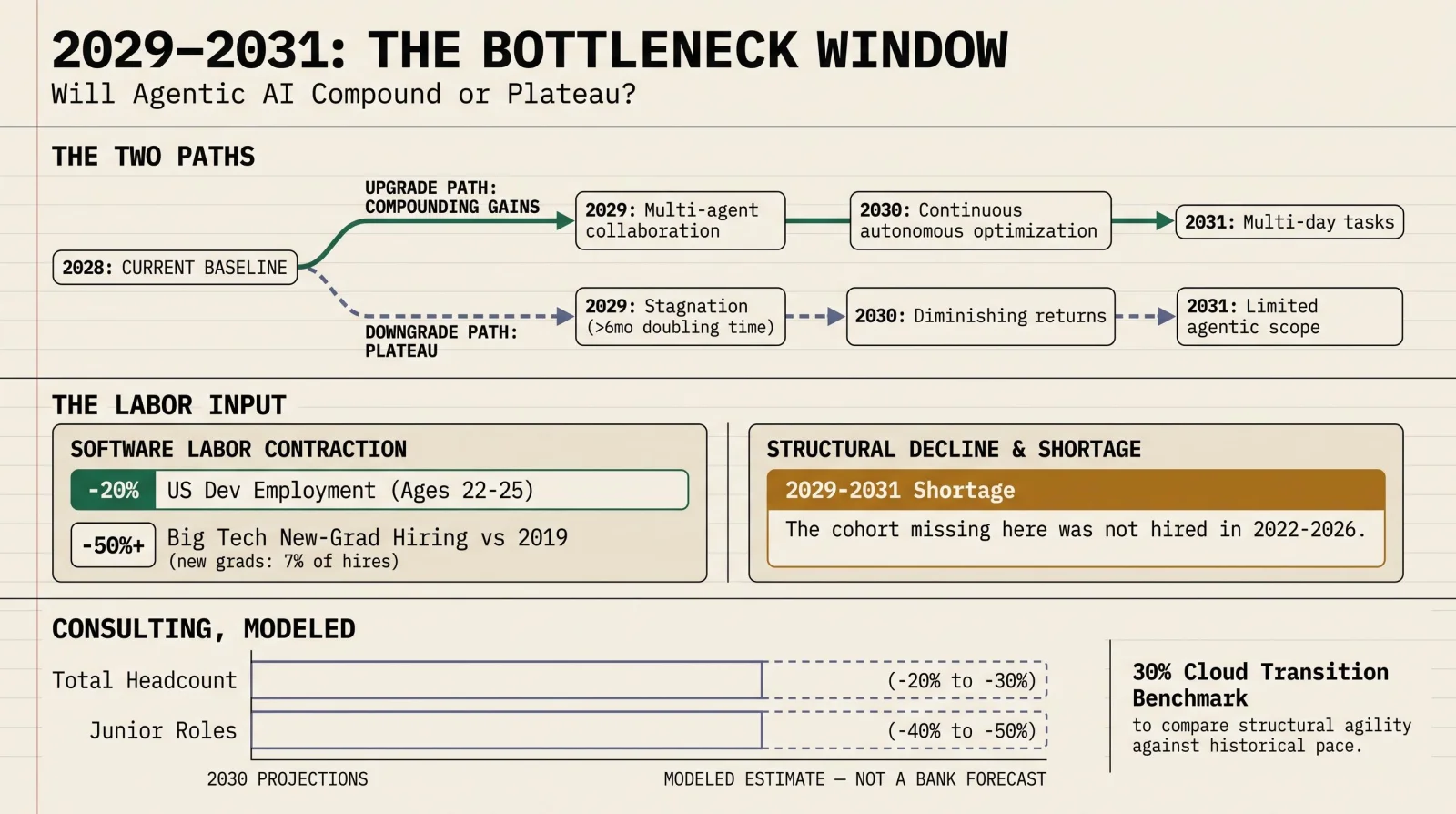
This is the decision window. 80,000 Hours calls 2028–2032 a potential “make-or-break period” for AGI-grade progress 80,000 Hours · Feb 2026; for these two professions, the operative question inside that window is whether agentic coding compounds — the programming feedback loop activates, and capability gains accelerate themselves — or visibly plateaus. Everything in this phase is conditional on which branch the evidence takes; the term sheet deliberately carries no standalone percentage, because this phase’s probability is inherited — it is whatever Phase 1 resolved to.
Re-price when Upgrade this phase if, by end-2028, agents routinely complete multi-day tasks with review-by-sampling (METR horizon comfortably past a working day under standardized measurement). Downgrade toward the plateau branch if the doubling time has stretched beyond ~6 months or SWE-bench-Pro-class benchmarks stagnate for four consecutive quarters.
Software: the mid-level shortage the industry ordered in 2024
The tracker milestones for this window — multi-agent collaboration in 2029, continuous autonomous optimization in 2030 — describe fleets, not copilots: agents reviewing agents, with humans setting objectives and auditing samples. Whether that works at organizational scale depends on the verification economics established in Phase 1, and on inference cost curves: fleets multiply token spend, and “continuous” optimization is only continuous if someone approves the invoice.
The labor consequence is already baked in. The entry-level contraction of 2023–2026 — US developer employment aged 22–25 down nearly 20% from peak Stanford Digital Economy Lab · Nov 2025, Big Tech new-graduate hiring down more than 50% from 2019 with new grads just 7% of hires SignalFire · 2025 — means the cohort that would have become 2029’s mid-level engineers is significantly smaller. Expect a mid-level/senior shortage in exactly this window, with the German two-speed market (structural shortage above, broken pipeline below) as the leading indicator Bitkom · 2026.
Consulting: fragmentation vs. the firm
Directionally, modeled estimates project consulting headcount declining 20–30% by 2030, with junior roles down 40–50% — treat that as a non-authoritative modeled estimate (it is not a McKinsey or investment-bank forecast, whatever the syndicated versions imply) modeled estimate, e.g. PitchGrade · Feb 2026.
The structural question is more interesting than the headcount one. The Coasean argument — AI agents can perform the activities that constitute transaction costs, “learning prices, negotiating terms, writing contracts, and monitoring compliance,” at very low marginal cost NBER w34468 · Shahidi, Rusak, Manning, Fradkin, Horton · 2025/2026 — implies solo and boutique consultants armed with agent fleets competing credibly against MBB on discrete tasks. The counterweight is Benedict Evans’ calibration: after a decade of cloud evangelism only ~30% of enterprise workloads actually moved, and enterprise AI in 2026 is still mostly pilots Evans, “AI Eats the World” · May 2026. Real reorganization of firm boundaries is slower and lumpier than theory implies. Both forces are real; this timeline refuses to resolve the race artificially — watch the boutiques’ win rate on RFPs they could not have entered in 2024.