Phase 1 · Near-term
2027–2028: Co-ownership under review
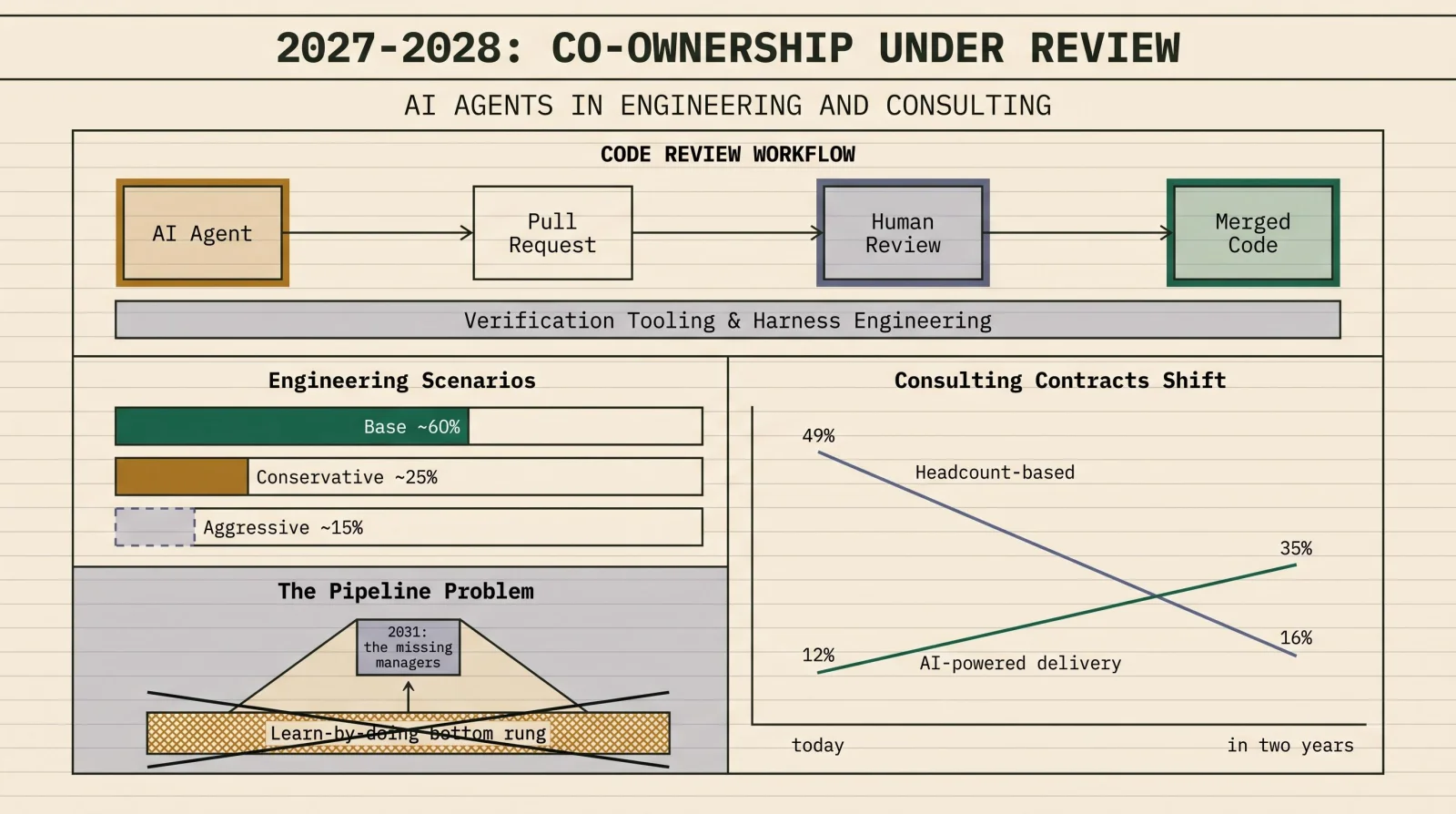
The base case for the next two years is unglamorous: agents become persistent contributors — pull requests, refactors, dependency upgrades — while humans keep the review authority. What changes is not who types, but where the engineering discipline lives: verification tooling and harness engineering become a named specialty with its own budget line.
The scenarios below price the disagreement in the evidence. The METR slowdown result and DORA’s instability finding anchor the conservative case; the capability trend — METR’s measured time-horizon doubling accelerated to roughly 4.3 months from 2023 onward METR Time Horizon 1.1 · Jan 2026 — anchors the aggressive one.
Base ~60%
Agents are persistent contributors under human review; harness engineering becomes a distinct, named discipline with dedicated tooling and budget.
Conservative ~25%
Instability and the verification tax cap net organizational gains; the skeptical DORA/METR evidence dominates real-world outcomes.
Aggressive ~15%
Time-horizon doubling continues on trend; agents reliably complete day-long tasks end to end, and review becomes sampling rather than gatekeeping.
Re-price when Downgrade the base case if METR's doubling time settles above 4 months, or if SWE-bench Pro stays below ~70% under standardized scaffolding through 2027. Upgrade if SWE-bench Pro clears 80% under standardized scaffolding, or a clean post-2026 productivity study shows net organizational gains.
The economics deserve one sober sentence: an agent fleet is not free labor. Multi-step workflows on frontier models burn real inference budget, and through this phase the interesting question is unit economics — when does an agent workflow beat a junior hire on cost, not just on speed? Teams that track cost-per-merged-PR will make better calls than teams that assume the artifact is free.
Consulting: the model shift gets contractual
If HFS’s respondents are right, this is the window where headcount-based contracts fall from 49% toward 16% and AI-powered delivery triples to 35% HFS Research · Nov 2025 — the shift moving from investor rhetoric into signed contracts: productivity commitments, outcome-based pricing, gain-sharing. Outcome and subscription pricing become mainstream rather than experimental; AI-native boutiques keep proving the obelisk shape works at smaller scale.
The unresolved casualty is the apprenticeship. The Big Four’s “learn by doing” bottom rung was already contracting in 2024; two more years of that and the profession’s training pipeline becomes an acute problem — not for 2028’s partners, but for 2031’s managers. That bill lands in Phase 2.