Phase 3 · Long-term
2032–2036: Ranges, not points
Speculative
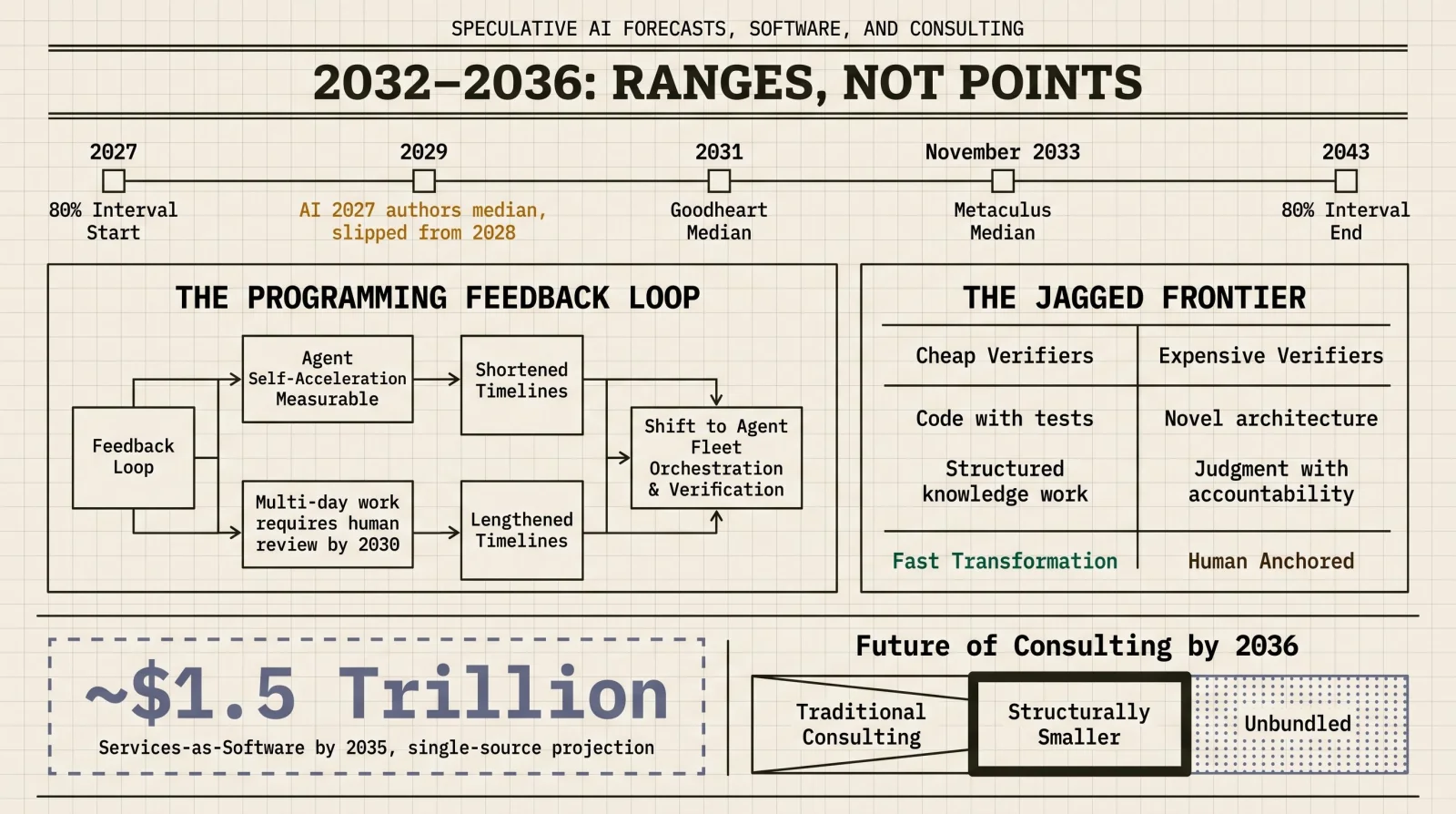
Everything past 2030 in this note is speculation, and it is presented as such. The forecaster communities themselves disagree by more than a decade: at this note’s last verification, the Metaculus community median for AGI sat around November 2033, the Goodheart Labs aggregate median at 2031 — with an 80% interval spanning 2027 to 2043 (live dashboards; the figures drift) Metaculus · Goodheart Labs · 2026. Any single-year claim about this window is rhetoric wearing a number.
The one variable that compresses or stretches every estimate is the programming feedback loop: if agents materially accelerate the development of better agents, timelines shorten everywhere at once; if not, this phase looks like a bigger Phase 2. For calibration, the AI 2027 scenario tracks near its predicted pace on the METR metric, but its own authors self-assess overall progress at ~65% of prediction, with their AGI median slipping from 2028 to 2029 AI 2027 self-assessment · 2026.
Re-price when Treat the short end of the range as live if the programming feedback loop shows measurable self-acceleration (agent-built tooling driving successive METR-horizon jumps). Slide toward the long end if 2030 passes with agents still requiring human-in-the-loop review for multi-day work.
Software: the jagged frontier as job description
If the loop activates, software work in this window is dominated by orchestration and verification of agent fleets — specification as the primary artifact, review as sampling and auditing. The jagged-frontier logic governs which domains move first: where verifiers are cheap (code with tests, structured knowledge work), transformation is fast; where verifiers are expensive (novel architecture, essential-complexity specification, judgment with accountability attached), humans remain the anchor. That asymmetry — not any single capability number — is the load-bearing prediction of this entire note, in every scenario including the slow ones.
Consulting: Services-as-Software, sized soberly
HFS projects “Services-as-Software” growing into a ~$1.5 trillion market by 2035, absorbing revenue from both traditional IT services and SaaS HFS Research · 2025 — a single-source projection to track annually, not to bank. Deloitte has reportedly shown its own consultants a chart with traditional labor-based consulting shrinking sharply as a market share by 2035. Read both as the industry forecasting its own disruption — directionally credible, precisely unknowable.
A range, then, instead of a point: by 2036 the consulting profession is plausibly anywhere between structurally smaller but recognizable (obelisk firms, outcome pricing, fewer juniors) and unbundled (agent-armed boutiques and software eating the delivery layer, with brand-name firms selling accountability itself). The dashboard’s metrics — not this page — will say which end is winning.