Phase 0 · The now-state
2026: Adoption is universal, value is uneven
Software has crossed the adoption line outright; consulting’s shift shows up in contracts and pricing models rather than usage surveys. Neither profession has crossed the value line — and the distance between adoption and value is what this whole timeline is about.
Software: everyone uses it, nobody agrees what it’s worth
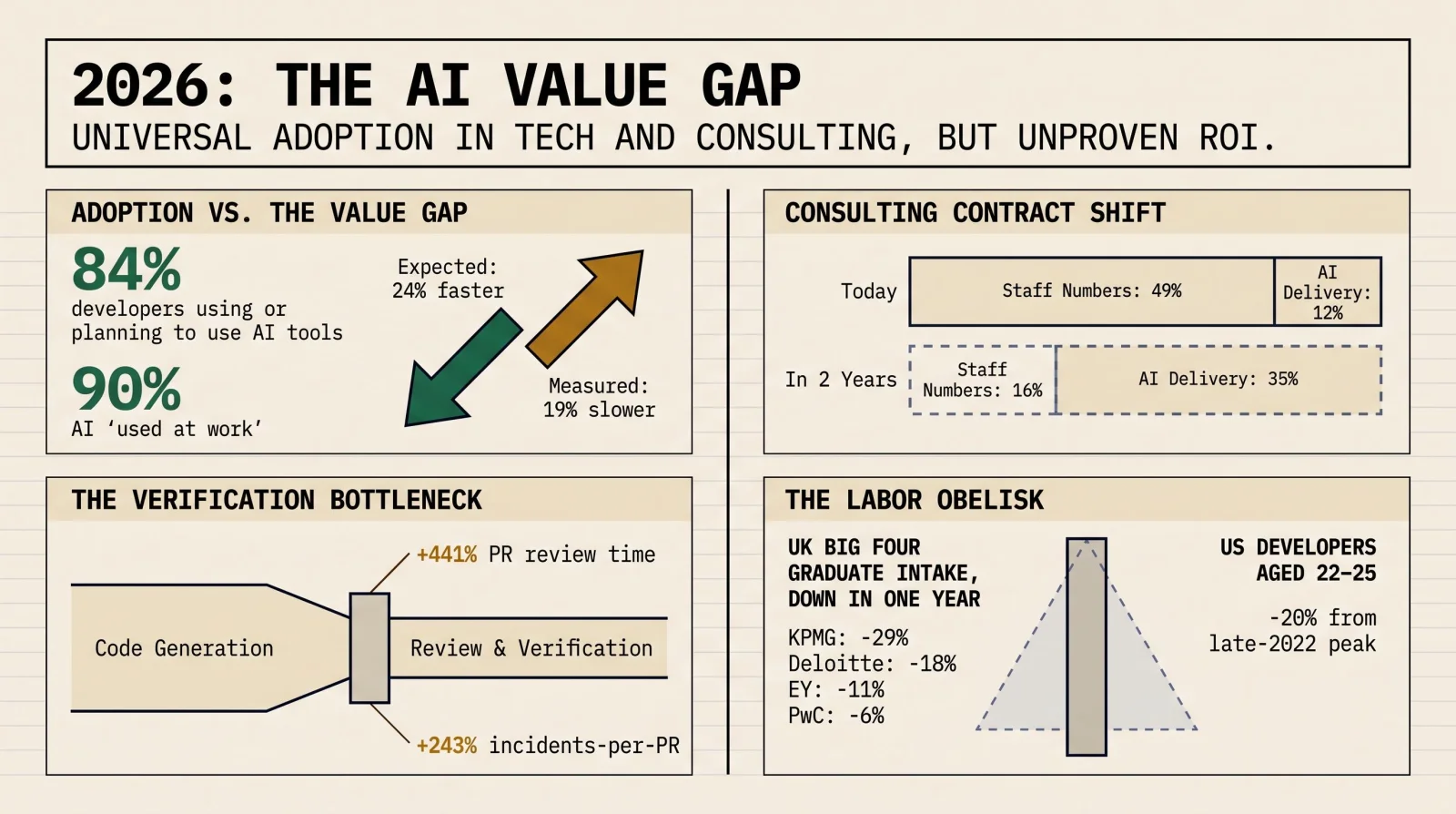
Adoption is no longer the story. Stack Overflow’s 2025 developer survey (49,000+ respondents across 177 countries) put usage-or-planned-usage at 84%, with 51% of professional developers using AI tools daily Stack Overflow · 2025; DORA 2025 and JetBrains both measure “used at work” around 90% DORA 2025, n≈5,000 · JetBrains Jan 2026.
Measured productivity is another matter. The strongest rigorous evidence still points the wrong way:
“Before starting tasks, developers forecast that allowing AI will reduce completion time by 24% … Surprisingly, we find that allowing AI actually increases completion time by 19% — AI tooling slowed developers down.”
That trial used early-2025 tools, and METR abandoned its follow-up in February 2026 because near-universal adoption destroyed the control group — so as of mid-2026 there is no clean RCT on current agentic workflows. On the evidence, the productivity question is open — not settled in either direction.
What the telemetry does agree on is where the friction moved. DORA 2025 finds AI now correlates positively with throughput — a reversal from 2024 — but still correlates with increased delivery instability; its headline is that AI is an amplifier of whatever engineering system it lands in DORA 2025. Faros telemetry across ~22,000 developers reports median PR review time up 441% and incidents-per-PR up roughly 243% Faros · 2026. Sonar’s 2026 survey found the top skill developers now cite is “reviewing and validating AI-generated code” (47%), and “reviewing” has overtaken “writing” as the largest AI-assisted time sink Sonar 2026 · Digital Applied Q1 2026.
Verification is the new bottleneck. Generation got cheaper — the meter still runs, and a fleet of agents on frontier models bills by the token — while review, validation, and accountability got more expensive. The disciplined answers emerging mid-2026 are spec-driven development (GitHub’s Spec Kit: spec → plan → tasks → implement) and harness engineering: statically enforced guardrails, TDD gates, subagent context isolation.
Consulting: the quarter the billable hour cracked
Consulting got its market-shaping event on January 12, 2026: the launch of Claude Cowork triggered a software and professional-services sell-off of roughly $285B in the first 48 hours, growing toward $1 trillion over Q1 as industry plugins and new model releases landed — a figure from financial-press synthesis, directional rather than audited press synthesis · Q1 2026.
Underneath the market noise, the pricing model is genuinely moving. McKinsey discloses that about a quarter of its global fees now come from outcome-based arrangements Michael Birshan via Business Insider · Nov 2025. Bain puts ~30% of its business in AI/tech-enabled work Bain · 2025; BCG’s trajectory from ~20% of revenue (2024) toward ~40% is, per its own April 2026 release, already realized — over 40% of 2025 revenue BCG · 2024–2026 — self-reported figures, not audited disclosures. The best-sourced structural datapoint: HFS Research (1,002 executives, IBM-sponsored) finds 49% of contracts today tied to staff numbers, but only 16% of leaders expect that model within two years, with AI-powered delivery projected to triple from 12% to 35% HFS Research · Nov 2025.
The labor signal is loudest at the bottom of the pyramid. UK Big Four graduate intakes fell hard 2023→2024: KPMG −29%, Deloitte −18%, EY −11%, PwC −6% Telegraph / Morgan data · Jun 2025. In the US, employment for software developers aged 22–25 declined nearly 20% from its late-2022 peak Stanford Digital Economy Lab, Brynjolfsson et al. · Nov 2025. The structure replacing the pyramid already has a name — the obelisk: a tall, narrow organization of AI facilitators, engagement architects, and client leaders HBR · Sept 2025. Indian IT is the clearest repricing: TCS cut ~23,460 jobs in FY26, its largest reduction ever, and the top five firms lost ~46% of combined market value since August 2024 — the market repricing headcount-led growth as such, not weak quarters FY26 filings · Nifty IT.
Germany runs both directions at once: Bitkom counts ~109,000 unfilled IT positions with an average 7.7 months to fill a role Bitkom · 2025/26, even as the junior rungs contract. The market is two-speed: senior and AI-specialist demand is strong; the junior pipeline is broken.
Two more European datapoints belong in the now-state file. CARIAD — Volkswagen’s €14B attempt to build software as a monolithic in-house subsidiary — failed on governance rather than vision, and the ~$5.8B VW–Rivian partnership that replaced it is now itself reporting delays that push Audi and Porsche launches back by years Manager Magazin · 2026. And regulation is a real deployment-speed brake, not a hypothetical: in June 2026 an export-control order briefly switched off a frontier model (Fable 5) worldwide — a production dependency turned off by government order June 2026 export-control episode. European engineering leaders plan against both — and Phase 2 shows where the broken junior pipeline leads.