Humanity has arrived in the information and knowledge society. No sooner have the first changes been digested than more news appears on the horizon: the Internet of Things, Big Data, Data Science, intelligent robots, and self-driving cars with artificial intelligence.
How should these technologies be evaluated? What consequences will they have?
Many people are very skeptical and fear that jobs, privacy, and freedom are threatened by these new technologies. Politicians, in turn, exploit these fears to push through their political and economic interests, as seen in discussions on internet regulation, data protection, fixed book pricing, and bogus self-employment.
But the dangers lurk elsewhere than most suspect.
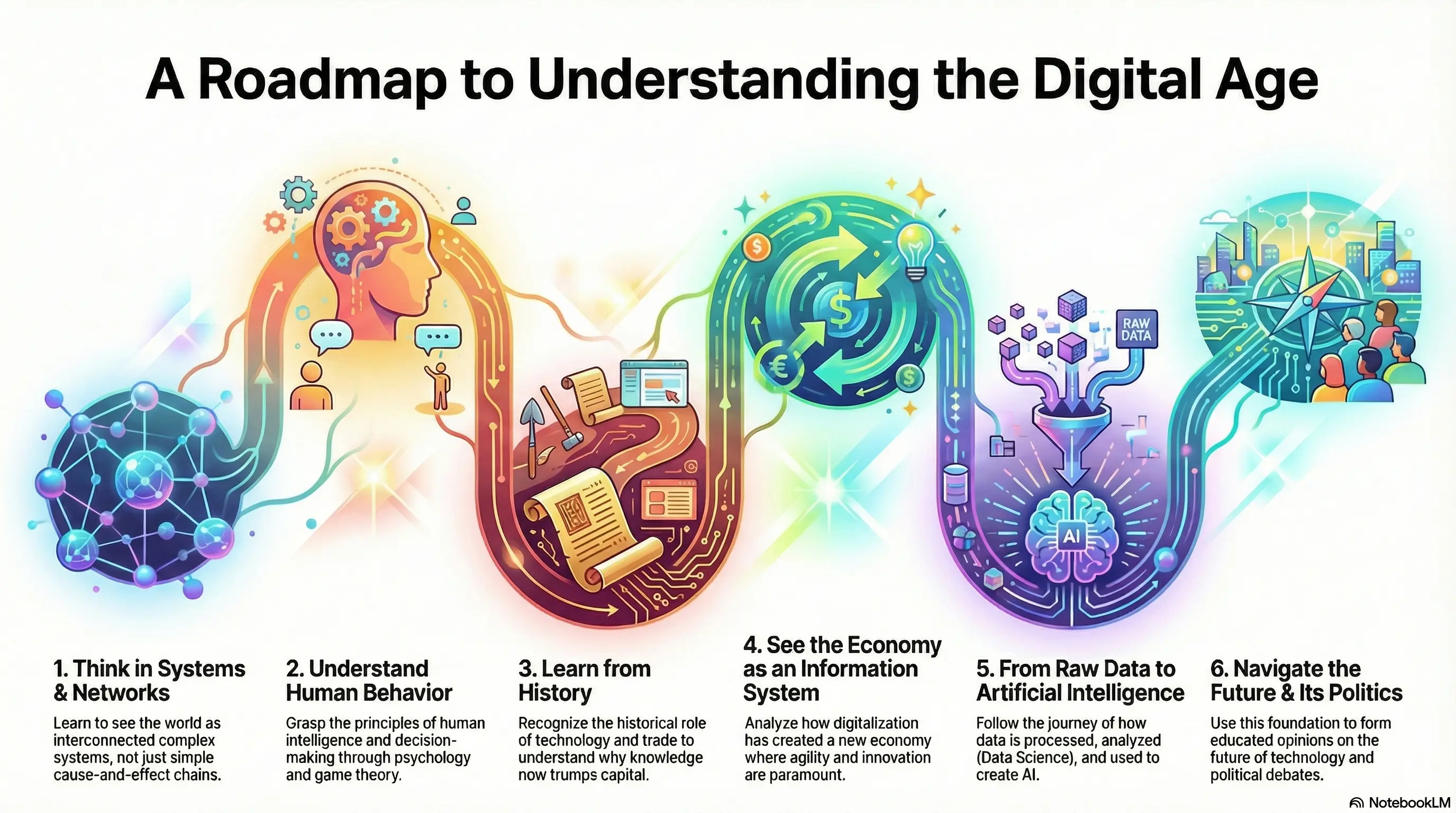
The goal of this book is to convey basic knowledge for the digital economy and society as simply as possible. The book is aimed at everyone, and no special prior knowledge is required. In this book, you will learn, among other things…
- Why complex systems are so difficult to understand and control
- Why data contains important knowledge
- How to process data, store it in databases, and generate knowledge from it using Data Science
- Why Artificial Intelligence is still far from being as intelligent as humans
- What impact digitization has on the economy and will continue to have in the future
- Why the market economy is an information system and why socialism does not work
- Why “knowledge” is more important than “capital” today and why we don’t actually live in “capitalism”
- Why information technology and innovations are so important for the economy today
- Why progress is becoming faster and faster
- Why politicians should be careful when regulating IT
The topic is so extensive because technology affects so many areas of life. To understand the limits of artificial intelligence, one must also know the limits of human intelligence. To assess the danger of incorrect regulation, one must have basic knowledge of economics. To this end, this book covers the basics of many different areas: data processing, databases, data warehouse, data mining, data science, artificial intelligence, digitization and its economic impact, complex systems, the bounded rationality of humans, human history, economics, markets, globalization, competition, innovation, entrepreneurship, agent-based modeling, and a bit of politics.
After reading this book, you can view the world and technical development from the perspective of “complex systems” and computer science and reassess the “dangers.”
Further information is available on the homepage of the book.