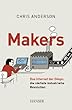
In “Makers: The New Industrial Revolution” (German title: “Makers: Das Internet der Dinge: die nächste industrielle Revolution”), Chris Anderson describes how industrial manufacturing processes using CAD, 3D printing, and/or outsourcing can also be carried out by small business owners.
Decentralization—meaning the widest possible distribution of the means of production, as opposed to socialist centralization—has long been seen by many as a guarantor of freedom and prosperity. The book dates from 2012, and the author describes the situation very enthusiastically, though perhaps a bit too uncritically.
- He does not go into enough detail regarding the industrial use of 3D printers. He writes, “There are no economies of scale.” That may be true on a small scale, but not when 3D printing is used industrially 24/7. How is the plastic refilled? If the model is changed, the computer must calculate the optimal cast, i.e., the paths for the 3D printer. That takes time. Here he writes, “The computer doesn’t care how many calculations it has to perform.” Yes, but it makes a difference in terms of electricity costs. This could become a decisive factor later on, especially with more complex models (particularly if electricity prices continue to rise).
- In my opinion, he doesn’t consider the “knowledge” that a 3D modeler and entrepreneur must possess, nor the infrastructure surrounding 3D operations. In a region like Baden-Württemberg with a lot of industry, there will be more orders than, for example, in East Frisia with little industry. In my view, the economy is not as global as the author describes it.
- The author also does not address the dangers of state regulation (or the EU in our case). As long as 3D printing is only a hobby for a few, it doesn’t hurt established industry. If that changes, there is a risk that established large companies will try to prevent competition. These firms might then lobby the state to enforce cost-intensive regulations that only large corporations can afford.
- Furthermore, legal aspects such as warranties, returns, complaints, customer inquiries, etc., are not handled. The author is American but does not address the situation in the USA either.
- The topic actually only has a marginal connection to the “Internet of Things.” The translator added that to the German book title, as it is not present in the English original.
- The proposed business model of “3D Robotics” unfortunately cannot be generalized to all companies. The company benefits from enthusiasts working on drones for free as a hobby, improving software, and so on. These people still work at other companies and draw their salaries from the “old” economy.
The book is, however, certainly worth reading as an introduction.
- Chris Anderson
- Makers: Das Internet der Dinge: die nächste industrielle Revolution
- Hanser
- 2013
See also the review on Amazon.