A monitor not to be bribed, not to be scared
1795 – 1799 · the last quotations, the plates burned, the mandats, and the bankruptcy of the two-thirds
The year 1794 was exceptionally fruitful, and it ended in scarcity. The sequence is not mysterious and White lays it out without ornament: the Assembly had inflated the currency and raised prices; it had then fixed a maximum price for produce; that price, large as it looked, soon fell below what produce was worth, so farmers raised less or kept what they had off the market, and were compelled by increasingly severe measures to bring it in. Paper money, he writes, seemed to possess a magic power to transmute prosperity into adversity and plenty into famine.
The quantities stop being comprehensible around here, which is itself part of the history. In the seven months to July 1795 the circulation doubled, and then doubled again — the figures are in the margin — while a hundred francs in paper came to buy four francs in gold, then three, then two and a half.
And in the middle of this came an apparent revival of business — a brisk trade in every kind of permanent property, which revived hope in certain quarters until it was understood. Whatever articles of lasting value needy people were willing to sell, cunning people were willing to buy and to pay good prices for in assignats, the Revolution’s land-secured paper. The activity was a symptom and not a recovery: the shrewder sort converting paper into anything they could hold until the collapse they foresaw arrived. White calls it the unloading of the assignats upon the mass of the people, and the phrase he uses for what it was — legal robbery of the more enthusiastic and trusting by the more cold-hearted and keen — is blunt even for him.
What the coin said
Prisons, guillotines, twenty years in chains for buying paper below its nominal value, death for investing abroad: all powerless. The Convention (the government of 1792–95) was fighting a world in arms and an armed revolt on its own soil and showed titanic power doing it, and in its struggle against one simple law of nature its weakness was pitiable. What defeated it was a coin sitting in a market, quoting a price — the louis d’or, whose gold content never changed:
“The louis d’or stood in the market as a monitor, noting each day, with unerring fidelity, the decline in value of the assignat; a monitor not to be bribed, not to be scared. As well might the National Convention try to bribe or scare away the polarity of the mariner’s compass.”
Andrew Dickson White · p. 50Logarithmic scale — each gridline is ten times the one below
The prices behind those quotations survive in the memoirs, and two of them carry the whole thing: Thibaudeau records a pound of sugar at 500 francs, and Mercier the hire of a carriage for a single drive at 600. A dozen more are tabulated, each with its page, on the numbers page. And then it stops mattering what anything costs: in May 1796 good bread stood at eighty francs a pound, and a little later provisions could not be had for paper at any price.
Everything rose except the wage. And for anyone who had seen it coming and borrowed, the fall was a windfall of a size that is hard to believe until it is stated arithmetically: a man who borrowed ten thousand francs in 1790 could pay the debt in 1796 for about thirty-five francs. On 18 May 1796 a young man told the Convention that his elder brother, administering their father’s estate, had paid the heirs in assignats and that his own share had come to scarcely one three-hundredth part of its value. The remedy was a “scale of proportion” adding a quarter to every debt for each five hundred millions added to the circulation, which meant that a two-thousand-franc debt contracted when two billions circulated would eventually run past thirty-five thousand — and which brought new evils, worse if possible than the old.
Who was holding the paper at the end is the question that decides what kind of story this is. White gives the answer in von Sybel’s words rather than his own: before the end of 1795 the paper money was almost exclusively in the hands of the working classes, employees and men of small means, whose property was not large enough to invest in stores of goods or national lands. Financiers and men of large means had put what they could into objects of permanent value. On the working classes came the great crushing weight of the loss.
The plates
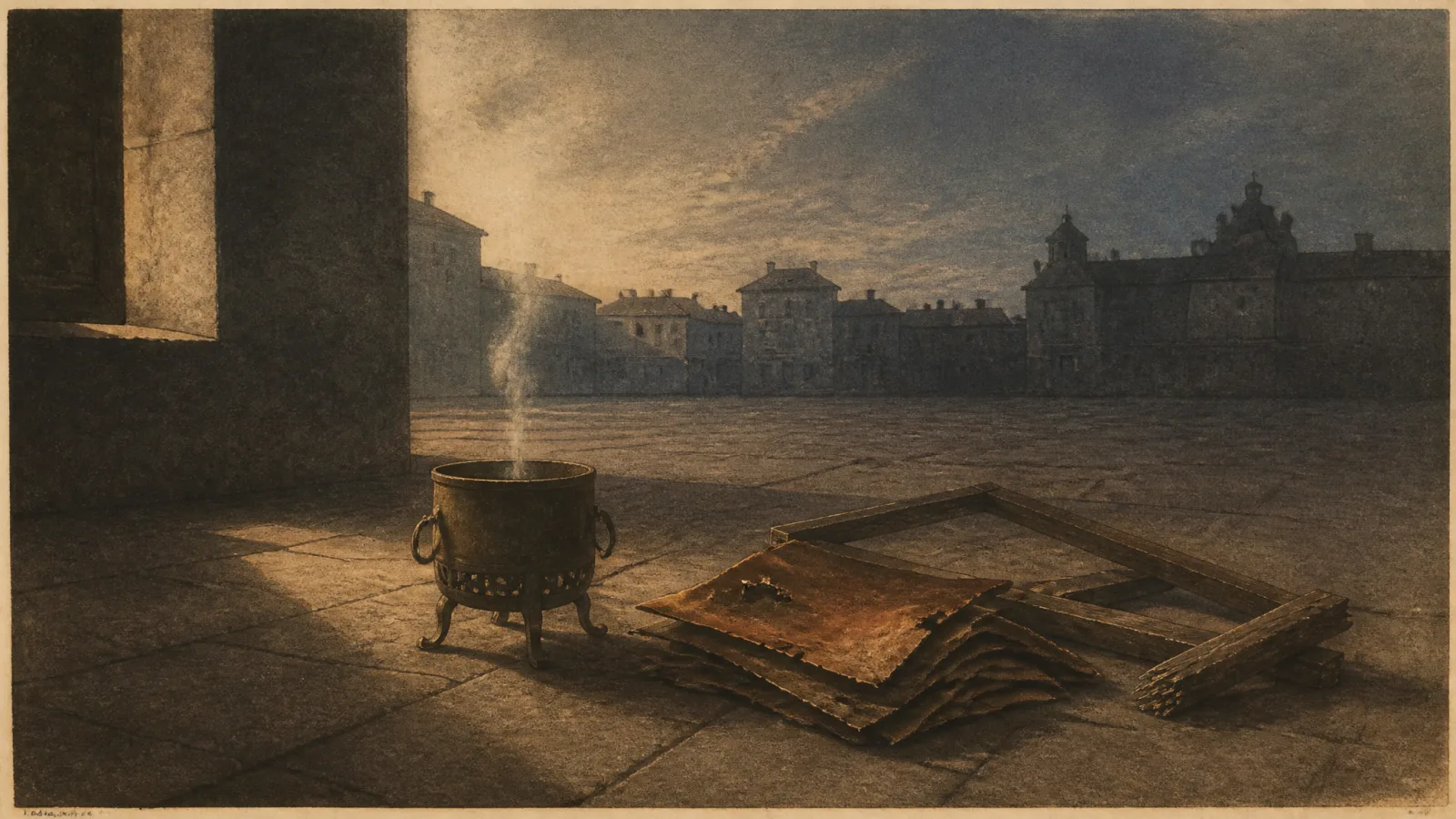
On 22 December 1795 it was decreed that the whole amount issued should be limited to forty thousand millions, and that when that was done the copper plates should be broken. About ten thousand millions more was issued anyway. Then:
“But on the 18th of February, 1796, at nine o’clock in the morning, in the presence of a great crowd, the machinery, plates and paper for printing assignats were brought to the Place Vendôme and there, on the spot where the Napoleon Column now stands, these were solemnly broken and burned.”
Andrew Dickson White · p. 53Camus then reported the totals to the Assembly: over forty-five thousand millions of francs issued in less than six years, over six thousand millions annulled and burned, and close upon forty thousand millions in circulation at the final catastrophe. Dewarmin’s count of what stood at the suppression is exact to the livre — 39,999,945,428 — and there is something bleakly funny in a figure that lands forty-four thousand francs short of the round number, as though the press had been stopped mid-sheet.
Logarithmic scale — each gridline is ten times the one below
“As good as gold”
The Directory, the five-man executive that succeeded the Convention, came to power in October 1795 and found the country impoverished. Its first thought was another forced loan from the wealthier classes, on terms — set out in the margin — that say everything about where the currency stood by then. A national bank was proposed, but capitalists were unwilling to go into banking while the howls of the mob against anyone connected with money resounded in every city.
So the Directory reached for the expedient that had already failed in colonial New England in 1737, under the American Confederation in 1781, and in the Southern Confederacy: a new paper, “fully secured” and “as good as gold.” The mandats of 1796 were better designed than the assignats had been. Choice public land was set apart equal in value to the whole issue; a holder could take possession at once, at a price set by two valuers, one named by the government and one by himself, without the delays that had attended land purchase with assignats.
The most whimsical thing in the whole situation, White says, is that the government went on issuing assignats at the same time as it was discrediting them by issuing mandats. Before the mandats could be got out of the press they stood at thirty-five per cent of their nominal value. Then fifteen. Then five. By August 1796 — six months from first issue — three. A pamphlet signed “Marchant” and dedicated to People of Good Faith explained at length how the mandats could not by any possibility sink as the assignats had done; before it was dry from the press the depreciation had refuted it.
The old remedy was applied, on the scale the margin records: fines for decrying the mandats in speech or writing, irons for repeating the offence, penalties for refusing to take them. There was also a decree that one franc in paper should thenceforth be worth ten pounds of wheat.
Then the unwinding, in eight months. On 4–14 February 1797 the engraving apparatus for the mandats was destroyed as the assignats’ had been, neither was legal tender any longer, and old debts to the state could be paid in government paper at one per cent of face. In May the twenty-one billions of assignats still circulating were annulled. On 30 September 1797 came the settlement usually called the bankruptcy of the two-thirds: national debts were to be paid two-thirds in bonds usable for buying confiscated real estate, and the remaining “Consolidated Third” was written into the Great Book to be paid as the government thought best. The bonds sank to three per cent of their value. The Consolidated Third was largely paid, until Bonaparte, in paper that sank to about six.
So ended the reign of paper money in France: two and a half thousand millions of mandats onto the common heap of refuse with forty-five thousand millions of assignats.
And then, quietly, coin
There is a passage near the end that is easy to skip and shouldn’t be. Everyone expected a crisis in the gap — the moment when paper had gone and metal had not yet come. Thibaudeau, a thoughtful observer, records that great fears were felt on this point, and that no such want was severely felt: coin came in gradually as it was wanted, first in sufficient quantity for the small amount of business that remained after the collapse, then as the demand grew, drawn in from the world at large. “There will always be money,” White quotes, and leaves it there.
Convalescence was another matter. The acute suffering lasted nearly ten years. It took fully forty years to bring capital, industry, commerce and credit back to where they had stood when the Revolution began.
Bonaparte pays cash
White ends with a sequel, and it is the part of the book a careful reader should hold at arm’s length even while enjoying it. Bonaparte took the consulship with the government bankrupt, an immense debt unpaid, tax assessments in hopeless confusion, war on three fronts and civil war in the Vendée, and the largest loan obtainable barely covering a day’s expenses. Asked at his first cabinet council what he meant to do, he answered: “I will pay cash or pay nothing.” p. 67
He arranged the assessments, funded the debt, paid in cash, and from Marengo through Austerlitz, Jena, Eylau and Friedland to the Peace of Tilsit there was one suspension of payment in specie — coined gold and silver — and that for a few days. Pressed, when the first coalition formed against the Empire, to resort to paper, he wrote to his minister: “While I live I will never resort to irredeemable paper.” He never did.
That ending leaves two things out. The first is what paying cash consisted of: the Empire’s finances leaned on indemnities and contributions levied on occupied countries, which is a way of making other populations bear a war’s cost rather than a demonstration that sound money is cheap. White half-concedes it a page earlier, calling Napoleon a man on horseback who threw away millions of lives. The second is that the 1797 repudiation — the two-thirds bankruptcy — is what cleared the debt Bonaparte inherited. The default did the arithmetic; the cash discipline kept it done. A book that ends on the discipline rather than the default has chosen its ending. Both omissions are set out on Reading White.