Oratory prevailed over science and experience
1789 – June 1791 · the deficit, Necker, and the two issues that were not supposed to be two
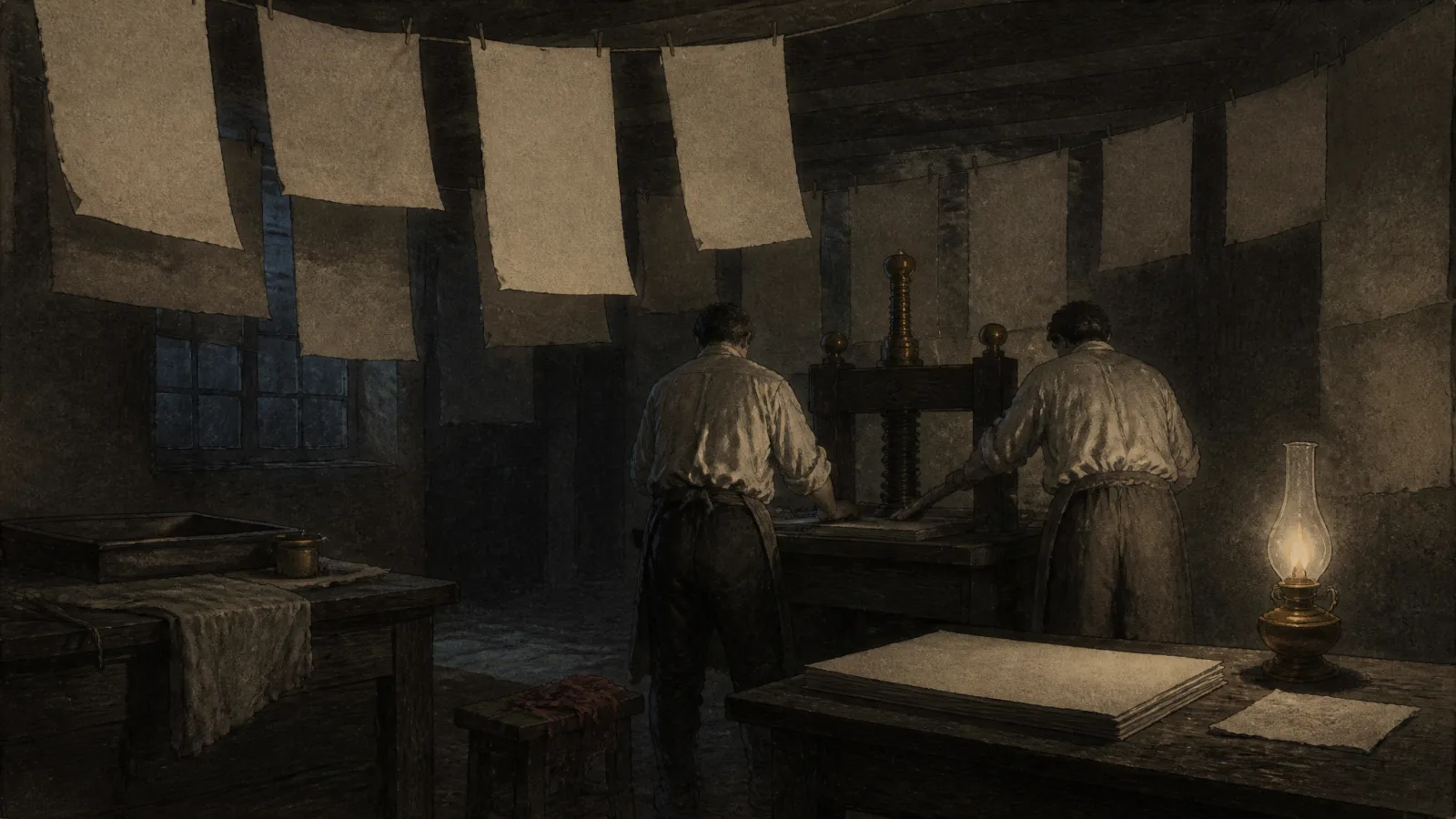
Early in 1789 France had a heavy debt and a serious deficit. Neither was fatal. What the situation wanted was patience and self-denial, and White — who has no illusions about how often those appear in politics — notes that few nations have ever managed them and France was not then one of the few. So the search began for a short road, and by the end of the year everyone had found the same one: the country needed more circulating medium.
Jacques Necker stood in the way of it for a year. He was among the great bankers of Europe and something more than a banker; he knew where irredeemable paper had always led, even when it was surrounded by the most skilful guarantees. Against him ran a current of journalism led by Marat, whose Friend of the People portrayed a man who had given up health and fortune for France as a wretch seeking to enrich himself from the public purse.
The compromise offered to that current was land. The Assembly had resolved to take the estates of the French Church into the possession of the nation — princely properties in the country, palaces and conventual buildings in the towns, the accumulation of fifteen hundred years. By a few sweeping strokes it became public property, and White’s judgement on the moment is generous: never, apparently, did a government secure a more solid basis for a great financial future.
Not a banknote in the modern sense. An assignat was a claim on a specific pile of confiscated real estate, which the holder could use to buy that estate from the nation at auction. The first issue paid 3 per cent, and the interest earned per day was printed in the margin of the note so the holder could see it accruing. This is why its defenders could say, without absurdity, that it was better secured than a note redeemable in metal — and why the modern literature calls it asset-backed money rather than fiat money. See Reading White.
The first four hundred million
The finance committee wanted the notes to be awkward. Denominations of 1,000, 500 and 200 livres (the unit of account of old France, twenty sous to one; renamed the franc in 1795 at nearly the same value) — too large to buy bread with, convenient for buying an abbey — and interest, so that holders would hoard them rather than spend them. The Assembly, remembering what small paper had done in John Law’s time seventy years earlier, held back from smaller obligations.
It held back for one debate. The committee reported that “the people demand a new circulating medium”; that “the circulation of paper money is the best of operations”; that “it is the most free because it reposes on the will of the people.” It appealed to patriotism: “Let us show to Europe that we understand our own resources; let us immediately take the broad road to our liberation instead of dragging ourselves along the tortuous and obscure paths of fragmentary loans.” It recommended four hundred millions, carefully guarded — and the objection to small notes faded from view.
It would be a mistake, White insists twice, to imagine that the men doing this were fools or that they did not know the history. They knew it exactly. They knew how easy such currency is to issue and how hard to check; how it falls on wage-earners and people with fixed incomes; how it breeds a class of debauched speculators more injurious than professional criminals, “whom the law recognizes and can throttle.” Many in the hall owed their families’ poverty to Law’s paper. One deputy held up a note from that era during the debate and said it was stained with the blood and tears of their fathers.
White will not let his reader take the comfortable view that this was done by cranks. The Assembly of 1790 contained Sieyès, Bailly, Necker, Mirabeau, Talleyrand, Du Pont de Nemours; few more keen-sighted legislative bodies, he says, have ever met. The argument only works if the men are able. It is the same move he makes later with Cambon: the abler the financier, the more his failure proves.
The decree passed in April 1790. The notes were engraved in the best style of the art: the king’s portrait at the centre to stimulate loyalty, patriotic emblems around it to arouse public spirit, the daily interest in the margin to stimulate public cupidity, and stamps and signatures all round to show the thing was registered and controlled. The Assembly issued an address explaining that the nation was now “delivered by this grand means from all uncertainty and from all ruinous results of the credit system,” and — in a passage worth reading twice — explained why this paper was different from Law’s:
“Paper money is without inherent value unless it represents some special property. Without representing some special property it is inadmissible in trade to compete with a metallic currency … therefore it is that the paper money which has only the public authority as its basis has always caused ruin where it has been established.”
Address of the National Assembly on the issue of assignats, 1790 · quoted at pp. 8–9The first results were everything the sanguine could have asked. The treasury was relieved, part of the debt paid, creditors encouraged, credit revived, trade increased. White concedes the point his own thesis has to survive: had the nation stopped there, few of the later evils would have been severely felt, and the four hundred millions would have done the work of a similar amount of specie. One enthusiast, a M. Sarot, was so vexed by Bergasse’s pamphlet against the assignat that he laid his house, garden and furniture on the altar of his country and offered to sell them for paper money alone.
Within five months the government had spent it all and was again in distress.
The eight hundred million
Everything turns on the second debate, because the second issue is where a limit becomes a suggestion. Montesquieu’s report of 27 August favoured more paper with evident reluctance and ended: “We must save the country.”
Mirabeau then made the speech that decided it. His own view of paper money was on record — in January 1789 he had called it a nursery of tyranny and a debauch of authority in delirium, and had said of an earlier suggestion that it was a loan to an armed robber, and that “that infamous word, paper money, ought to be banished from our language.” Now he confessed he had feared the assignats and now dared urge them; that deceptive subtleties could no longer mislead patriots and men of sense; that just as soon as the paper became too abundant it would be absorbed in purchases of national land, like rain falling on the earth, running to the sea, drawn up as vapour and scattered again in fertilising showers.
Against him, Talleyrand — a former bishop, and the man who more than anyone had carried the confiscation of Church property — put the objection nobody in the hall could answer:
“You can, indeed, arrange it so that the people shall be forced to take a thousand livres in paper for a thousand livres in specie; but you can never arrange it so that a man shall be obliged to give a thousand livres in specie for a thousand livres in paper,—in that fact is embedded the entire question; and on account of that fact the whole system fails.”
Talleyrand, September 1790, in the Moniteur · quoted at p. 16The rest of the debate reads like a catalogue of how a body talks itself into something. Gouy proposed to liquidate the whole national debt of twenty-four hundred millions “by one single operation, grand, simple, magnificent,” and the newspapers noted that the discourse was loudly applauded. Brillat-Savarin — remembered now only as the most brilliant cook that ever existed — predicted a depreciation of thirty per cent. The Abbé Goutes explained that new issues of paper would supply a circulating medium that would protect public morals from corruption. Lablache quoted a saying that paper money is the emetic of great states. Boutidoux coined un papier terre, land converted into paper. A pamphlet so pungent that it was carried into the Assembly and read aloud there argued that doubling the quantity of money simply raises prices, disturbs values and helps only the rich with large debts to pay; it was signed “A Friend of the People.” Du Pont de Nemours then rose, avowed the pamphlet to be his, and said sturdily that he had always voted against irredeemable paper and always would.
Necker’s last report against the issue was spurned; he was a man of the past. He resigned and left France for ever, and Marat, Hébert and Camille Desmoulins — all three of whom would follow him out of public life by a shorter route — were jubilant.
Mirabeau’s final speech, on 27 September, is described by the man White calls the most sober and conservative of his modern opponents as “prodigious.” Its argument was the mortgage: the notes were better secured than if redeemable in specie, because metal is employed only in the secondary arts while land is the source of all production; whoever holds French paper holds a claim on property that can be sold to satisfy him, where other nations could offer only a vague claim on the nation entire. “I would rather have a mortgage on a garden than on a kingdom!” p. 18
It settled the question, and drew White’s sharpest verdict. People did not stop to consider, he writes, that this was the dashing speech of an orator rather than the matured judgement of a financial expert; that calling on Mirabeau or Talleyrand to advise on monetary policy because they had shown boldness in danger and strength in conflict “was like summoning a prize-fighter to mend a watch.”
On 29 September 1790, by 508 votes to 423, eight hundred millions more were authorised — and the Assembly solemnly declared that the entire amount in circulation should never exceed twelve hundred millions, and that notes paid in for land would be burned as they arrived, so that a healthful contraction would be constantly maintained. A pamphlet called The Friend of the Revolution opened: “Citizens, the deed is done. The assignats are the keystone of the arch. It has just been happily put in position.”
The slope
What followed is not a story about a decision. Small coin vanished, because the cheaper currency drove out the dearer; sixty-three kinds of private “confidence bills” appeared in Paris alone, guaranteed by nobody, and the confusion of them pushed the Assembly into issuing exactly the small notes it had sworn to avoid. Of the 160 millions received into the treasury for land — which the September act said would be burned — the greater part was reissued as small notes under the plea of necessity. Silverware went to the mint, the king sent his plate, churches gave up vessels, church bells were melted for copper, and the coin kept disappearing anyway. Then parchment notes, down to a single sou.
On 19 June 1791 six hundred millions more passed with few speeches, in a silence White calls very ominous. He gives the pattern a name — the law of accelerating issue and depreciation — and states it as physics: it was comparatively easy to refrain from the first issue, exceedingly difficult to refrain from the second, and practically impossible to refrain from the third and those following.
That “law” is the book’s central claim and its most contested one. It attributes the acceleration to the logic of paper itself. The modern literature attributes most of it to something White mentions but does not weigh: from April 1792 France was fighting a continental war, the tax administration had largely stopped collecting, and land sales were slow — so the press was the only instrument left. The distinction matters, because one version indicts paper money and the other indicts a fiscal collapse that paper money was used to paper over. The distinction is the hinge of the whole modern argument, and Reading White turns on it.