The toolbox

Eight moves, defined once

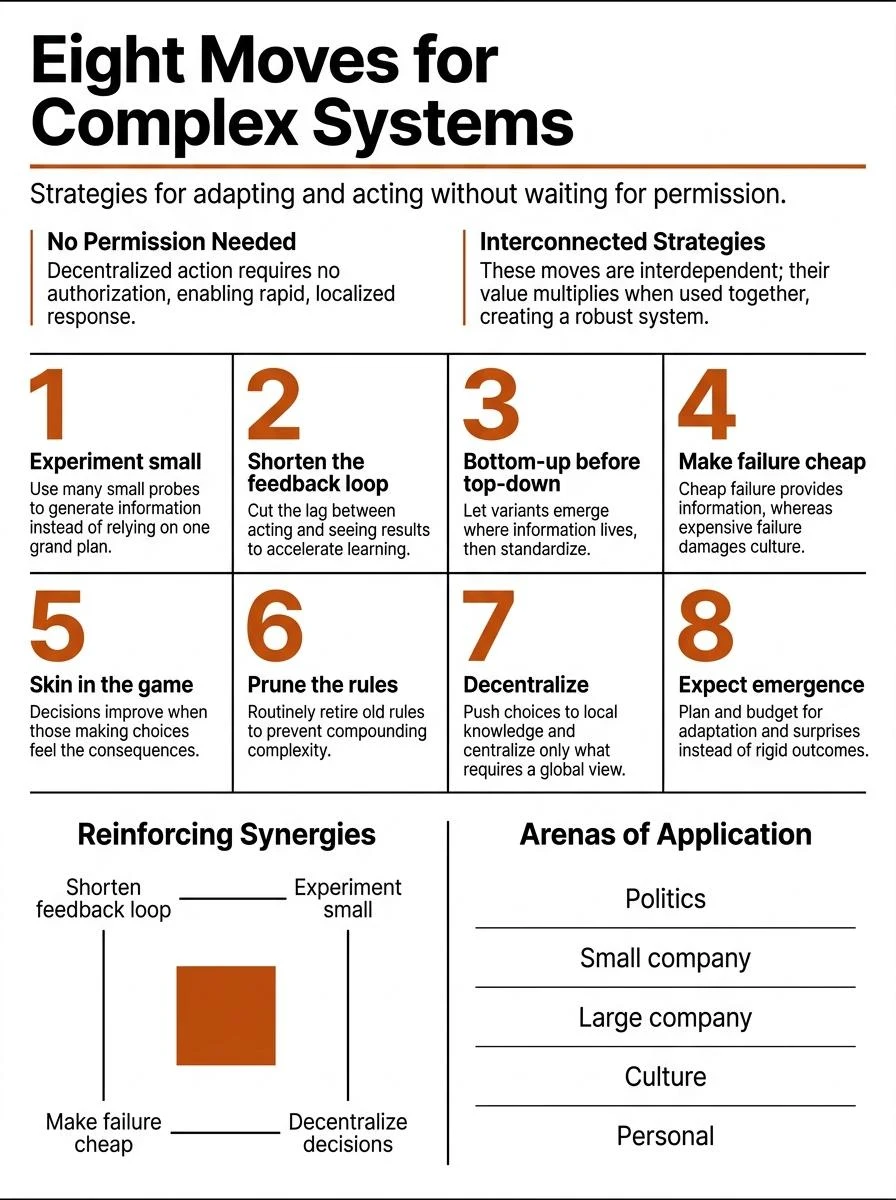
Generated infographic listing the eight toolbox moves — experiment small, shorten the feedback loop, bottom-up before top-down, make failure cheap, skin in the game, prune the rules, decentralize decisions, expect emergence — each with a one-line mechanism.
GENERATED INFOGRAPHIC · CLEAN-MINIMALIST · POLYPTYCH + PIXBRIDGE

Every arena chapter applies these by name. Each move states its mechanism — why it works in a complex system — in one clause. The theory behind the mechanisms lives in the 2016 book; the chapters only apply it.

Two things to notice before you use them. First, none of these moves requires a budget, a committee, or permission from anyone above you — that is not an accident. Moves that need the whole system to agree before they start are plans, not moves. Second, they reinforce each other: small experiments only teach if the feedback loop is short; cheap failure only stays cheap if decisions are made close to the work. Start anywhere.

M1

Experiment small

Complex systems punish big bets you can't read back. Many small probes generate the information one grand plan never will.

USED IN · politics · small company · culture

M2

Shorten the feedback loop

A system learns at the speed of its slowest loop. Cut the lag between acting and seeing the result before you add people, budget, or process.

USED IN · large company · small company · personal · culture

M3

Bottom-up before top-down

Solutions emerge where the information lives. Let variants run, then standardize the winners — not the other way around.

USED IN · politics

M4

Make failure cheap

You cannot remove failure from an adaptive system — you can only choose its price. A cheap, honest failure is information; an expensive hidden one is culture damage.

USED IN · large company · small company · personal · culture

M5

Skin in the game

Decisions improve when the people making them feel the outcomes. Separate deciders from consequences and the feedback loop is severed.

USED IN · large company

M6

Prune the rules

Rulebooks only ratchet upward, and their interactions compound. Retiring rules must be as routine as writing them, or complexity wins by default.

USED IN · politics · culture

M7

Decentralize decisions

Push choices to where the local knowledge lives; centralize only what genuinely needs the global view. The center cannot know enough, fast enough.

USED IN · large company · culture

M8

Expect emergence

The system will do something you did not specify. Plan for adaptation, not outcomes — budget for reading the surprise, not for preventing it.

USED IN · small company · personal · culture