Threshold Guardian
A guardian tests access to a new situation. The obstacle can be a person, a rule, a danger, or an internal resistance.
A boundary becomes visible
A threshold is a point at which the conditions of action change. Vogler’s guardian function makes that boundary tangible. A guard may demand proof, a bureaucrat may control a permit, a creature may block a road, or a protagonist’s fear may prevent an approach. The test tells us something about both the world and the person trying to enter it.
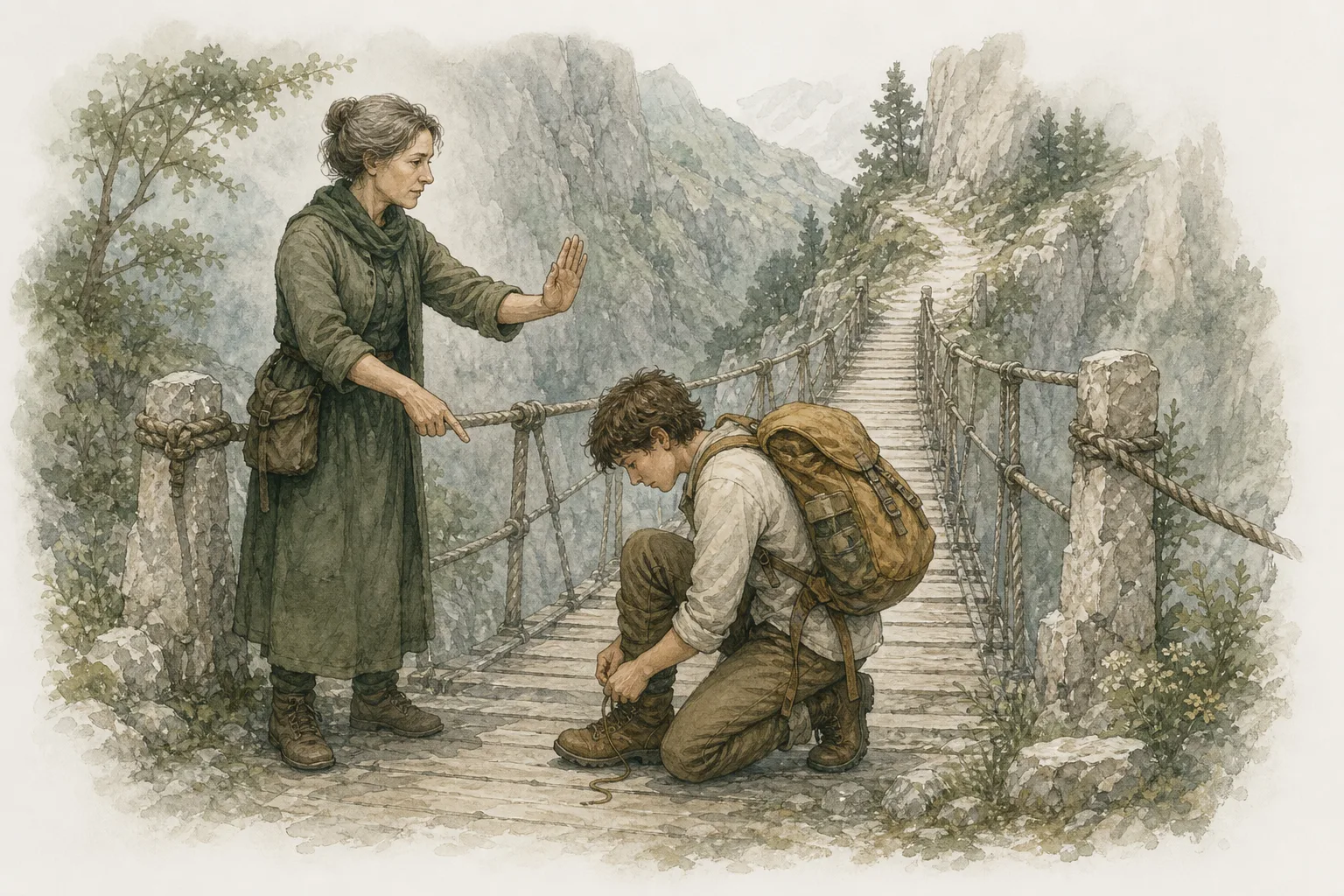
A guardian is not necessarily the central villain. Their concern may be narrow: enforce a rule, protect a place, preserve a livelihood or keep someone safe. Reading every obstruction as evil loses useful distinctions between opposition, legitimate responsibility and misunderstanding.
More than a fight
The protagonist can defeat a guardian, but can also persuade, evade, satisfy or learn from one. A changed response can demonstrate growth more clearly than an increase in force. Someone who always argues might learn to listen; someone who obeys every rule might recognize that a rule is unjust.
The method of passage matters. If entry requires lying, abandoning someone or accepting a debt, crossing creates consequences. A guardian scene can therefore make a value conflict concrete. What does the protagonist consider a permissible price, and who gets to bear it?
Examples and qualifications
The threatening patrons in the Mos Eisley cantina in A New Hope (1977) show Luke that his earlier expectations will not protect him in this setting. Obi-Wan’s intervention reveals both the danger and Luke’s dependence on help. The encounter works as a threshold test without making those patrons the story’s main antagonists.
The Sphinx in the Oedipus tradition is a more literal boundary figure: access depends on responding to a challenge. That function differs from the deeper problem of knowledge and identity developed in Sophocles’ Oedipus Tyrannus. A solved riddle does not mean the protagonist understands himself or the situation he has entered.
In Ocarina of Time (1998), requirements for equipment, songs or access can serve a guardian-like function. Some teach the player what kind of preparation a location demands. Others are ordinary progression gates with little represented character conflict. Calling all locked doors archetypes would add vocabulary without necessarily adding understanding.
A household authority in a social novel may perform the same function without a literal gate. Permission to marry, inherit, work or speak can regulate entry into a new life. Here the important question is often whose authority the story regards as legitimate, not how quickly the protagonist can bypass it.
The internal reading
Vogler’s psychological language allows a guardian to represent an inner obstacle. A fear of humiliation can keep a capable person from asking for help. Yet that reading should not turn structural barriers into mere personal insecurity. A discriminatory institution remains a material obstacle even when its effects have been internalized.
Use the analogy by naming the relation between the outer test and the protagonist’s response. Does the person repeat a familiar avoidance strategy? Do they misread caution as hostility? Does the boundary expose a skill they have neglected? Such questions connect the interpretation to observable action.
Give the obstacle a purpose
A guardian placed only to slow the story often feels interchangeable. Ask what becomes known through the encounter. It might establish danger, expose a weakness, introduce a rule or change a relationship. If removing it alters only the running time, the scene may not need its own dramatic emphasis.
A converted guardian can become an ally, but the change needs a reason. Respect, shared interest, new information or a revised understanding can support it. Sudden friendliness after defeat is less convincing when the earlier opposition had a serious independent cause. A person’s function in the hero’s route does not erase their motive.
The role also offers a way to question the journey. Sometimes the boundary protects something the protagonist should not enter or take. A good analysis leaves room for the guardian to be right.
Diagnostic question: what does this boundary protect, and what does the protagonist’s way of crossing reveal about their judgment?
Sources & further reading
Source notes identify the model or work discussed. Story mappings and diagnostic questions are this site’s interpretations.
- Christopher Vogler — The Writer’s Journey: Mythic Structure for Writers. 25th Anniversary Edition, Michael Wiese Productions, 2020. Author’s account of the memo, book and flexible use of the model; stage and archetype discussions refer to the book.
- C. G. Jung — The Archetypes and the Collective Unconscious. Collected Works 9, part 1; second edition, translated by R. F. C. Hull, 1969. A historical psychological theory, distinguished here from dramatic roles.
- George Lucas, writer and director — Star Wars: Episode IV—A New Hope. Lucasfilm, 1977; originally released as Star Wars. Official film record. Our mapping concerns this film alone and is interpretive.
- Nintendo — The Legend of Zelda: Ocarina of Time. Nintendo 64, 1998. Developer interview for the later 3D edition supplies context and identifies the original game; the example discusses the 1998 story.