Mentor
A mentor gives the protagonist something they can use: knowledge, equipment, a standard to live by, or an example to question.
Guidance as a dramatic function
A mentor changes the learner’s capacity to act. They may teach a skill, identify a danger, offer a tool, reveal a history or make a possibility imaginable. In Vogler’s account, the role is a flexible function rather than a requirement for a wise elderly character. Age, gender and benevolence do not define it.
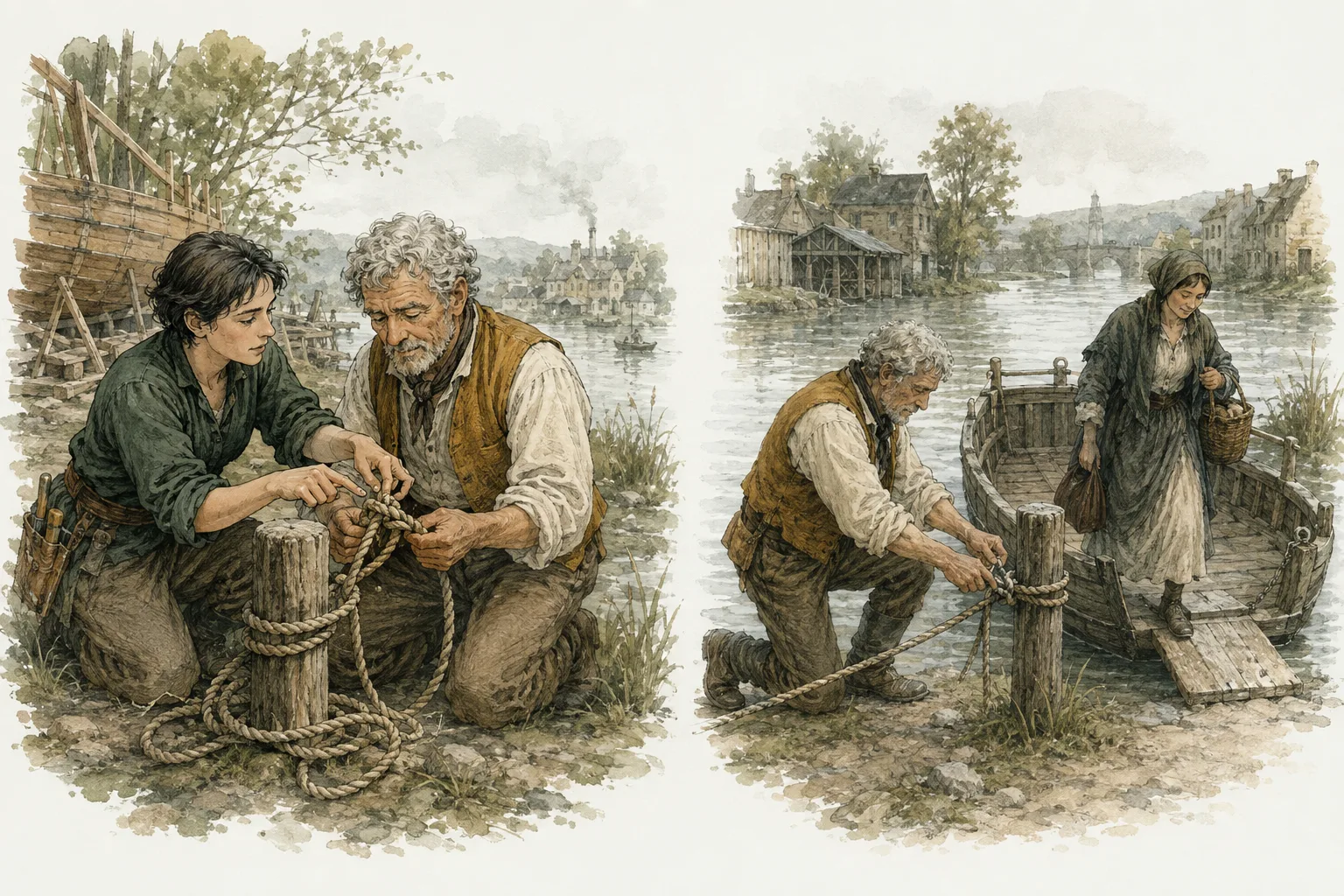
The Meeting the Mentor stage describes a passage of preparation. The mentor role can operate throughout a story. A companion may teach one lesson and need help with another; an antagonist may reveal a weakness the hero must address. Separating role from stage prevents the analysis from assigning one person to one box forever.
One passage of preparation; guidance that can recur
A stage in the journeyLearn a skill
Teach through conditions
A lesson becomes dramatic when it changes a later choice. Information delivered in a speech may be necessary, but the audience needs to see why the learner can or cannot use it. Practice, misunderstanding and resistance make the relationship more specific. A teacher can know a technique while misunderstanding the student’s circumstances.
Gifts work similarly. A useful object creates an expectation about its eventual use, yet the learner still has to recognize the occasion and accept the risk. The object can also carry a relationship: inherited equipment may bring a family story, a debt or a disputed identity into the present.
Mentors across stories
Obi-Wan gives Luke a lightsaber and an introduction to the Force in A New Hope (1977). The practical gift is inseparable from a story about Luke’s father. The later training aboard the Falcon establishes a lesson that the climax revisits, making guidance part of the film’s causal and emotional structure.
Glinda’s guidance in the 1939 Wizard of Oz offers direction but also raises questions about withheld knowledge. A reader can identify her mentor function while asking whether the film makes that withholding persuasive. Recognizing a role does not require accepting every narrative decision that supports it.
Athena in The Odyssey guides different members of the household through different disguises and interventions. Her assistance is not a single training scene. In the Telemachus books, encouragement helps a young man begin acting in a situation dominated by others. Divine agency also complicates how independently the mortals achieve their aims.
The fairy godmother in familiar versions of Cinderella provides temporary access to an otherwise closed social setting. The conditions attached to the help matter as much as the gift. A timed opportunity produces decisions and danger; unconditional power would produce a different story.
A psychological interpretation
Vogler connects the mentor with a wiser or more developed possibility of the self. Guidance can become an internal voice that remains after the teacher is absent. In Jungian terms, some readers relate the figure to images of wisdom or the Self, but this is not a direct scientific classification of teachers or fictional characters.
An internalized mentor can be useful or harmful. A remembered rule may support courage in one situation and become restrictive in another. A mature arc can involve revising a teacher’s lesson rather than merely reproducing it. The story then treats learning as judgment, not obedience.
Let the learner remain necessary
The most common problem is a mentor who could solve the central conflict but inexplicably does not. Give the limitation substance: incomplete knowledge, physical distance, conflicting obligations, a different value system, or a task that depends on the learner’s consent. The limitation should belong to the world and relationship, not appear only when suspense is needed.
A second problem is guidance without consequence. If the lesson never changes action, it may function as exposition rather than mentorship. That is not inherently wrong, but the distinction clarifies what the scene is doing. A false mentor, meanwhile, should have an intelligible motive for directing the learner badly.
Diagnostic question: what can the learner now attempt, and what must they judge for themselves even if the mentor’s advice is correct?
Sources & further reading
Source notes identify the model or work discussed. Story mappings and diagnostic questions are this site’s interpretations.
- Christopher Vogler — The Writer’s Journey: Mythic Structure for Writers. 25th Anniversary Edition, Michael Wiese Productions, 2020. Author’s account of the memo, book and flexible use of the model; stage and archetype discussions refer to the book.
- C. G. Jung — The Archetypes and the Collective Unconscious. Collected Works 9, part 1; second edition, translated by R. F. C. Hull, 1969. A historical psychological theory, distinguished here from dramatic roles.
- Homer — The Odyssey. Samuel Butler prose translation, 1900. Book numbers identify the scenes discussed; interpretations do not claim this modern translation is culturally neutral.
- Victor Fleming, director — The Wizard of Oz. MGM, 1939. Library of Congress exhibition documents the film adaptation and distinguishes it from Baum’s book.
- George Lucas, writer and director — Star Wars: Episode IV—A New Hope. Lucasfilm, 1977; originally released as Star Wars. Official film record. Our mapping concerns this film alone and is interpretive.