Meet Montaigne
“Of all egotists, Montaigne, if not the greatest, was the most fascinating, because, perhaps, he was the least affected and most truthful. […] He investigated his mental structure as a schoolboy pulls his watch to pieces, to examine the mechanism of the works.”
— William Carew Hazlitt, editor’s preface to the 1877 edition
Michel Eyquem de Montaigne was born at 11 o’clock in the morning on the last day of February 1533, at the château of Saint-Michel-de-Montaigne, near Bordeaux. His father Pierre, a Jurat and later Mayor of Bordeaux himself, had strong (and for the time, unusual) ideas about raising a son: he had the infant Michel held at his christening by the poorest villagers he could find, put him out to nurse with a peasant family, and hired a German tutor who was forbidden to speak to the boy in anything but Latin. Michel later said he learned Latin before French. At six he went to the College of Guienne in Bordeaux, taught by some of the era’s most celebrated scholars — by thirteen he had finished every class the school offered.
The friendship
Sometime between 1556 and 1563, Montaigne met Étienne de La Boétie — by accident, at a party — and the two became inseparable. It lasted only about four years before La Boétie died of the plague, but the friendship stayed the emotional center of everything Montaigne wrote afterward. Asked why he loved the man, Montaigne could only answer:
“Because it was he, because it was I.”
— Of Friendship, Book I, Chapter XXVII
The tower
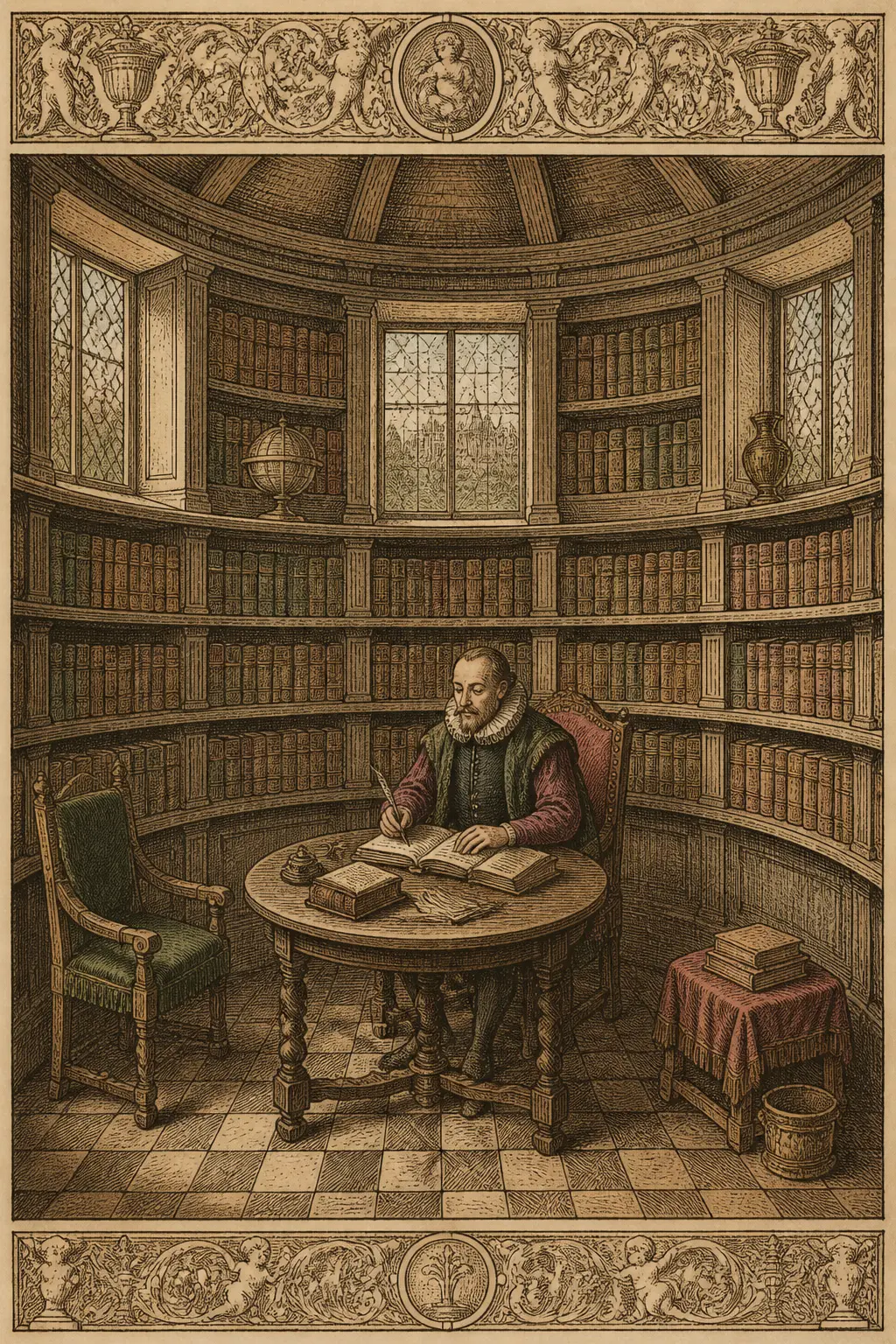
In 1566 he married Françoise de Chassaigne. Five years later, on his thirty-eighth birthday, he retired from public life and had a Latin inscription carved into the wall of his chateau announcing that he intended to spend “the remaining moiety of the [life] allotted to him in tranquil seclusion” — in the library on the third floor of a round tower, described in one of the later essays exactly as he built it:
“The figure of my study is round, and there is no more open wall than what is taken up by my table and my chair, so that the remaining parts of the circle present me a view of all my books at once, ranged upon five rows of shelves round about me. It has three noble and free prospects, and is sixteen paces in diameter. […] ‘Tis there that I am in my kingdom, and there I endeavour to make myself an absolute monarch.”
— Of Three Commerces, Book III, Chapter III
The first edition of the Essays was printed at Bordeaux in 1580, when he was fifty-seven. He kept revising and adding to it for the rest of his life — new editions came out in 1582, 1587, and 1588 (by then including a whole third Book), and a final, posthumous edition followed in 1595, prepared from his own annotated copy by Marie de Gournay, a young admirer he had befriended late in life.
The mayor
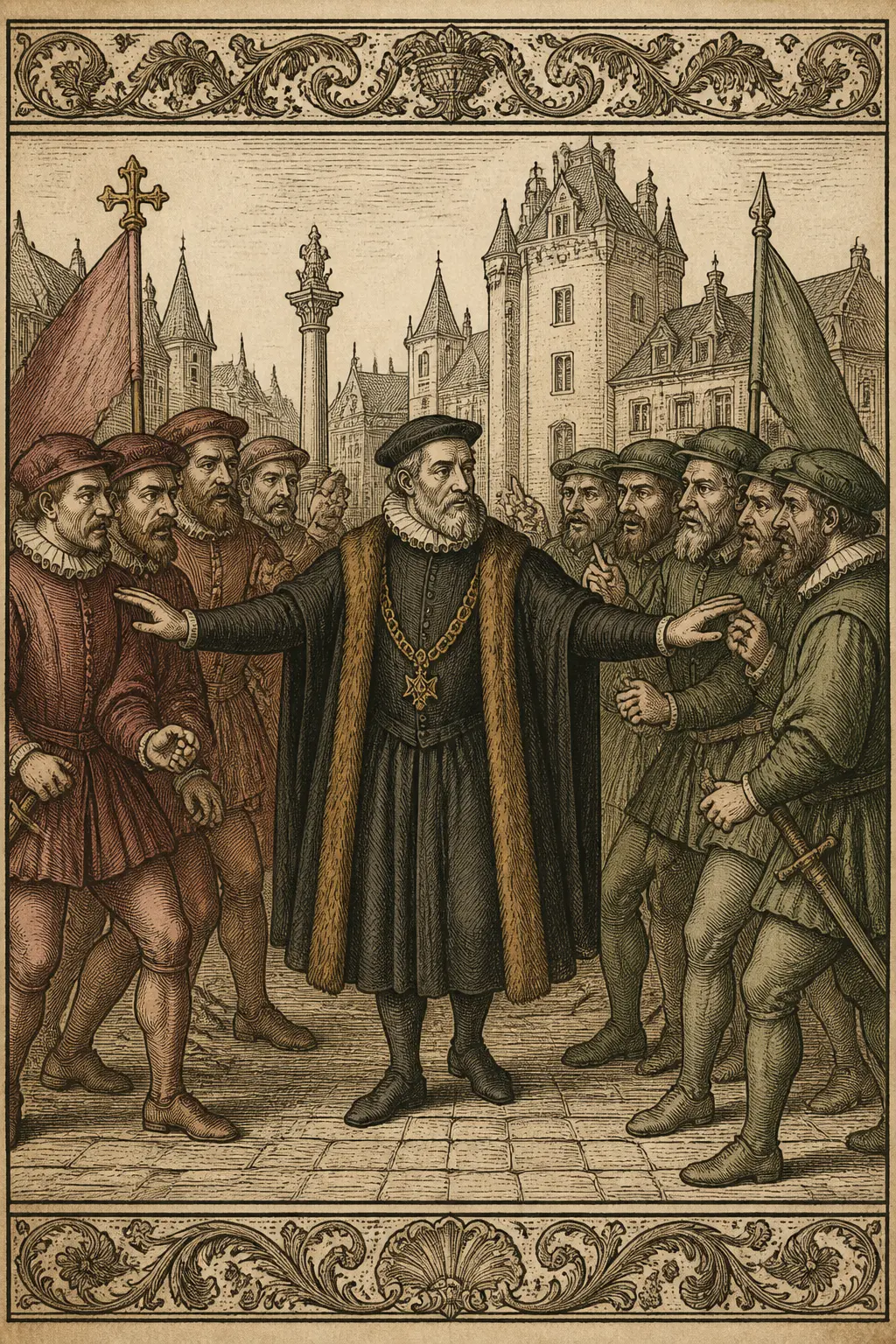
In between, Bordeaux made him its mayor — twice, four years in total, starting in 1581. It was no ceremonial post: the city sat in the middle of France’s Wars of Religion, and Montaigne spent much of his term keeping Catholics and Protestants from each other’s throats, by his own account favoring “a middle and temperate policy” over victory for either side.
The end
He died at home on 13 September 1592, in his sixtieth year — struck by quinsy, unable to speak for his last three days, and reportedly collapsed mid-Mass, arms outstretched, as the host was raised. He was buried nearby; his remains were later moved to Bordeaux, where they still rest.
The book outlived every fear that it might not. Madame de Sévigné, writing decades later, put it about as well as anyone has:
“O, what capital company he is, the dear man! he is my old friend; and just for the reason that he is so, he always seems new. My God! how full is that book of sense!”
Ready to meet the book itself? Start with Where to Start.