Abundance Requires Metis
Brasília was an abundance project. So was Soviet collectivization, Tanzania’s ujamaa villagization, and the scientific forestry that replaced Germany’s mixed woodland with straight rows of Norway spruce. Each one promised more — more housing, more grain, more timber — delivered faster, through rational central design. Each one is now a chapter in James C. Scott’s Seeing Like a State, the standard catalogue of how confident large-scale planning fails.
This matters now because building fast is back on the agenda, and this time the builders are right. Ezra Klein and Derek Thompson’s Abundance argues that the rich world’s housing shortages, energy constraints, and infrastructure paralysis are self-inflicted — procedural sclerosis, not physical limits. The diagnosis is correct. The prescription — build faster, permit faster, say yes more — is directionally correct. And it is exactly the mood in which every disaster in Scott’s catalogue was launched.
The engineering question, then, is not whether to pursue abundance but how to pursue it without rebuilding the failure modes. That question has an operational answer, and it comes from an unexpected direction: the practices that software and manufacturing developed after their high-modernist phase failed.
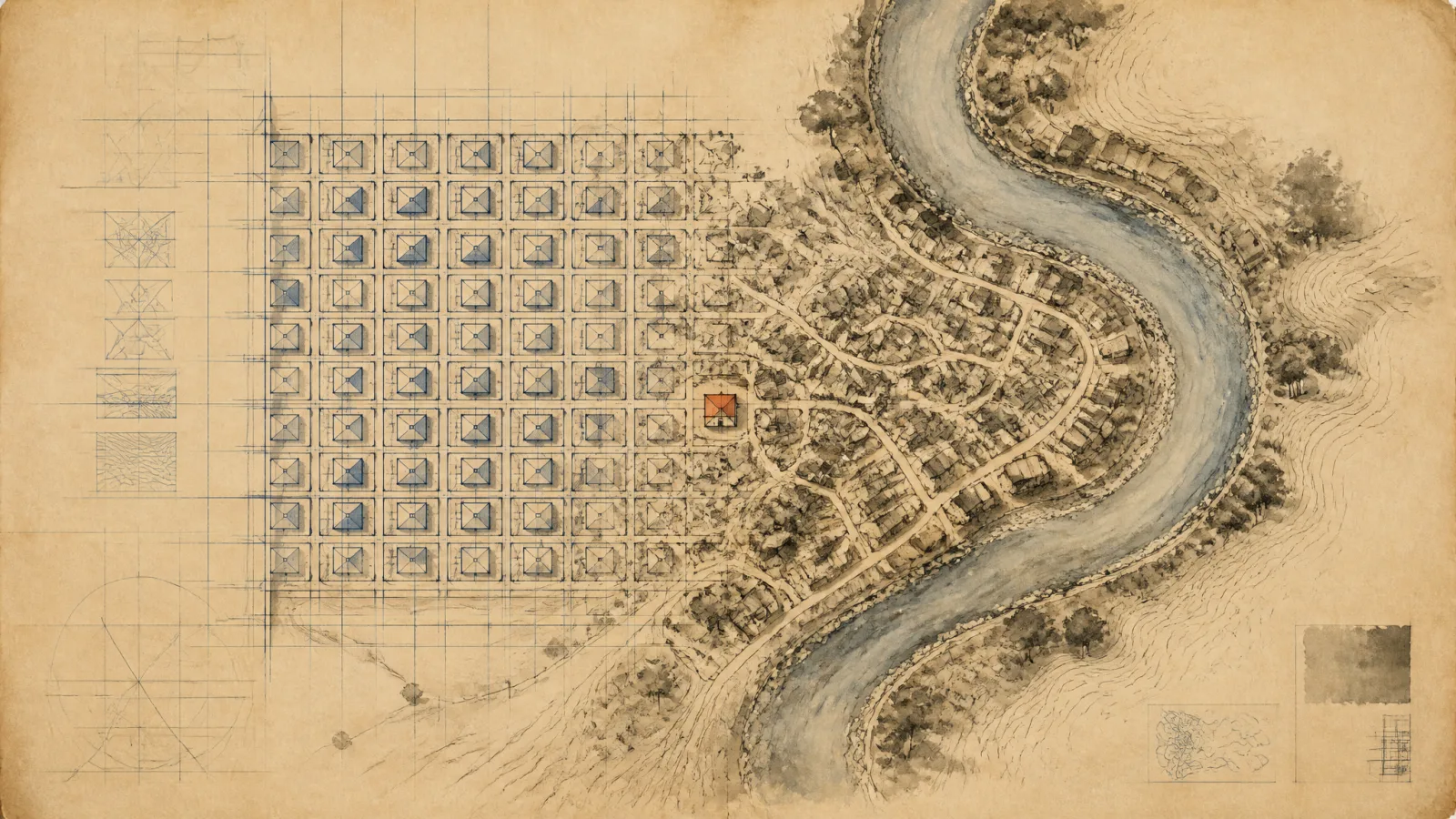
Two kinds of knowledge, one missing from the blueprint
Scott’s central term needs a precise definition, because the whole argument turns on it. Metis (from the Greek for cunning intelligence) is practical, local, adaptive knowledge — the kind a harbor pilot has and a hydrodynamics textbook does not. It is learned by doing, held by practitioners, and largely impossible to write down. Its opposite number is the schematic, standardized, transmissible knowledge a central planner works with: maps, models, codes, averages.
The high-modernist failure pattern is structural, and it repeats:
- Compression. The plan reduces a territory to the variables the planner can see. The German foresters saw board-feet; they did not see the soil fungi, insect ecologies, and undergrowth that kept the forest alive. First harvest: excellent. Second: collapse, and a new German word — Waldsterben, forest death.
- Amputation. Implementation deletes the local practice that was silently doing the work. Brasília’s planners eliminated the street; they got a capital famous for having nowhere to be a pedestrian, ringed by unplanned satellite cities where the actual life happens.
- Lock-in. The plan executes at full scale before feedback can arrive, so by the time the error signal shows up, it is the size of the country. Collectivization’s feedback arrived as famine.
The pattern needs no villains and no bad taste to run — only systems built with no error-correction path: high coupling, no rollback, feedback latency measured in years. Any engineer who has shipped a big-bang rewrite recognizes the shape immediately.
The toolkit that already solved this
Software’s own high-modernist era — waterfall planning, multi-year specifications, integration at the end — died of the same disease, and the practices that replaced it are a working answer to Scott’s critique, not a metaphor for one:
- Small batches. Ship the smallest increment that produces a real signal. Batch size is the master variable: it bounds the blast radius of every wrong assumption.
- Safe-to-fail probes. In domains where cause and effect are only clear in hindsight — what the Cynefin framework calls complex domains — you do not analyze your way to the answer. You run cheap parallel experiments, amplify what works, and kill what doesn’t. The probe is designed to be survivable before it is designed to succeed.
- Fast feedback, tight loops. The value of feedback decays with latency. A code review in an hour changes the design; the same finding a year later is archaeology.
- Reversibility as a requirement. Feature flags, canary deployments, rollback plans: modern infrastructure treats “how do we undo this?” as a design input, not an incident-response question.
Translate the toolkit to the physical world and you get a recognizable abundance politics, just not a Promethean one: zoning reform that legalizes the next increment of density everywhere (small batches) rather than master-planning megaprojects; dozens of parallel geothermal and storage pilots (probes) rather than one bet-the-decade facility; permitting that returns an answer in ninety days (loop latency) as the reform metric, rather than permitting that returns a perfect answer never.
None of this counsels timidity — it is how you go fast without betting the system on your model of it being right. The opposite of stagnation is not centralization. It is feedback.
The steelman contains two distinct objections, and they deserve separate treatment.
The lumpy-asset objection is real physics, and the answer is to move the iteration, not to deny the lump. A tunnel is atomic; a tunnel program is not. France built fifty-six reactors in two decades not by treating each as a bespoke experiment but by standardizing a handful of designs and letting each unit feed corrections into the next — iteration at the fleet level, wrapped around irreducibly lumpy units. The US built reactors as one-off artisanal projects and got cost curves that bent the wrong way. Same physics, opposite feedback architecture. Where even the program is a single shot — one harbor barrage, one megadam — the honest engineering position is that these are the projects that earn high-modernist rigor: exhaustive reference-class forecasting, independent red teams, and the humility to treat “reversible” as meaning “we wrote down the decommissioning plan and funded it,” because for a nuclear plant that is what the word can mean. Incrementalism hits a boundary at physics; the discipline of bounded bets does not.
The vetocracy objection mistakes veto latency for feedback. A feedback loop measures the world’s response to the thing you built. An environmental review that takes seven years before anything exists is not a feedback loop; it is open-loop delay — worse than none, because it consumes the error budget before the first real signal arrives. The distinction is operational: feedback is fast, empirical, and consequence-bearing (the pilot plant underperforms, the next one changes); vetoes are slow, predictive, and consequence-free for the vetoer. A regime of “build the increment, measure it, let the measurement gate the next increment” is more permissive than the status quo precisely because it moves judgment from forecasts to results. Klein and Thompson want the state to deliver; delivery is a control loop, and control loops need plants that actually run.
What this costs
There are no solutions, only trade-offs — Sowell’s rule — so state them. A feedback-first abundance agenda gives up the outsized wins of a moonshot in the cases where the moonshot would have worked. It accepts coordination overhead: many probes need portfolio management that one megaproject does not. It requires institutions capable of killing their own pilots, which is politically the hardest kill in government. And it will sometimes be slower to start — though rarely slower to finish, because the megaproject’s schedule was fiction all along.
What it buys is survivability of error, and that is the correct thing to optimize, because the defining property of building in complex domains is that some of your confident assumptions are wrong and you do not know which.
A falsifiable version of the claim, for the record: across infrastructure categories, delivery programs with shorter build-measure cycles and standardized repeatable units should show flatter real-cost curves over time than one-off master-planned equivalents — nuclear France versus nuclear America is one existing data point, and the comparative transit-costs literature already documents the Madrid-versus-New-York version of the same gap. Assemble the dataset; if the correlation runs the other way, the feedback-first position stops being an engineering claim and becomes a taste, and should be weighted accordingly.
Scott ends Seeing Like a State not against planning but against imperial planning — the kind that silences the feedback of the governed and the ground. The abundance movement is young enough to choose its ancestor. It can descend from the moonshot, and re-run the century’s most expensive experiment in ignoring the terrain. Or it can descend from the practices that learned, at industrial scale, how to let the terrain talk back — and build more, faster, because the error signals arrive while they are still cheap.