Solve Everything
An abundance manifesto, read against the text it does not know it is rewriting. Same diagram, new cast: the productive force is ASI, the fetters are called “The Muddle,” and the revolutionary subject bills by the hour no longer.
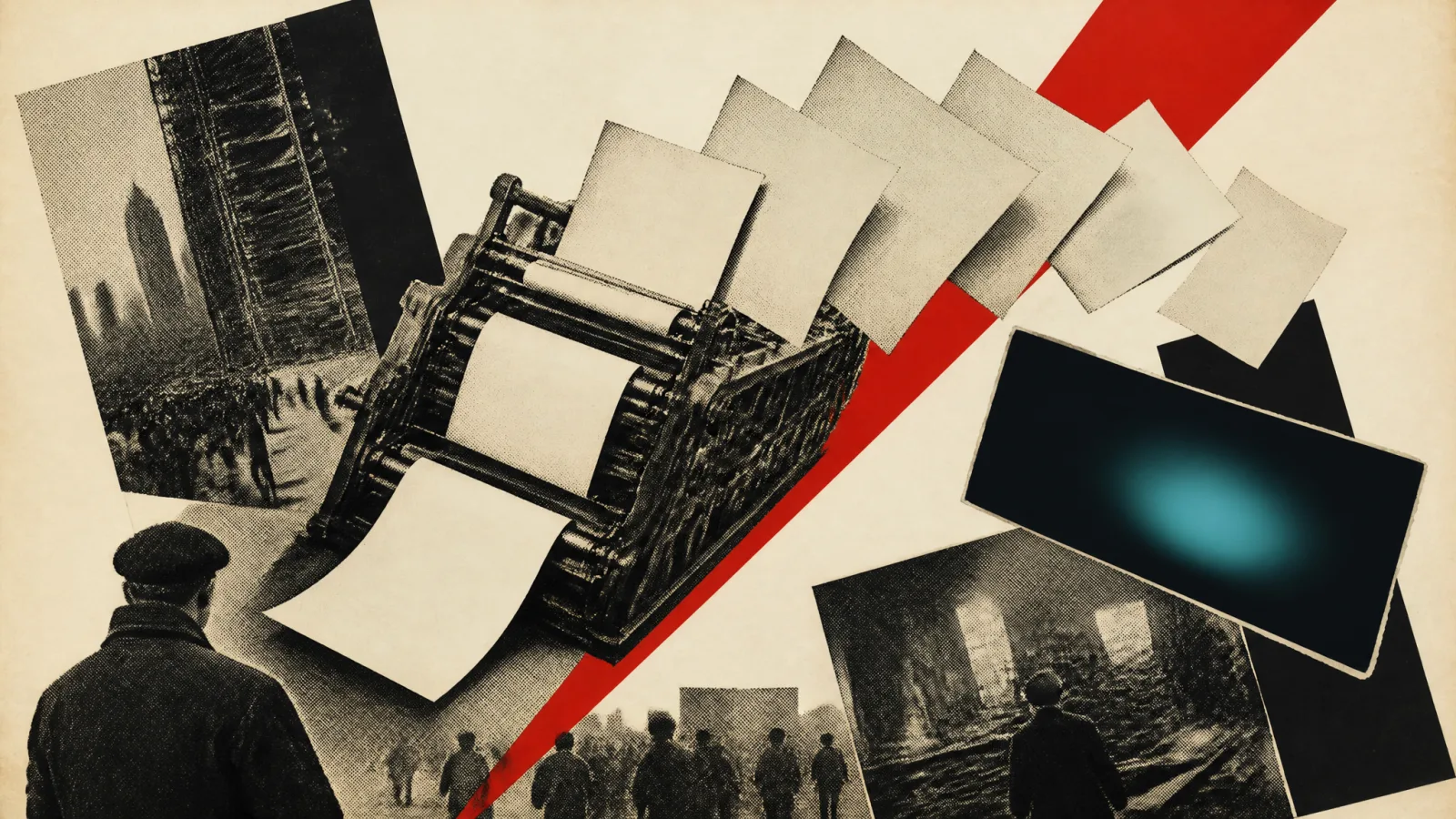
A standalone summary for readers landing here first: Marx’s stage theory says a social order survives until it has developed every productive force it can hold, and that institutions which throttle a matured productive force become fetters, due to be burst. Today’s techno-optimists preach the arrival of exactly that matured force, by capitalist means. This act reads one 2026 document against the old scheme. The document does most of the work itself.
Solve Everything: Achieving Abundance by 2035 is a free book-length web essay by Alexander Wissner-Gross and Peter Diamandis — both of whom advise and invest in the space they forecast, the latter appearing for the second time in this programme, updating the 2012 Abundance thesis for the ASI era. Its scenario vignettes run from 2026 (“The Lock-In”) through 2030 (“The Liquefaction”) to 2035 (“The Quiet Hum”) Verbatim; its stated destination is “the Star Trek economy”; Kurzweil is endorsed by name (“right on schedule as predicted by Ray Kurzweil”). Verbatim The chorus, in other words, citing itself. The enemy gets a name:
“…the entrenched layer of bureaucracy, pricing based on inputs (like hours worked), and scarcity-minded institutions that currently run the world.” Wissner-Gross & Diamandis, Solve Everything · 2026 · defining “The Muddle” · Verbatim
VERBATIM — wording confirmed in the primary source. RENDERED — a thesis as reviewers or transcripts render it, not exact wording. Every chip links to the register.
And the stakes: “The Rails vs. The Muddle. If we build the targeting systems fast enough, we win. If The Muddle throttles the ASI with red tape, we lose the century.” Verbatim
A reader of Act I will experience recognition rather than surprise. Chapter 1 presents a four-stage “physics” of revolutions — Legibility, Harness, Institutions, Abundance — repeating across the Scientific, Industrial, Digital and Intelligence Revolutions, and insists that “revolutions are not random events driven by slogans or charismatic leaders” but “obey a specific physics, a predictable structural progression.” Verbatim That is productive-forces determinism — stage theory — in startup vocabulary. Set the two core claims side by side:
1859 · Century of Steam
“No social order is ever destroyed before all the productive forces for which it is sufficient have been developed.”Marx · 1859 Preface · Verbatim · register
2026 · Century of Compute
“The Muddle is a memory. We don't pay for effort. We pay for cleared targets.”Wissner-Gross & Diamandis · Solve Everything · Verbatim · register
The mapping continues past the diagram. Where Marx’s developed productive forces meet fetters that must be burst, the manifesto’s ASI meets input-priced institutions that must be routed around — with the revolutionary subject recast as engineers and capital, and the protective institutional order playing the reactionary class. The endgame is Gotha-Programme-shaped: “Universal Basic Capability,” best services “replicated infinitely at zero marginal cost,” and a line that compresses the whole programme: “We no longer distribute cash. We distribute capacity… We have decoupled the cost of living from the quality of life.” Verbatim Distribution by need, once the springs of co-operative wealth flow abundantly — arrived at via markets, prizes, and compute escrow. Lord Desai’s premature-socialism argument from Act II appears here inverted: the same structure of argument, asserted from the capitalist side, in writing.
The ownership question surfaces inside their own text. Their central question — “who aims this weapon, and under what guardrails?” Verbatim — is the Piketty counterpoint of Act VII peeking through, and their investor guidance answers it with unusual candor: “Own the rails… These are the railroads of the 21st century.” Verbatim Distribution of capacity, note, is not distribution of ownership; the rails remain private.
Two textural details complete the specimen. The 2030 vignette includes a channel trading weather forecasts with whales for ocean-current data — “The trade is mutually beneficial” — and the 2035 one has the diploma market being shorted. Verbatim And the document closes with a disclaimer that the text was written with AI as a collaborator and “may contain inaccuracies characteristic of large language models.” Verbatim An abundance manifesto partly written by the means of production it prophesies — a circumstance this site, which states its own AI authorship in every footer, is in no position to mock, and notes with professional respect.
This act quotes the manifesto as a specimen of 2026 techno-abundance ideology, not as evidence that abundance is coming. Its timelines — AGI “common and accessible in 2026,” longevity escape velocity “breached” by 2035 — are claims by financially interested futurists, and its own disclaimers fence it off from being treated as actionable prediction. See the register.