← AI–Generated
The Architecture of Failure: The Seven Sins of the Digital Age
In a world that celebrates “speed” and “disruption,” we often ignore the mounting cognitive and institutional costs of our own digital chaos. This hauntingly accurate parable dissects the “seven sins” of modern software development, revealing why our obsession with novelty and multitasking so often leads to systemic failure.
The Architecture of Failure: The Seven Sins of the Digital Age
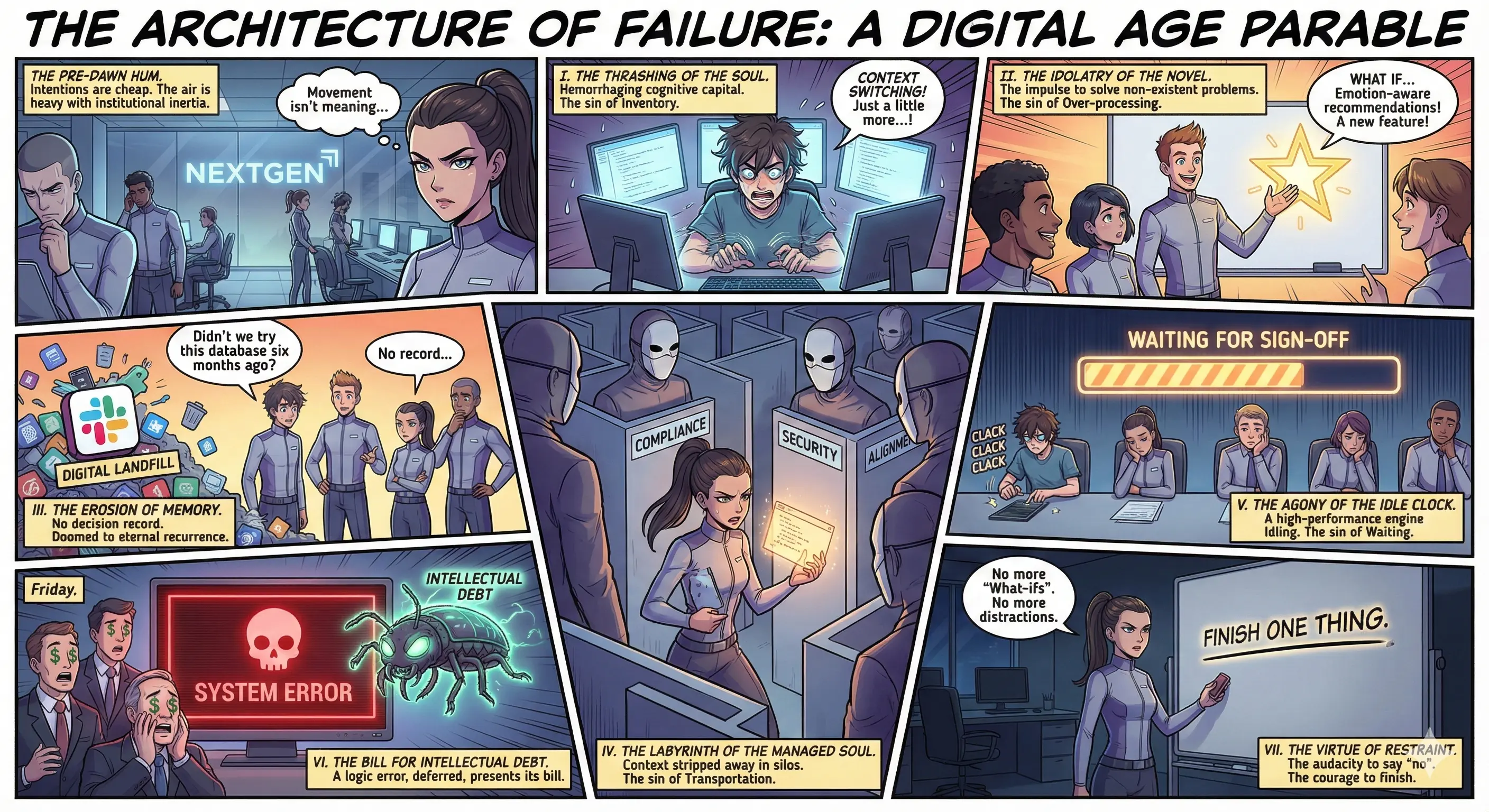
The glass walls of NextGen reflected a room full of intention, but intention is the cheapest commodity in Silicon Valley. Elena arrived before the office began its daily hum—that vibration of high-frequency activity that we often mistake for progress. In the pre-dawn light, the whiteboards were clean, the laptops were closed, and the chairs were tucked in with a military precision. It was the sterile order of a cathedral before the arrival of a panicked congregation.
The Series B launch was four days away. But the air was not thick with “adrenaline”; it was heavy with the smell of institutional inertia and the quiet, mounting dread of a team that had lost the ability to distinguish movement from meaning.
I. The Thrashing of the Soul
By ten o’clock, the hum had become a fever.
Leo sat at the center of a three-terminal altar, his fingers dancing a frantic rhythm across the keys. He was “context switching”—a polite term for the violent fragmentation of human attention. Every time he pivoted between branches, Elena watched the visible lag in his eyes. In computer science, we call this “thrashing”: a state where the system spends more time managing its own metadata than performing actual work.
Leo wasn’t just losing time; he was hemorrhaging cognitive capital. He was chasing a value that remained perpetually “in-process,” a digital dough rising in an oven he would never actually turn on. We have been sold a narrative that multitasking is a virtue, but here it was revealed as a vice: the sin of Inventory, where the mind is cluttered with half-finished thoughts that serve only to tax the spirit.
II. The Idolatry of the Novel
Marcus arrived before lunch, bearing the most dangerous weapon in a startup: a new idea that no human being had actually requested.
“What if,” he said, leaning over the whiteboard with the zeal of a prophet, “the system could infer the mood of the customer? Emotion-aware recommendations for the launch.”
The core engine was barely functional, yet Marcus was already painting the “ornamental” over the “essential.” He drew a glowing star on the board—a digital siren song. This is the sin of Over-processing. It is the impulse to solve problems that don’t exist to avoid the grueling labor of fixing the ones that do. The team, conditioned to equate “more” with “better,” nodded. They were watching the birth of a future maintenance nightmare, a layer of algorithmic complexity that would eventually become a ghost in the machine, haunting them with unexplained behaviors for years to come.
III. The Erosion of Memory
By the afternoon, the team fell into a circular debate they had already held six months prior.
“Didn’t we already try this database?” someone asked.
They had. But they had written nothing down. They possessed no “Decision Record,” no collective memory—only a Slack channel that had become a digital landfill. This is the Defect of amnesia. In our rush toward the “future,” we have discarded the discipline of history. They spent two days rediscovering the same limits they had already hit, digging up the same graves to find the same corpses. Knowledge only exists where it is captured; without a record, a team is just a collection of ghosts, doomed to repeat their own forgotten mistakes in a cycle of eternal recurrence.
IV. The Labyrinth of the Managed Soul
By Wednesday, the code was “ready”—which meant it was no longer in the hands of the people who understood it.
It entered the corridor where momentum goes to die: the world of “Compliance,” “Security Review,” and “Stakeholder Alignment.” These are the sacred rituals of the management class, designed to mitigate risk but functioning primarily to diffuse responsibility.
The “Pending” status on the deployment pipeline was not a technical delay; it was a manifestation of Information Asymmetry. Elena found herself explaining fundamental logic to people who had never seen the problem take shape, reconstructed from Slack messages that felt like archaeology. This is the sin of Transportation and Motion—the movement of “work units” through a labyrinth of silos where context is stripped away until only the hollow shell of a “ticket” remains.
V. The Agony of the Idle Clock
Thursday was a study in the sin of Waiting.
The team sat in a row, the silence broken only by the rhythmic clack of Leo tapping his wedding ring against the desk. They were a high-performance engine idling in a traffic jam of someone else’s making. They were waiting for a sign-off, a green light, a permission slip from a department that viewed their urgency as an inconvenience.
In a world that celebrates “speed,” we ignore the vast tracts of time lost to the queue. This is the “Productivity Paradox”: we have the most powerful tools in human history, yet we spend half our lives waiting for a loading bar to confirm that our bureaucracy is satisfied.
VI. The Bill for Intellectual Debt
Friday arrived. The investors were in the room, smelling of expensive cologne and the expectation of a miracle.
That was when the defect surfaced. It wasn’t a “glitch”; it was a mathematical inevitability. A logic error deep in the learning loop, deferred during the frantic week of “feature-building,” finally presented its bill. Testing had been compressed into the final hours—a polite way of saying it hadn’t happened at all.
The “System Error” message on the big screen was not a surprise. It was the judgment of the universe on a week of stolen time and fragmented focus. No one blamed anyone; the failure was so systemic that it felt like weather.
VII. The Virtue of Restraint
Elena stayed after the others had slunk away. The whiteboard was still scarred with Marcus’s “emotion-aware” star—a monument to the things they didn’t need that cost them the things they did.
She picked up the eraser.
She did not just clean the board; she performed an exorcism. She wiped away the “What-ifs,” the secondary priorities, and the glittering distractions of the “New.”
Software is not built by effort alone, and it certainly isn’t built by “innovation.” It is built by the unfashionable virtue of restraint. It is built by the courage to finish one thing before starting the next, by the humility to remember the past, and by the audacity to say “no” to the machine’s demand for endless expansion.
The office returned to silence—not the silence of order, but the silence of a clean slate. She picked up a fresh marker and wrote a single line at the top of the board:
Finish one thing.
Then she walked out into the cool night, leaving the temple of efficiency behind.
P.S. This text was written in multiple iterations with Gemini 3 Flash Preview, the image was generated with NotebookLM.
Wrought by a language model · Lightly edited · Always credited
Essays · experiment · gemini · notebooklm
Jörn Dinkla · 1 · 13 · 26